
Green Swamp Preserve
Clip: Season 23 Episode 27 | 4m 21sVideo has Closed Captions
At Green Swamp Preserve, see how pine fueled the British before the Revolution cut off its supply.
Tar and pitch from North Carolina’s abundant longleaf pines fueled the British Navy for decades and, after the American Revolution, built the nation. The Green Swamp Preserve in Brunswick County offers a step back in time to the landscape of the Revolution. Visitors can walk free trails in longleaf pine savannas and spot native plants like the carnivorous Venus flytrap and rare endangered species.
Problems playing video? | Closed Captioning Feedback
Problems playing video? | Closed Captioning Feedback
North Carolina Weekend is a local public television program presented by PBS NC
Green Swamp Preserve
Clip: Season 23 Episode 27 | 4m 21sVideo has Closed Captions
Tar and pitch from North Carolina’s abundant longleaf pines fueled the British Navy for decades and, after the American Revolution, built the nation. The Green Swamp Preserve in Brunswick County offers a step back in time to the landscape of the Revolution. Visitors can walk free trails in longleaf pine savannas and spot native plants like the carnivorous Venus flytrap and rare endangered species.
Problems playing video? | Closed Captioning Feedback
Where to Watch North Carolina Weekend
North Carolina Weekend is available to stream on pbs.org and the PBS app.
Providing Support for PBS.org
Learn Moreabout PBS online sponsorship- If you want to know what most of coastal North Carolina looked like during the American Revolution, this is it, a prehistoric longleaf pine savanna with carnivorous plants and incredible biodiversity.
Welcome to the Green Swamp Preserve in Brunswick County.
This incredible ecosystem once covered 92 million acres across the southeast.
Less than 5% remains.
But to understand why, you have to travel back nearly 500 years.
In 1584, English explorers wrote home that the Seas Forest contained enough tar and pitch to make their queen ruler of the seas.
They were right.
But first, Britain had a problem.
Ships don't just need wood.
They need tar and pitch to seal the hull, turpentine to treat the rigging.
- And what they would do is they would take that honing tool, put a hole in to get the sap running out of the tree.
- Britain called these materials naval stores.
But in 1705, war in the Baltic cut off their Scandinavian supply and left one of the world's most powerful navies openly exposed.
So Parliament acted, bounties for colonial producers, sales restricted to British merchants.
It worked.
By 1768, 60% of Britain's colonial naval store shipped through North Carolina, down the Cape Fear River, out through Brunswick town, just a few miles from where we're standing.
Today, thanks to decades of conservation work, nearly 5 million acres of longleaf pine have been restored across the southeast.
The Brunswamp Preserve is one of the finest examples, managed with controlled burning, open to the public, and free to visit.
- It's a national natural landmark that's been set aside in perpetuity for protection of a whole bunch of amazing and rare species.
The preserve itself is almost 16,000 acres.
It is one of the gems in North Carolina's crown, as I've heard it put.
As part of the naval stores industry, there was a lot of harvesting of the tar and pitch from longleaf pine.
What I'm standing on here is a tar kiln, and you can see this ditch that was kind of dug.
It's a circle all the way around.
And so all that tar eventually, over the course of like nine, 10 days of cooking that pile, would come out and they'd collect it in those barrels.
It's a very messy job, and so the folks working it obviously got very messy as well.
And that's one of the thoughts behind why we call this the Tar Heel State.
- If you're a tar heel, it is a North Carolina treasure.
300 years ago, it would have covered many, many miles continuously.
Now it's broken up with golf courses, Walmarts, and housing developments.
So this preserves the longleaf pine forests and the plants and the animals that live here.
- But the trees are only part of the story.
The Green Swamp is home to 14 species of carnivorous plants.
Venus flytraps ride alongside the trail, pitcher plants, sundews.
And if you look up, you may spot a red-cockaded woodpecker.
- It is world famous for its carnivorous plants.
These are plants that live in nutrient-poor environments, sandy or acidic soils.
And so the way they get their nutrients is from catching animal prey, mostly insects.
And they have different kinds of traps, different ways of catching their prey.
And there's no place in the world you can see a greater diversity of carnivorous plants than at this location.
- You walk out here, and you don't really see everything at face value.
It doesn't really look like that much.
But then when you really get down to the forest floor, that's where the really cool stuff is.
And once you see that micro-scale diversity, it is truly an amazing place.
- The trail runs 1.3 miles one way through Pine Savannah, Boardwalk, and Open Meadow.
Flat and accessible, but stay on the trail.
The Brunswick County Sheriff's Office has had to rescue hikers who wandered off.
The red diamonds on the trees are there for a reason.
- The Green Swamp Preserve is located in Brunswick County, and it's open to the public free of charge.
To learn more and plan your visit, go to nature.org/greenswamp.

Video has Closed Captions
Clip: S23 Ep27 | 4m 35s | Join us at Asheville’s Burial Beer Co., where bold beers and immersive spaces invite discovery. (4m 35s)

Video has Closed Captions
Clip: S23 Ep27 | 4m 35s | Come with us to Newgrass Brewing Company, a lively gathering spot in the heart of downtown Shelby. (4m 35s)

Video has Closed Captions
Preview: S23 Ep27 | 18s | Discover locally crafted beverages as we visit destinations pouring creativity into every glass. (18s)
Video has Closed Captions
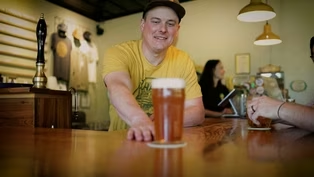
Clip: S23 Ep27 | 4m 29s | Whaley Farm Brewery blends farming, brewing and community in the heart of Old Fort. (4m 29s)
Providing Support for PBS.org
Learn Moreabout PBS online sponsorship













Support for PBS provided by:
North Carolina Weekend is a local public television program presented by PBS NC