
W.E.B. Du Bois: Rebel With a Cause
5/19/2026 | 1h 52m 45sVideo has Audio Description
Explore the life and legacy of notable Black scholar and civil rights pioneer W.E.B. Du Bois.
Explore the life and legacy of notable Black scholar and civil rights pioneer W.E.B. Du Bois. From his birth, just five years after the Emancipation Proclamation; to his death, on the eve of the March on Washington in 1963, his legacy as an activist continues to resonate today.
See all videos with Audio DescriptionADProblems playing video? | Closed Captioning Feedback
Problems playing video? | Closed Captioning Feedback
Support for American Masters is provided by AARP, The Rosalind P. Walter Foundation, Thea Petschek Iervolino Foundation, Burton P. and Judith B. Resnick Foundation, The Philip and Janice Levin Foundation,...
Support provided by:

W.E.B. Du Bois: Rebel With a Cause
5/19/2026 | 1h 52m 45sVideo has Audio Description
Explore the life and legacy of notable Black scholar and civil rights pioneer W.E.B. Du Bois. From his birth, just five years after the Emancipation Proclamation; to his death, on the eve of the March on Washington in 1963, his legacy as an activist continues to resonate today.
See all videos with Audio DescriptionADProblems playing video? | Closed Captioning Feedback
Where to Watch American Masters
American Masters is available to stream on pbs.org and the PBS app.
Buy Now

A front row seat to the creative process
How do today’s masters create their art? Each episode an artist reveals how they brought their creative work to life. Hear from artists across disciplines, like comedian Chris Fleming, actor Greg Kinnear, sports journalist Taylor Rooks, and more on our video podcast "American Masters: Creative Spark."Providing Support for PBS.org
Learn Moreabout PBS online sponsorship♪♪ ♪♪ ♪♪ ♪♪ ♪♪ ♪♪ -W.E.B.
Du Bois is arguably the greatest black intellectual scholar/activist in American history.
♪♪ -"I believe in God, who, made of one blood, all nations that on Earth do dwell.
I believe that all men, black and brown and white, are brothers."
-He dies in August 1963, on the eve of the March on Washington for Jobs and Freedom.
-Now, this was before Martin Luther King's speech.
This was in the early time of the march.
-Ladies and gentlemen, your attention, please.
-It was announced that W.E.B.
Du Bois had just died in Ghana.
There was a gasp and a moment of silence.
It was a really somber moment.
-At the dawn of the 20th century, his was the voice that was calling to you to gather here today in this cause.
[ Cheers and applause ] -I'm sure everybody was thinking, like I was thinking -- "It's time for us to take over now" That he had brought us this far by himself.
But now we were standing out there with 100,000 people that were united by the same phenomena that awakened him.
-"I very early got the idea..." -"...that I was going to prove to the world that Negroes..." -"...were just like other people."
♪♪ ♪♪ -William Edward Burghardt Du Bois was born in the rolling hills of Western Massachusetts in 1868, the year the newly ratified 14th Amendment guaranteed full citizenship and equal protection of the law to all Americans, black men and black women included.
♪♪ -Du Bois is born in a small town in a very white state, in an area that has a very small black population.
He's able to enjoy freedoms that the vast majority of Black Americans can never have.
-William's mother's family had been free for generations and planted deep roots in Great Barrington.
♪♪ -They also held tight to the thread that tied the family to its distant past across the Atlantic.
[ Woman singing in Wolof ] A song was passed down from an ancestor who was kidnapped from West Africa and sold into slavery.
-It was Wolof, the language that seemed to say, "Let me out, let me out!
"Do ba-na co-ba, do ba-na co-ba, ge-ne me, ge-ne me."
[ Singing continues ] Du Bois always used that memory and that ancestor to peg himself -- "My African roots."
-William's father, a mixed-race native of Haiti and Civil War veteran, feuded with his in-laws and abandoned the family when William was a toddler.
He would never see his father again.
The Burghardt family and the town rallied around his mother, Mary Silvina, so that young William could concentrate on his education.
-Mary Silvina -- she has a precocious kid, a brilliant child, who is devouring everything that comes into his view.
He's going to be introduced to Latin.
He's going to be introduced to Greek.
He's going to be introduced to religious doctrine.
So Du Bois is kind of baptized in this understanding of the West.
-He was able to distinguish himself as a student, becoming the valedictorian of his high-school class.
-His mother had a stroke right around the time that Du Bois was getting out of high school.
She died shortly after Du Bois graduated from high school.
-"There followed the half-guilty feeling that now I could begin my life without forsaking my mother.
Now I was free and unencumbered, and, at the same time, more alone than I had ever dreamed of being.
This very grief was a challenge.
Now especially, I must succeed as my mother so desperately wanted me to."
-William Edward Burghardt Du Bois set his sights on Harvard University, but the cost was beyond reach.
The Burghardts, townsmen, and church congregations raised funds to send the young scholar to Fisk University in Nashville, Tennessee.
-"I was thrilled to be, for the first time, among so many people of my own color, or, rather, of such various and such extraordinary colors.
That first supper came with me opposite two of the most beautiful beings God ever revealed to the eyes of 17."
[ Woman laughs ] "I promptly lost my appetite, but I was deliriously happy."
-Suddenly, I am in a Negro world.
-Fisk, at that time, was the preeminent institution of higher education for black people.
-The faculty, for the most part, was from Yale, Harvard, or Dartmouth and white.
-He goes from being the only to being in a community filled with high-achieving black people, with extraordinary faculty, with a common ethos of striving, of uplift.
-"Never before had I seen young men so self-assured and who gave themselves such airs -- and colored men at that."
-Some were the sons of white men, many quite prosperous.
He found that they had a degree of literacy, even coming out of slavery.
♪♪ -Du Bois stayed in Tennessee that summer to explore the South and took over a one-room classroom.
-"I loved my school, and the fine faith the children had in the wisdom of their teacher was truly marvelous.
We read and spelled together, wrote a little, picked flowers, sang, and listened to stories of the world beyond the hill."
-That summer was a revelation for Du Bois.
His first extended experience among country folk digging their way out of slavery and his first real experience with the opposite sex.
-"I was literally raped by the unhappy wife who was my landlady.
From that time, I went through a desperately recurring fight to keep the sex instinct in control."
-Du Bois' early life was quite sheltered and he really didn't have any sexual experience.
It sort of awakened his sexual life.
-Back at college, Du Bois won the editorship of The Fisk Herald, excelled in his classical liberal-arts education, and graduated once again at the head of his class.
"One of my best," a professor said of him.
"An unusually quick, active mind," said another.
Du Bois earned a spot at Harvard, but only as an undergrad.
He would have to complete two more years of coursework to earn his Ivy League bachelor's degree.
-This was very, very, very common that people would get full educations at black schools, but the white schools did not think that they were sufficient and would make them start all over again.
♪♪ -"I was in Harvard, but not of it.
About the Harvard of which most white students conceived, I knew little."
-If I had gone directly from my high school in Great Barrington to Harvard, I would have thought of myself as a Massachusetts man, and my fellows would have been the whites there.
I never felt myself a Harvard man as I had felt myself a Fisk man.
-Du Bois majored in history and political science.
He graduated cum laude, determined to continue his studies abroad.
-Harvard wasn't the be-all and end-all in the world academy.
German universities were.
An entirely new field was being invented, and that new field was called sociology.
So his dream was to get his PhD in Berlin.
-Somebody called my attention to what Rutherford B. Hayes, ex-president of the United States, was saying.
He was head of the Slater Fund, which had money to educate Negroes.
-Rutherford B. Hayes announced, "If a talented Negro boy could be found sufficiently brilliant enough to study at a European university, we will fund his education."
And they didn't give anybody one of these scholarships.
-I got mad at that and wrote Mr.
Hayes.
-Saying, "You're not a man of your word.
You made the promise.
I'm smart enough.
Put your money where your mouth is."
-So the next year, I started on him again, and I got everybody, from the president of Harvard down, to give recommendations.
And so I got the fellowship.
-"I crossed the ocean in a trance.
'Always,' I seemed to be saying, 'it is not real.'
'I must be dreaming.'
I saw Milan, Florence, Rome, Venice, Vienna.
I looked on the boundaries of Russia and I sat in Paris and London.
I met men and women as I had never met them before."
-For the first time in my life, I was just a human being and not a particular kind of human being.
-"I found myself on the outside of the American world looking in.
I gained a respect for manners.
I came to know Beethoven's symphonies, the colors of Rembrandt.
I came in contact with several of the great leaders of the developing social sciences.
I began to see the race problem in America, the problem of the peoples of Africa and Asia, and the political development of Europe as one."
-In Berlin, Du Bois began to think of himself as a budding social scientist, a detached observer.
But Du Bois' European sojourn was cut short.
-To get a PhD, he had to satisfy a residency requirement of three years.
They funded him for two years.
-"As a student in Germany.
I dreamed and loved and wondered and sang.
Then, after two long years, I dropped suddenly back into nigger-hating America."
-Du Bois returned from Europe without the degree he coveted, but with a plan to study the history of America's peculiar institution -- slavery.
♪♪ [ Waves crashing ] -Slavery was deeply embedded in the U.S.
Constitution and in American politics.
It was taken for granted in the early parts of the 19th century.
Ten of the first 13 presidents owned slaves.
♪♪ ♪♪ -Du Bois re-enrolled at Harvard and went to work on his PhD dissertation, "The Suppression of the African Slave Trade."
He was able to show, with facts and data, that African slavery was neither widely supported nor inevitable.
-He's using empirical research in order to document and to measure a racial and social injustice.
It's like he's using their weapons that they created against them in order to make the argument.
-This was something that no other historian was doing -- the scientific approach.
This really set him apart as a historian and as a social scientist.
-It was published as a book a year later by the Harvard University Press.
-The first volume in Harvard's acclaimed Historical Studies series, and he kicked it off.
-Du Bois, at this moment -- he's completed his dissertation.
I'm sure he's feeling nice about himself, but he has to get a job.
-Harvard wouldn't have dreamed of giving Du Bois a job as a professor.
-He's one of the most educated men in the country.
Not black men.
The fact that Du Bois is not at a Penn or a Harvard or a Yale or an Amherst is an indication of how deep the racism is.
-At just 27, Du Bois was an academic star in some circles.
The first African-American to receive a PhD from Harvard.
He had also won a job as chair of the Classics Department at Historically Black Wilberforce University in Ohio.
He caught the eye of a student there and she his.
-He falls in love.
He meets Nina Gomer, and they form a relationship, which continues to grow.
-She's a beautiful young black woman from a middle-class family in Iowa.
-W.E.B.
Du Bois and Nina Gomer married in May of 1896.
Three weeks later, he received a telegram with an enticing proposition.
♪♪ [ Car horn honks ] ♪♪ -I got my chance.
I was asked to come to the University of Pennsylvania to make a study of the Negro population of the Seventh Ward of Philadelphia.
-Like many other cities at this time, Philadelphia is experiencing an influx of African-Americans from the South.
Philadelphia becomes kind of this experiment of trying to understand the problem of the Negro in the context of urban America.
-It was the first sociological study of a black community in the United States.
So he and Nina moved into the heart of the Seventh Ward to live among thousands of men, women, and children there to better understand their lives.
-"I settled in one room in the city, in the worst part of the Seventh Ward.
In the midst of an atmosphere of dirt, drunkenness, poverty, and crime."
-There's inter-racial pockets.
There are tenements never up to code.
It was crowded.
It was hot in the summer.
People hung out on the streets.
-"Murder sat on our doorsteps.
Police were our government.
Kids played intriguing games like 'Cops and Lady Bums.'
And in the night, when pistols popped, you didn't get up, lest you find you couldn't."
-This is completely out of Nina's social context, and Du Bois was working morning, noon, and night on this study, so she was alone for the most part.
-Du Bois walked the streets of the Seventh Ward in tailored suits, carried a cane, and wore kid gloves.
He conducted 5,000 interviews.
-"How many people live here?
How many people go to school here?
Do you have a job?
Are you married?"
He also just observed.
-This was an empirical study, a study that is designed and based on the systematic collection and analyzation of data.
"What are the demographic, census, birth rate, death rate, hard facts telling us about patterns in society?"
-He's also pioneering different kinds of visual representation of statistics, using the bell curve, the very new methodology at that time period.
-They thought he was going to be explaining black pathology.
-As opposed to saying that there's something wrong with them in the survey, he's arguing that it is the circumstances that they have put in that produce these outcomes.
-"It revealed the Negro group as a symptom, not a cause."
-If we want to talk about why there are lower literacy rates, we need to talk about how far the schools are away from the black community.
There are not as many jobs that will hire black women as there are jobs that will hire white women.
He's producing a book that's making an argument for structural racism.
-In the autumn of 1897, W.E.B.
Du Bois moved his wife and their newborn son, Burghardt, onto the campus of Atlanta University.
♪♪ He had been invited to the school to develop a curriculum that explored the history of Black Accomplishment.
-Ours was the first institution in the United States, white or black, that had any course on the history of the American Negro or on Negro history in general.
I increasingly believed the Negro problem was a matter of knowledge, and that what we needed was an academic study of the American Negro.
-Atlanta is this extraordinary space of black intellectual and civic energy.
It's a time of extraordinary creative flourishing in black communities.
Black folk are starting professional organizations.
We're advocating for ourselves.
But he's in the South.
Even if it's Atlanta, he's still in the South.
-Racial inequality is written into every aspect of life.
What kind of work you can do.
It's also where you can be at certain times.
So the threat of violence if you step outside of the prescribed places for black people.
-♪ Southern trees ♪ ♪ Bear strange fruit ♪ -More than 1,000 black men were lynched in the South in the last decade of the 19th century alone.
But Du Bois himself had no close experience of the vicious practice, until the spring of 1899, when a man was lynched on the outskirts of Atlanta.
-♪ Strange fruit hanging ♪ ♪ From the poplar trees ♪ -His name was Sam Hose, and that's going to be a turning point for Du Bois.
-It's rumored that more than 2,000 people gathered to cut off the fingers, the ears.
Then they stabbed Sam Hose.
Then they carve up his heart.
They peel off his skin.
They douse it with gasoline.
They set it on fire.
-Lynching is this complex ritual practice.
It's not just simply about the exacting of violence on the body.
It's the taking of digits.
It's the attack on the genitals.
The postcards that were sent out to get people to come.
-♪ ...certain smell ♪ -It's the burning of flesh.
-♪ ...flesh ♪ -And imagine, you know, when you smell burning flesh, you taste it.
It has this cannibalistic dimension to it.
Prior to this moment, Du Bois understands white supremacy and racism as ignorance.
This isn't about reason.
This isn't about them not knowing.
These people are monstrous.
-Du Bois was so stunned and startled that he wrote a note to the editor of The Atlanta Constitution, which he intended to present in person.
-Sam Hose -- his fingers and toes were being exhibited in the meat market, which was on the way I had to pass.
Well, I didn't deliver the letter and I went back to Atlanta University.
-One could not be a calm, cool, and detached scientist while Negroes were lynched, murdered, and starved.
-My faith in knowledge as a solution was shaken.
I made up my mind that knowledge wasn't enough.
I changed from studying the Negro problem to letting people know just what the Negro problem meant in what the colored people were suffering.
-Du Bois still counted his own young family safe because their lives were on the university campus, a small citadel above the city.
-They lived in the dorms, because the area around Atlanta University is racially segregated.
Burghardt, the son, was very much a part of the Atlanta University community.
These individuals that worked on the campus were like an interracial family that existed high on this hill, but surrounded by a sea of whites.
-At around 18 months old, Burghardt falls ill.
The three black doctors that exist in Atlanta are not in town.
He goes into the city, trying to seek help from a doctor, any doctor, but the white doctors refused to grant him service.
-"I saw the shadow of the veil as it passed over my baby.
I held my face beside his little cheek."
♪♪ "He died at eventime, when the sun lay like a brooding sorrow above the western hills.
With an even-song, the unvoiced terror of my life."
-Du Bois spends one-third of his salary for the funeral of little Burghardt.
-"Blithe was the morning of his burial.
The trees whispered to the grass, but the children sat with hushed faces."
-The professors, the students, all black and white, leave the campus and enter into downtown Atlanta.
-"The busy city dinned about us, those pale-faced, hurrying men and women.
They did not say much.
They only glanced and said, 'Niggers.'"
-Nina retreated into herself and never, ever, ever got over it.
Neither did Du Bois.
-Du Bois gets a reality check of what it's like to be a black man in the American South.
His experience in Atlanta produces the Du Bois that we have come to know.
His social consciousness is activated.
♪♪ ♪♪ -W.E.B.
Du Bois returned to Europe less than a decade after his retreat from Berlin to take part in the World's Fair.
-This was a time where different societies interact and see the best of the best of what folks were inventing and creating and producing.
-An extraordinary event that took place over six months, that drew nearly 50 million people.
-Du Bois curates and assembles these albums of Black American life.
This beautiful exhibition of African-American progress from the Emancipation Proclamation until that moment in 1900.
It was a counternarrative and a disruption of how African-Americans were portrayed in the media at that time.
-And it also directly upsets, throws on its head all of this photographic evidence that eugenicist white supremacists were using to prove African-American and blacks' innate inferiority.
-Du Bois understood very clearly how important it was for black people to have control of the narratives that were being written about us at that time.
-He takes publicly available census data and creates these beautiful visual displays of charts and graphs showing black land ownership from 1865 to 1900.
Black population statistics... black educational attainment.
He understood the power of aesthetics.
-"It was an immediate success.
The American press, white and colored, was full of commendation.
And in the end, the exhibit received a grand prize and I, as its author, a gold medal."
-He left the exposition with a bittersweet experience.
He was proud of the exhibit he had done, but he didn't like a lot of the stuff that he saw there.
Du Bois had hoped that Paris and France would be beyond the ugliness of American Jim Crow culture, but part of what they did was to demonstrate they had this large number of colonies.
Primarily in Africa, primarily with people with black skin.
There was a great deal of condescension, displaying colonials in the same way they'd display animals in a zoo.
-After the conference, Du Bois left Paris and headed to the seat of colonialism and capital of the British Empire, London.
He was there to take part in the first-ever Pan-African Conference, where delegates envisioned a future beyond colonial rule, a future of self-government.
It was organized by the 31-year-old Trinidadian attorney and activist Henry Sylvester Williams.
-"In the metropolis of the modern world, in this closing year of the 19th century, there has been assembled a congress of men and women of African blood to deliberate solemnly upon the present situation and outlook of the darker races of mankind."
-Virtually all of Africa is under control of some European power that is dictating its educational systems, it's extracting the wealth, the natural resources of the country, and deciding who runs the country.
-"All this, I began to realize, was but a result of the expansion of Europe into Africa, where a fierce fight was precipitated for the labor, gold, and diamonds of South Africa, for domination of the Nile Valley, for the gold, cacao, raw materials, and labor of West Africa, and for the exploitation of the Belgian Congo."
-This would have been the burgeoning beginnings of what would later become an anti-colonial movement.
-Du Bois had settled into what Africa was, what Africa could be, and for him, Africa would be Africa only when Africa was free.
-Du Bois' speech at the closing session electrified the conference.
It included a phrase that was impossible to forget.
-"The problem of the 20th century is the problem of the color line."
-He didn't mean just the United States.
He meant in the world.
He was now thinking on a much broader scale, that African-Americans were part of a much larger reality.
-Soon after Du Bois returned from London, he and Nina welcomed their second child, Yolande.
He went to work on a book of essays, oral histories, Negro spirituals, and fiction.
He titled it "The Souls of Black Folk."
-He opens up with this concept that has three parts -- "Double Consciousness"... -"It's a peculiar sensation, this double consciousness, this sense of always looking at oneself through the eyes of others, of measuring one's soul by the tape of a world that looks on in amused contempt and pity."
-..."Twoness"... -"One ever feels his twoness.
An American, a Negro.
Two souls, two thoughts.
Two unreconciled strivings.
Two warring ideals in one dark body, whose dogged strength alone keeps it from being torn asunder."
-..."the veil."
-"I who speak here am bone of the bone and flesh of the flesh of them that live within the veil.
Surely, there shall yet dawn some mighty morning to lift the veil and set the prisoned free."
-Du Bois makes reference to "the veil" over 50-something times in "The Soul of Black Folks."
He talks about it in different ways.
"Lifting the veil."
"Going through the veil."
"Behind the veil."
-All those worked together to form a theory that's so powerful because it helps to explain, "What does it mean to be black in America?"
-"Negro blood has a message for the world.
He would not Africanize America, for America has too much to teach the world and Africa.
He would not bleach his Negro soul in a flood of White Americanism.
He simply wishes to make it possible for a man to be both a Negro and an American without being cursed and spit upon by his fellows, without having the doors of opportunity closed roughly in his face."
-♪ Wade in the water ♪ ♪ Wade in the water, children ♪ -Every section in "The Souls of Black Folk" opens with a quotation from the Negro Spirituals.
He's saying, "Black people have not only a literary heritage, we also have a sung and spoken heritage, an oral tradition."
-He saw, on the one hand, the unbelievable sorrow, the heartbreak, the devastation, but, also, he could hear in them a kind of spiritual transcendence and power and beauty.
-He will try whatever it takes to shift the social and political landscape.
Something like fiction can do something that the sociological study cannot.
"The Coming of John" is the penultimate chapter of "Souls of Black Folk."
It's the only piece of fiction.
He's working through the questions that come up in his politics about what is the place of education in relationship to progress?
-"Was this John?
Where was his smile and hearty hand-grasp?
'Appeared kind of down in the mouth,' said the Methodist preacher thoughtfully.
'Seems monstrous stuck-up,' complained a Baptist sister.
But the white postmaster from the edge of the crowd expressed the opinion of his folks plainly.
'That damn nigger has gone North, and got plumb full of fool notions.'
The judge sat in the dining room amid his morning's mail, and he did not ask John to sit down.
'In their place, your people can be honest and respectful, and God knows I'll do what I can to help them.
But when they want to reverse nature and rule white men and marry white women and sit in my parlor, then, by God, we'll hold them under if we have to lynch every nigger in the land.'"
-♪ Let my people go ♪ -Ultimately, John gets lynched.
♪♪ ♪ Let my people go ♪ -The publication of the book had also ignited a public fight with a titan of Black America, Booker T. Washington.
-Washington was almost untouchable in those years, and Du Bois was one of the few people who really took him on.
-"Souls of Black Folk" is the original diss tape.
The majority of the reviews and the comments and the whispers and the shock were centered on that essay.
-Booker T. Washington was principal of the Tuskegee Institute in Alabama, which he literally built from the ground up.
Booker T. Washington was born a slave in Virginia.
He lived through slavery.
Arguably the most powerful and influential black person in the world at this time.
♪♪ -He gets money from Andrew Carnegie.
He gets money from the Baldwins, from the Ogdens, from the Wanamakers.
You need a building?
Booker T. Washington can get it up for you in no time at all.
-Booker T. Washington had summed up his own accommodationist philosophy in an 1895 speech in Atlanta.
-Those of the white race, cast down your bucket among these people who have, without strikes and labor wars, tilled your fields, cleared your forests... -Booker T. Washington is saying that African-Americans, 30 years after slavery ended, need to return to the fields to work in mechanics and in trade and to continue to be the machines of the American South.
-We did not need to be concerning ourself with things like the vote, with things like civil rights and equality.
-Du Bois had initially agreed with Washington's instinct to accommodate white Southerners who held power in the Old Confederacy, but now Du Bois believed it was time to push for the civil rights and liberties guaranteed in the 13th, 14th, and 15th amendments.
-I had begun to criticize Booker Washington, saying it wasn't enough to teach Negroes trades.
The Negroes had to have some voice in their government, they had to have protection in the courts, and they had to have trained men to lead them.
-Du Bois is going to make some arguments about a talented tenth, a leadership class, who's educated, that will represent the interests of everyday, ordinary folk.
-"The Negro race, like all races, is going to be saved by its exceptional men.
The problem of education, then, among Negroes must first of all deal with the talented tenth."
-Du Bois concluded that what we needed now was a protest movement.
He and others worked together to form the Niagara Movement in 1905.
It was made up largely of black elites.
They did not have a mass base within the black community.
-This group demanded freedom of speech and criticism, the abolition of all distinctions based on race, recognition of basic principles of human brotherhood, and respect for the workingman.
-This organization becomes key as a counterbalance to Washingtonian politics.
-Du Bois and his tensions with Booker T. Washington have exploded, and they are full-scale adversaries.
Booker T. Washington is doing all that he can to undermine Du Bois and his influence.
-And anybody reading that chapter would say, "He is not speaking for his race.
He's an invention.
He's been ventriloquized by the White South."
-Booker T. Washington was not above bribing certain news editors and outlets to propagate these Tuskegee ideals to the masses, both in the South and for constituents in the North.
-Without funds, without a mass base, and with the opposition of Booker T. Washington, the Niagara Movement was not able to sustain itself.
♪♪ [ Cows mooing ] -In the summer of 1906, W.E.B.
Du Bois left his wife and young daughter at home to do field research in Lowndes County, Alabama.
So he was 200 miles away when he heard some terrifying news.
♪♪ -Atlanta experienced a race riot/massacre.
It was ignited by two newspapers that were making erroneous stories about sexual advances that black men were making towards white women.
-African-Americans were murdered, viciously, hung from lampposts, killed out in the street, stabbed, shot, maimed with no repercussion.
-Du Bois rides on the Jim Crow car, going back to Atlanta to protect his family.
-"Hear us, good Lord.
Listen to us, thy children.
Our faces, dark with doubt, or made a mockery in thy sanctuary."
-He wrote this as he headed back to Atlanta.
"Litany of Atlanta" is a denunciation of the South and all of its racism and its injustices.
-"Call, great God, for thy silence is white terror to our hearts.
The way, O God.
Show us the way and point us the path."
-He rushes to get back to campus.
-"I bought a Winchester double-barreled shotgun and two dozen rounds of shells filled with buckshot.
If a white mob had stepped on the campus where I lived, I would, without hesitation, have sprayed their guts over the grass."
-The Atlanta massacre had badly shaken Nina, and she wanted no more of the Deep South.
Du Bois moved his wife and daughter to Great Barrington.
In 1908, two years after the Atlanta massacre, white mob violence jumped the Mason-Dixon Line.
Scrapbooks and postcards cataloging white-supremacist cruelty were becoming commonplace.
[ Glass shatters ] -In Springfield, Illinois, the home of Abraham Lincoln, a riot breaks out.
Whites are indiscriminately killing black people, especially those who had any kind of power and resources, such as businesspeople.
-They burned homes, looted stores, and shot black people in the streets.
[ Gunshot ] At least eight black people were killed.
And thousands fled Springfield, Illinois.
-It revealed that white supremacy had defined all of the United States.
-White liberals were very disturbed.
They issued out a call for black people and white people to come together and form an organization to deal with it.
And that's how the NAACP came about.
-Its board is largely comprised of wealthy white people who believe in civil and political rights for African-Americans.
Du Bois is the only black board member.
-He serves as director of research and publications and, most prominently, as editor of The Crisis.
The title was extremely important.
The crisis of the color line was the crisis of America.
-Not only is he going to become a social activist, but he understands the power of the press.
-He insisted that "I have all editorial privilege and power.
Nobody will dictate to me what I can say."
-It was like our Internet now.
The topics that were covered in The Crisis covered everything.
-Using photography... using art, using poetry, celebrating social accomplishments, the political and economic accomplishments of African-Americans.
-A single issue didn't just go to one person.
It went to a community.
People would share the publication.
They would read collectively.
It further developed literacy skills and gave people a reason for learning to read that was not just the practical skill, but awareness of the world.
[ Train whistle blows ] -The Pullman porters who were on the trains would come to New York and they would pick up large bundles of The Crisis and drop them off all across the South and in other places.
No one knew that The Crisis magazine was going to take off the way that it did.
In many black homes, there were two publications that stood above all others.
One was the Bible, and the other was The Crisis magazine.
-He's doing theater.
He's doing poetry.
He's doing short stories.
He's doing novels.
He's doing sociological studies.
He's doing speeches.
You name it, Du Bois has tried it.
-He comes up with this idea of doing the "Encyclopedia Africana."
It's nothing he can do overnight or even in a year or even in 10 years.
He's going to work on it for the rest of his life.
But he feels he has to do something now, and so he composes a pageant called "The Star of Ethiopia."
-The state of New York wanted to celebrate the 50th anniversary of the Emancipation Proclamation.
And Du Bois pulls out "The Star of Ethiopia," a pageant that dealt with recording the history of people of African descent from pre-colonial times all the way up to emancipation.
A pageant is a play on steroids.
-Du Bois casts over 1,000 people.
This went on for hours and hours, and there were costume changes.
♪♪ Blueprints.
And he had architects.
♪♪ -They performed "The Star of Ethiopia" in baseball fields in New York, Washington, D.C., Philadelphia, Los Angeles.
He would fill up those baseball fields.
The productions drew an audience of 35,000 attendants.
-"The Star of Ethiopia" symbolized the story of African majesty for the African-American imagination.
It changed the meaning of Africa for them so that they could then also have a much more positive association to their own history.
-Once we see it, we can imagine ourselves differently, we can imagine our past differently, and if we imagine our past differently, we can imagine our future differently.
And any white people who want to come, you will also begin to see us differently.
♪♪ -The success of "The Star of Ethiopia" and The Crisis had made W.E.B.
Du Bois a powerful voice for black leadership.
-Du Bois joined several major African-American clerics in approaching the governor of New Jersey and former president of Princeton, Woodrow Wilson.
-♪ From east and west, from north to south ♪ ♪ There's just one name in every mouth ♪ ♪ It's Wilson, that's all ♪ ♪ Wilson, that's all ♪ -Wilson allowed himself to be understood to say that he would be fair and just in all matters racial if he received the support of African-Americans.
Du Bois had a certain illusion that here was another PhD and historian, a gentleman.
"My goodness, I think I understand the man."
-Most blacks were voting Republican at that time because it was the party of Lincoln, the party of Reconstruction, the party of emancipation.
-Du Bois called for an exodus from the Republican Party.
-Du Bois said, "Wilson is a reformer.
Yes, he's a Southerner, he's a racist, but we can deal with him."
-And so he broke ranks with much of the community.
Voting for a Democrat?
For God's sake.
♪♪ Wilson is elected president and immediately segregates the entire federal establishment.
Du Bois was beginning to feel quite embarrassed that he had campaigned for this man.
-"Never before has the federal government discriminated against its civilian employees on the grounds of color.
How long will it be before the hateful epithets of nigger and Jim Crow are openly applied to these sections?"
-He'd become fed up with Wilson by the time of "Birth of a Nation."
♪♪ -"Birth of a Nation" was the first motion picture screened inside the White House.
The film was a celebration of the Ku Klux Klan's violent demolition of Reconstruction in the wake of the Civil War.
-Incredibly propagandistic, defiantly racist film which depicts blacks as almost subhuman.
Wilson loves it.
-Du Bois' pen is acidic in his response.
-"A new art was used deliberately to slander and vilify a race.
A public menace, not art, but vicious propaganda."
-Exactly what people like Du Bois, what the NAACP feared happened.
-It's the first blockbuster.
It creates Hollywood.
-It is considered the movie that led to the resurgence of the Ku Klux Klan in America.
-America had entered a frightening new age.
Jim Crow segregation, increasingly enforced by violence, had even infected the federal government.
A full-on white supremacist occupied the White House.
And at that moment, a once-powerful black voice fell silent.
♪♪ -"The death of Mr.
Washington marks an epoch in the history of America.
He was the greatest Negro leader since Frederick Douglass and the most distinguished man, white or black, who has come out of the South since the Civil War.
On the other hand, his basis of better understanding between white and black was founded on caste."
-W.E.B.
Du Bois now stood among the most influential black men in America.
But when President Wilson began to ship soldiers overseas to fight in the First World War, it begged a larger question.
Should black men risk their lives to fight for democracy, even while America refused to grant them basic civil rights?
-Du Bois was approached to use the crisis to engender support and patriotism in the African-American community.
-Du Bois was against war in theory, but World War I put his pacifist beliefs to the test.
He views the war as a potential moment of change.
He makes the decision that African-Americans, as American citizens, need to support their country.
-"Let us not hesitate.
Let us, while this war lasts, forget our special grievances and close our ranks, shoulder-to-shoulder with our own white fellow citizens, and with the allied nations that are fighting for democracy."
-It created a firestorm, because most of the board of the NAACP was pacifist.
Du Bois sailed abroad to visit black troop encampments in France.
And there, he found the treatment of these soldiers was, as you could predict, by Southern white officers of many of the units, barbarous.
-They passed laws by which colored soldiers were to go into separate camps, couldn't be trained with the white soldiers, and then there were to be no colored officers.
-Back in the United States, thousands of black civilians left the South to search for jobs in the North, but they were often greeted with suspicion, resistance, and even violence.
Du Bois traveled as an investigative journalist to report on what had become the Great Migration.
In 1917, he observed the tragedy of East Saint Louis.
-Narcis Gurley, 71 next birthday, lived in her home 30 years.
Afraid to come out till the blazing walls fell in.
Mineola McGee, shot by soldier and policemen.
Her arm had to be amputated.
Negroes were butchered to make an East Saint Louis holiday.
'Get a nigger' was the slogan, and it was varied by the recurrent cry 'Get another.'
We have fought for the liberty of white Americans in six wars.
Our reward is East Saint Louis."
-Policemen in East Saint Louis had stood by and let the attackers have their way.
Federal troops were called in, but offered little protection.
In the aftermath, the NAACP organized a silent parade down Fifth Avenue in New York City.
And W.E.B.
Du Bois spoke through the pages of The Crisis.
-"America has lynched, without trial, 2,867 Negroes in 31 years, and not a single murderer has suffered.
Your hands are full of blood."
♪♪ ♪♪ -When the war in Europe finally ended, in 1918, nearly 200,000 black men had served overseas.
Many had fought in the trenches alongside French troops and won medals for bravery in combat.
But their service and sacrifice had won them little actual reward.
-Du Bois writes an expurgatory op-ed.
"We return fighting, we have saved democracy in the fields of France, and by God, we will save democracy here, or know the reason why.
We will expect to be treated as full citizens."
-What they thought might be a great new lease on life for African-Americans becomes one of the toughest periods that they'd ever experienced.
-Black soldiers had returned from segregation overseas to segregation at home.
Their very presence, some still wearing their uniforms, many still armed, ignited a new wave of violence.
-"During that year, 77 Negroes were lynched, of whom one was a woman and 11 were soldiers.
Of these, 14 were publicly burned.
11 of them being burned alive."
-It really was an effort to signal to black folks what their place was going to be in this society, that there was no safe place for us.
There was no welcoming community for us.
♪♪ -Du Bois responded with "Darkwater," his most radical book to date.
In one pointed essay, "The Souls of White Folk," he asserted that white rule, sustained as it was by brute force and mindless violence, could not possibly endure.
-"With Negro and Negroid, East Indian, Chinese, and Japanese, they form two-thirds of the population of the world.
If the uplift of mankind must be done by men, then the destinies of this world will rest, ultimately, in the hands of darker nations.
The dark world is going to submit to its present treatment just as long as it must and not one moment longer."
♪♪ ♪♪ -In "The Comet," the final chapter of "Darkwater," Du Bois turned to science fiction to contemplate how a society shackled by racism might react to an apocalyptic natural disaster.
-The story is wild, one of the first stories of its kind.
It's certainly working in the tradition of what we would now call Afrofuturism.
It is a world where black people can be something that they are not in this world as we know it.
Jim, who is a black man who works in a bank, goes downstairs into the vault and misses the comet.
♪♪ He finds Wall Street totally dead.
-"He knew that he must steady himself and keep calm or he would go insane."
-He happens to find one other individual, a white woman who's also survived.
-"She looked upon the man beside her and saw him glorified.
He was no longer a thing apart, a creature below, a strange outcast of another blood, but her Brother Humanity incarnate."
-Du Bois is setting up the impossibility of this kind of human intimacy between a black man and a white woman in the world as we know it.
It can only happen in the context of an apocalypse.
It can only happen when we are in utter destruction.
In the end, a car of her white relatives shows up.
-"'A nigger?
Where is he?
Let's lynch the damn --' 'Shut up!
He's all right.
He saved her.'
'Saved hell.
He had no business.
Here he comes.'
Into the glare of the electric lights, the colored man moved slowly, with the eyes of those that walk and sleep.
'Well, what do you think of that?
', cried a bystander.
'Of all New York, just a white girl and a nigger.'
The colored man heard nothing."
♪♪ -In 1920, he also founds this magazine called The Brownies' Book.
W.E.B.
Du Bois served as the editor in chief.
It is the first periodical to feature black children as a matter of consequence and joy.
-He wanted these beautiful children to know how great they are, to know how brilliant they are.
These children and adults would see these images of a princess and realize, "There's more to Africa than we've ever been taught."
-Du Bois understood that so much of the self-perception of black people was being shaped in childhood.
It was so important for him to imbue in them that we have a history, that we are thinkers, that we have tradition.
-This black boy writes in and he says, "I don't think that my mother should spank me.
What do you think?"
Dr.
Du Bois put out a public statement to black parents and said, "Stop whipping y'all's kids and listen to them and develop a sense of character and accountability in them."
He was, for the most part, self-funding it, so he could not continue to keep it going.
-In 1921, in London, Brussels, and Paris, W.E.B.
Du Bois organized another Pan-African Congress, a gathering of black delegates struggling against European colonial rule.
-And that arose the colonial powers.
They got very much excited because they thought I was trying to start revolution in Africa, which I wasn't at all.
-The Congress was nearly upended by a revolutionary, Marcus Garvey.
Garvey headed the internationally known separatist Universal Negro Improvement Association, the UNIA.
Du Bois felt Garvey's ideology caused confusion, both at the conference and in America from Garvey's headquarters in Harlem.
-Marcus Garvey felt, "What we need to do is, we need to get on ships, find our homeland in Africa, and create separatist racial states."
-"I characterized him as a hard-working idealist, but called his methods bombastic, wasteful, illogical, and almost illegal."
-Garvey met with groups that shared his separatist views, including the Ku Klux Klan.
He said, "I regard the Klan as better friends of the race than all other groups of hypocritical whites put together."
-"He is either a lunatic or a traitor.
I have been exposing white traitors for a quarter-century.
If the day has come when I cannot tell the truth about black traitors, it is high time I died.
As for Garvey himself, this open ally of the Ku Klux Klan should be locked up or sent home."
-Du Bois continued to attack Garvey in print for his alleged corruption.
Garvey retaliated.
Garvey was also under constant FBI investigation in those years.
When federal prosecutors finally indicted him on a charge of mail fraud, Garvey was eventually found guilty and sentenced to five years in federal prison.
[ Cell door slams ] As the UNIA lost its foothold in Harlem, Harlem became a force of its own.
♪♪ [ Whistle blows ] ♪♪ -Harlem is growing to be one of the meccas of Black America through the Great Migration.
♪♪ There's this social and cultural milieu.
Harlem is the place to be if you are a young black artist.
-How do we say that we are citizens of the United States, but you are citizens with less liberties?
To have those conversations is uncomfortable, but they can be had through artwork.
They can be had through imagery.
They can be had through poetry.
They can be had through song.
They can be had through prose.
-In 1920, Du Bois is at a crisis.
Ostensibly, we are citizens, but we have no access to the rights of citizens.
Art increasingly becomes a political tool for him.
-As editor in chief of The Crisis, Du Bois made a point to promote a new generation of black artists, helping to spur what became known as the Harlem Renaissance.
-A lot of the younger Harlem Renaissance intellectuals are getting their first start being published in the pages of The Crisis.
-Writers like Zora Neale Hurston, Langston Hughes, Countee Cullen all kind of step into their own in this same moment.
-Jessie Fauset wrote one of the first novels of the Harlem Renaissance, and Du Bois applauded it.
-Du Bois is already the elder by the time we get to the Harlem Renaissance, and so he's not one of the young, straight-out-of-college, firing-on-all-eight-cylinders, like, hot-rod young people.
He has some perspective, because, like many elders, he doesn't love all of what the young people are doing.
-He felt concerned when it seemed that Harlem Renaissance art was devolving into entertainment for white readership, white audiences.
-"There are today a surprising number of white people who are getting great satisfaction out of these younger Negro writers because they think it is going to stop agitation of the Negro question."
-You have these upcoming writers and artists who speak for another reality that young people are embodying as they are born farther away from the shadows of slavery and have a different relationship with who they are in the world.
-In 1926, Du Bois publishes this article, "Criteria of Negro Art."
-"Despite the wailing of the purists, I stand in utter shamelessness and say that whatever art I have for writing has been used always for propaganda for gaining the right of black folks to love and enjoy.
I do not care a damn for any art that is not used for propaganda."
-Du Bois' single artistic contribution to the Harlem Renaissance was "Dark Princess," a novel centered on the relationship between an Indian princess and a black physician.
-"She lay there on her back, looking straight up into his eyes.
Shuddering, she drew Matthew's arms close about her.
Matthew began to talk, low-voiced, and quickly caressing her hair and kissing her closed eyes."
-It was bold for him to write an interracial, erotic romantic novel.
-Readers were taken aback.
This is Du Bois.
-While Du Bois explored, for the first time in his work, deep interpersonal intimacy, he was often absent from the daily lives of his wife and daughter.
-"My wife and children were incidents of my main life work.
My main life work was out in the world and not at home."
-The years have not been kind to that relationship.
Nina lives apart.
At one point, she's living in the local YWCA.
Du Bois is living in a very fancy part of Harlem.
-"My wife's lifelong training as a virgin made it almost impossible for her ever to regard sexual intercourse as not fundamentally indecent.
It took careful restraint on my part not to make her unhappy at this most beautiful of human experiences.
This was no easy task for a normal and lusty young man with all normal appetites.
I loved wine, women, and song."
-Other women have become major factors in his life.
One is Jessie Fauset, the literary editor of The Crisis.
Another is Virginia Alexander, a pediatrician from the Medical College of the University of Pennsylvania, the woman who delivers Du Bois' granddaughter.
And there were others.
-He was drawn to more intellectual women who could share his ideas.
He never divorced his wife, Nina.
In some senses, he left her behind.
-Du Bois was not faithful as a husband, but his advocacy for women's rights was unusually expansive for a man of his generation.
-"The future woman must have the right of motherhood at her own discretion."
-It was a big deal for a man like Du Bois to be talking about reproductive rights and freedom.
There's not many men who are advocating for women's independence in any form.
-"The statement that woman is weaker than man is sheer rot.
It is the same sort of thing that we hear about darker races and lower classes."
-Du Bois was an uneven advocate for his own daughter and could be overbearing.
-Yolande wanted to marry a man, Jimmie Lunceford, a great jazz musician, her classmate at Fisk, and Du Bois said, "The jazz musicians don't make any money.
They don't do anything."
-♪ Tain't what you do ♪ -♪ It's the way that you do it ♪ -James Lunceford became one of the greatest jazz musicians we know.
-The father so believes in race men and so believes in the tableau of the perfect racial couple who will represent progress.
She married the poet Countee Cullen.
It was a wedding such as Harlem had never seen before.
But the fact of the matter that his daughter was trying to tell him, even if she didn't necessarily have the language or understanding for precisely what the problem was, something was amiss.
After the wedding, Countee Cullen, who was a gay man, went off on the honeymoon with his best man, Harold Jackman, the writer.
-And Harold Jackman was god-awfully handsome.
Harold does say, "I don't know how this is going to work out, brother."
-And the marriage was short-lived.
♪♪ [ Car horn honks ] -The stock-market crash revealing the depths of poverty and misery.
African-Americans were not doing very well prior to 1929, but the bottom fell out.
-It's a devastation.
-"Thousands of workers, black and white, were starving in the '30s.
I began to awake and to see in the socialism of the New Deal emancipation for all workers."
♪♪ -The nation relieved distress, built public works, helped agricultural trade, encouraged literature and art.
-[ Laughs evilly ] -Du Bois begins to seriously consider socialism as an alternative.
-Among the casualties of the Great Depression was The Crisis.
Du Bois witnessed the magazine's circulation, which had peaked at 100,000, plummet.
-"By 1933, it was scarcely more than 10,000 paid subscriptions.
The association would have to share its costs and have a right to a larger voice in its conduct and policy."
-Du Bois did not get along with the NAACP's new executive secretary, Walter White, and had many clashes with the new leadership.
-In the 1930s, he started arguing that some forms of segregation might be necessary for black people.
Build their own economy, build their own schools, because they were not getting anywhere fighting for integration.
-"Negroes can develop, in the United States, an economic nation within a nation, able to work through inner cooperation to found its own institutions, to educate its genius, and at the same time, without mob violence or extremes of race hatred, to keep in helpful touch and cooperate with the mass of the nation."
-The NAACP is a known for fighting for racial integration, and they were not going to have it any other way.
-In 1934, after 24 years, Du Bois broke with the NAACP and left The Crisis.
-Suddenly, he's free to explore other avenues.
It opened up all other kinds of possibilities for him.
-He goes to Atlanta University.
He plunges in and writes one of the masterpieces of the American bibliography.
-His new project was an answer to the sentiments of "Birth of a Nation."
He intended to take back the history of Reconstruction from the Klan sympathizers and neo-Confederate apologists who had been forwarding their view of Reconstruction for three generations.
♪♪ -Prior to this time, Reconstruction was considered to be the tragic era.
It was a terrible mistake to try to put blacks in political power in any way.
-Historians were writing histories of Reconstruction completely devoid from historical fact, that if you gave equal rights to black and white Americans, they would be a complete social disaster, that black people just don't have the capacity to take part intelligently in political activity and voting and holding office.
This was the public view of Reconstruction at that point.
-1866 to 1877 saw America's first experiments with truly interracial democracy.
-Black people took that citizenship and all the rights and duties that came along with that and got active in every single way.
We had over 2,000 African-American politicians, elected, appointed officials.
-We see progressive taxation coming from black legislatures.
There was no real public education system in the South, but black people wanted education for their children.
And in doing so, they're also providing education for white children as well.
-A widespread system of Negro public schools, day and night schools, industrial schools, Sunday schools and colleges, founded or substantially aided in their earliest days by the Freedmen's Bureau.
-The more you found African-Americans exercising their new rights, the more there was a white backlash.
-Reconstruction falls, and Southern states resume their rights, their "states' rights," and we know what came next from that.
Du Bois just couldn't get over it because what if they had carried through all of those reparative actions then?
Where would the country be?
How far along would we be?
-"The slave went free, stood a brief moment in the sun, then moved back again toward slavery."
♪♪ -By the summer of 1936, Du Bois had become increasingly disillusioned with American-style winner-take-all capitalism.
He set out to investigate political and economic structures in other countries... ...traveling to Russia, China, Imperial Japan, and Hitler's Germany.
Many American observers were praising Hitler's revitalization of the German economy and its military.
But Du Bois saw a bleak future in the rise of the Third Reich.
-"There has been no tragedy in modern times equal in its awful effects to the fight on the Jew in Germany.
It is an attack on civilization, comparable only to such horrors as the Spanish Inquisition and the African slave trade.
-When the United States was finally drawn into World War II, Du Bois was torn.
The ugly treatment of black soldiers during and after the First World War was hard to forget.
And he was an increasingly dedicated pacifist.
But Du Bois grudgingly accepted that African-Americans, as they had in every war, must fight for democracy for all oppressed people.
-They could not win the war without black manpower.
And it couldn't be just manpower as cooks and janitors.
The Tuskegee Airmen were so effective, they drove the Germans who conquered North Africa out.
-The war had shaken the world.
Du Bois, who had returned to the NAACP as its director of special research, saw an opportunity for international change.
♪♪ -The boys and our father, Kwame Nkrumah -- they were preparing the Fifth Pan-African Congress in Manchester in 1945.
♪♪ -Du Bois connecting black struggle in the U.S.
to black struggle and brown struggle across the globe isn't that unusual, but he's formalizing it with other black elites.
-This particular Fifth Congress brought together not only intellectuals and scholars, but also teachers, trade unions, students, workers.
-There I met some of the great present leaders of Africa -- Nkrumah of Ghana, Johnson of Liberia, and Kenyatta of Kenya -- and began to see the new spirit that was starting in Africa.
-The Manchester conference was devoted solely for African liberation.
Those who are at this conference came back to their various countries to spearhead the liberation of Africa.
-After nearly 50 years, the Pan-African movement was finally gaining traction, and Du Bois could sense it.
[ Applause ] When the United Nations was founded, he issued a stark warning against Western hubris and Eurocentrism.
-"The attempt to write an International Bill of Rights without any specific mention of the people living in colonies seems to me a most unfortunate procedure."
"750 million people, forming the most depressed peoples in the world, for the most part, have been considered as sources of profit and not included in the democratic development of the world."
-If you spoke out against racism and against class inequality, you were going to be labeled a communist and you were going to be punished.
And Du Bois said that he would not compromise his principles.
-Critiquing the U.S.
and their relationship to imperialism and colonialism in the 1940s, on the eve of McCarthyism.
This is gonna go over well.
-It's clear that he's gone very far left, and it's just a next step to being all the way over to the left.
And Shirley Graham is waiting for him.
-Shirley Graham was a firecracker.
She was a composer.
-She was a scholar.
-She was a biographer.
-She was a playwright.
She was an activist.
Shirley is heavy in the Communist Party.
-Her father was a self-proclaimed Du Boisian.
He believed in what Du Bois was saying, what he was doing, particularly in his founding of the NAACP.
And her father worked to establish chapters of the NAACP.
-It's no exaggeration to say that Shirley Graham has been in love with W.E.B.
Du Bois since she was a little girl.
-When she was a teenager, he stayed with her family, and she was gobsmacked that evening.
-She sent her thesis to W.E.B.
Du Bois and asked his opinion on her work, and he gave her feedback.
She had built a name and career for herself by the time she and Du Bois began their affair.
-Shirley Graham, who thought very highly of herself, felt like she had her match, her intellectual equal.
We start seeing her name appear in The Daily Worker in the 1940s, which was a Communist paper.
And we know that her FBI file starts to be pulled together around the same time.
-Du Bois and Graham spoke out for radical political change.
At a time when NAACP executive director Walter White was cultivating President Harry Truman, Du Bois criticized Truman's use of the atomic bomb... ...then campaigned against the president in the 1948 election.
The NAACP did not renew Du Bois' contract.
-The storms over Du Bois' career are gathering because of his advocacy of world peace.
-I had attended the great Congress of Arts and Sciences here at the Waldorf Astoria.
-Du Bois and Norman Mailer are the co-chairs of the literary committee.
-This was a meeting for peace, and it had some of the great leaders of the world.
-People came from Russia and Czechoslovakia and France.
For three days, New York City came to a halt.
The United States and Russia were going to bring the world to an end, and so peace was urgent.
-We know why Italy has been promised Ethiopia's territory by our Department of State.
Lynching and disfranchisement go merrily on.
-Du Bois gives a stem-winding speech on peace from Madison Square Garden.
-The white race may, if it will, tax itself into poverty and arm itself for suicide, but the vast majority of mankind will march on to freedom and self-rule.
-And then the same year, '49, I was asked to come to Russia to a peace meeting.
25 Americans were asked to come with their expenses paid.
I was the only one that went.
I don't know why the others didn't go, but they probably were warned.
Perhaps they didn't think it was necessary to warn me.
I was speaking for those Americans who did not want war and that they were a majority of the nation.
No one visiting the Soviet Union at that time could for a moment doubt its peaceful intentions.
-It was the kiss of death for his position in the United States.
[ Applause ] -I was notified that I would have to go down to Washington and register as a representative of a foreign government.
And I wrote back and told them that was nonsense.
I wasn't representing a foreign government.
I was representing peace.
[Birds crying] ♪♪ -On June 26th, 1950, Nina Gomer Du Bois died at home in Baltimore.
-"My first married life lasted over half a century, and its ending was normal and sad, with the loneliness which is always the price of death.
It seemed fitting that she should go back to the hills of Berkshire, where the boy Burghardt had been born, and be buried beside him in soil where my fathers, for more than two centuries, lived and died.
I feel that here she will lie in peace."
♪♪ [ Indistinct conversations ] -In the late 1940s, early 1950s, Senator Joseph McCarthy was rousing up hatred of people who they didn't agree with, being a flamboyant baloney artist.
Let's just put it that way.
-...or whether there are communists in government and in the State Department.
I have in my hand a document which I've never used before.
-Waving pieces of paper in Congress, saying, "I have the list of 200 communists working for the government."
People who refused to take a loyalty oath would be fired.
Universities were firing people with radical points of view.
-One communist on the faculty of one university is one communist too many.
♪♪ -Du Bois did not shy from the limelight.
He made an unsuccessful run for the United States Senate in 1950... ...and increased his involvement in the peace movement alongside Paul Robeson and others who were under constant FBI surveillance.
In 1951, Du Bois helped circulate a controversial petition against nuclear arms.
♪♪ ♪♪ -He was arrested.
♪♪ He was handcuffed.
♪♪ Du Bois was thought to be an enemy of the United States.
He was charged with being a foreign agent, essentially for the Soviet Union.
-His passport is revoked.
He's really being cut off from the world he has occupied.
-Black America literally starts taking his books off the shelves.
-But the radical left shored up support.
-He was 83 years old.
If found guilty, he would have died in jail.
Shirley says, "Look, W.E.B., we can't wait for this wedding as we had it planned."
-Less than a week after the indictment, Shirley Graham and W.E.B.
Du Bois were married privately, followed by a public ceremony that became national news.
-She knew there was much more she could do to advocate for his case on his behalf as his wife than as his girlfriend.
And guess what.
She can't testify against him in court if she's his wife.
-He was 28 years her senior.
W.E.B.
Du Bois actually doesn't have a lot of money.
Shirley Graham does.
And she's able to buy the playwright Arthur Miller's home in Brooklyn Heights.
♪♪ She says, "We need money.
We need to rally the troops."
-The trial cost $30,000.
My wife and I started out and made two or three trips across the country, passing the hat.
I talked about socialism and Russia, just as I had been talking, and she asked for contributions.
She used to say that I used to make it pretty hard for her to get -- [chuckles] to get contributions.
-She sees herself as his protector.
I always think of her as just a fiery presence in the life of a man who's in the twilight of his years.
-Eventually, the judge threw the case out.
I mean, it was ridiculous.
Du Bois was not working for any foreign power.
-Einstein was due to be a character witness.
And imagine if Einstein had come to say that Du Bois was a great man.
Imagine if Du Bois had been able to explain himself.
In 1958, the Supreme Court says that you cannot deny the right of a citizen to travel because of his ideas.
And so passports are restored.
The Du Boises go and travel the world.
♪♪ -I and my wife went abroad to Great Britain and Holland, France and Czechoslovakia, to Sweden and Germany, to the Soviet Union and to the Chinese Republic.
-His birthday becomes a national holiday of China.
-I was treated with the courtesy that I had known nowhere else in the world.
♪♪ Outside this matter of feeling was my discovery that the world was going socialist, that most people in the world, in Europe, Asia, and even Africa, were either socialistic or Communistic.
-Du Bois actually thought that socialism was going to win out and usher in a new era of human emancipation.
We can say in hindsight that there was some naiveté on the part of Du Bois.
There were times where he was uncritical of communism in terms of how it was practiced.
The main thing is to understand that Du Bois wanted to embrace any system that he thought that would liberate humankind.
-In the spring of 1961, Du Bois' surviving child, Yolande, died of a heart attack at the age of 60.
She was buried in Great Barrington next to her mother, Nina, and her brother, Burghardt.
Du Bois, at 93, had outlived both his children.
He did not sit long with his grief.
-He joins the Communist Party and flies to Accra, Ghana.
-"I just can't take any more of this country's treatment.
We leave for Ghana October 5th, and I set no date for return.
Chin up and fight on, but realize that American Negroes can't win."
-He left the United States to live in the first independent nation in sub-Saharan Africa, at the invitation of the new country's first president, his friend and fellow Pan-Africanist Kwame Nkrumah.
-For Kwame Nkrumah, this feels like a coup.
He has one of the world's greatest intellects living in his country, which is in its infancy.
-President Nkrumah encouraged his mentor turned friend to continue his work on the "Encyclopaedia Africana."
-Du Bois is rewriting African history from an African and a Pan-African perspective.
They were working on changing our colonized minds.
-Kwame Nkrumah insists that every resource be at his disposal.
-He was given a whole new compound, with a driver, with a car.
It was not so much a diplomatic treatment, but a royal treatment.
-It had gorgeous gardens and grounds around it.
It was a house meant for entertaining and hosting.
-Compare that with how they had been treated in the U.S.
-Our mother would say she metaphorically would sit at Du Bois' feet to learn from him all his ideas, philosophies.
-Du Bois is in his 90s at this point.
Shirley was very, very protective over his image.
And they wanted to make sure that he maintained his dignity through his last days.
-Hello, everybody.
Accra calling.
In the living room of the beautiful Du Bois house.
And now there's a wonderful surprise for all of you.
-[ Singing in German ] -Dear sisters and brothers, he is very weak.
He feels so grateful to all of you.
[ Singing continues ] ♪♪ -Mrs.
Du Bois was a friend of mine when I lived in Ghana, and she had invited me to come for lunch to their house.
And she came out and said, "I'm sorry.
He's not really feeling very well."
And Doctor Du Bois died, I think, that same day.
-♪ I've been buked ♪ ♪ And I've been scorned ♪ ♪ I've been buked ♪ -William Edward Burghardt Du Bois died on August 27th, 1963... ...the eve of the March on Washington.
-♪ I've been buked ♪ -The word went through that large crowd that Du Bois is dead.
And Roy Wilkins of the NAACP gave a speech in which he said... -If you want to read something that applies to 1963, go back and get a volume of "The Souls of Black Folk" by Du Bois, published in 1903.
[ Applause ] [Woman vocalizing] ♪♪ -♪ I've been buked ♪ -He was given a royal, a state funeral in Ghana.
-♪ And I've been scorned ♪ -People all over the world came to the funeral.
-♪ I've been buked ♪ ♪ And I've been scorned ♪ -It feels right that he is with those ancestors who were able to remain on the continent and not cast about in the wilderness where the rest of us are.
-♪ And I've been scorned ♪ Dr.
William Edward Burghardt Du Bois, a great son of Africa.
A phenomenon.
-♪ I've been talked about ♪ ♪ Talked about ♪ -♪ Talked about ♪ -♪ Talked about ♪ -May he rest in peace.
♪ Sho's you' born ♪ -"It is much more difficult, in theory than actually to say the last goodbye to one's loved ones and friends and to all the familiar things of this life."
"I am going to take a long, deep, and endless sleep.
This is not a punishment, but a privilege to which I have looked forward for years."
"I have loved my work.
I have loved people and my play."
"But always I have been uplifted by the thought that what I have done well will live long and justify my life, that what I have done ill or never finished can now be handed on to others for endless days to be finished perhaps better than I could have done.
And that peace will be my applause.
One thing alone I charge you.
As you live and believe in life, always human beings will live and progress to greater, broader, and fuller life.
The only possible death is to lose belief in this truth simply because the great end comes slowly because time is long."
"Goodbye."
W.E.B.
Du Bois.
♪♪
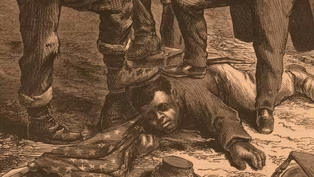
A brief history of Reconstruction
Video has Closed Captions
Reconstruction saw Black progress, then backlash erased gains after brief equality. (2m 32s)
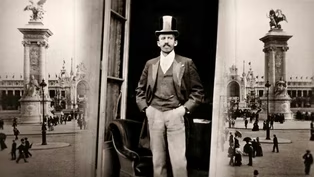
Du Bois used visualized data to confront racism at the 1900 Paris Exposition
Video has Closed Captions
At the 1900 Paris Expo, Du Bois used data to present a visually captivating case against racism. (2m 25s)
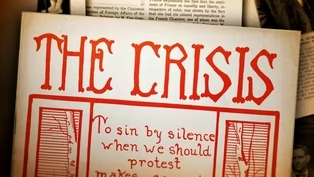
The formation of the NAACP and Du Bois’ magazine, “The Crisis”
Video has Closed Captions
How Du Bois used "The Crisis" and NAACP efforts to expose racism and celebrate Black achievement. (3m 10s)
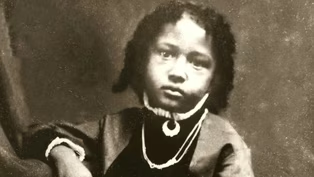
W.E.B. Du Bois' childhood, family and education
Video has Closed Captions
Born in 1868, W.E.B. Du Bois rose from hardship to academic excellence. (3m 43s)
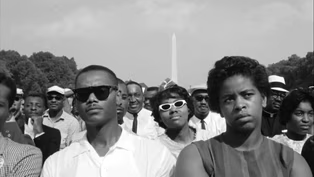
W.E.B. Du Bois passed away on the eve of the 1963 March on Washington
Video has Closed Captions
Du Bois’ death at the 1963 March on Washington marked a passing of the torch in civil rights. (1m 48s)
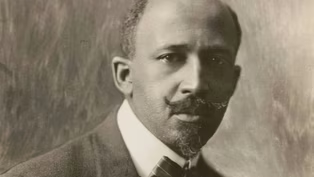
W.E.B. Du Bois: Rebel With a Cause
Video has Closed Captions
Explore the life and legacy of notable Black scholar and civil rights pioneer W.E.B. Du Bois. (2m 29s)
Providing Support for PBS.org
Learn Moreabout PBS online sponsorship












Support for PBS provided by:
Support for American Masters is provided by AARP, The Rosalind P. Walter Foundation, Thea Petschek Iervolino Foundation, Burton P. and Judith B. Resnick Foundation, The Philip and Janice Levin Foundation,...