
October 9, 2026 - PBS News Hour full episode
10/9/2026 | 56m 45sVideo has Closed Captions
October 9, 2026 - PBS News Hour full episode
October 9, 2026 - PBS News Hour full episode
Problems playing video? | Closed Captioning Feedback
Problems playing video? | Closed Captioning Feedback
Major corporate funding for the PBS News Hour is provided by BDO, BNSF, Consumer Cellular, American Cruise Lines, and Raymond James. Funding for the PBS NewsHour Weekend is provided by...
October 9, 2026 - PBS News Hour full episode
10/9/2026 | 56m 45sVideo has Closed Captions
October 9, 2026 - PBS News Hour full episode
Problems playing video? | Closed Captioning Feedback
Where to Watch PBS News Hour
PBS News Hour is available to stream on pbs.org and the PBS app.
Providing Support for PBS.org
Learn Moreabout PBS online sponsorshipAMNA NAWAZ: Good evening.
I'm Amna Nawaz.
Geoff Bennett is away.
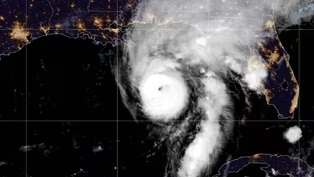
On the "NewsHour" tonight: The Gulf Coast braces for impact, as Hurricane Isaias threatens communities from Mississippi to Florida.
Outrage in New York after an ICE agent shot and wounded a man during an immigration operation with his 5-year-old son in the car.
And we examine how local officials are testing their voting machines to ensure the integrity of the upcoming elections.
BOBBIE GROSS, Mesa County, Colorado, Clerk and Recorder: We're going to be disappointed in outcomes, but we need to be able to trust those outcomes and know that there's nothing nefarious going on behind the scenes.
(BREAK) AMNA NAWAZ: Welcome to the "News Hour."
AMNA NAWAZ: Hurricane Isaias has now strengthened into a Category 3 major hurricane as it heads towards the Gulf Coast.
The storm is packing winds up to 120 miles an hour and is expected to make landfall later tonight.
States of emergency have been declared in parts of Alabama, Florida, and Georgia, warning of storm surge up to nine feet and as many as 15 inches of rain in some coastal areas.
All along the coast, residents are rushing to prepare, lining up for gas and boarding up their homes ahead of the storm.
Florida Governor Ron DeSantis today urged people to get ready.
GOV.
RON DESANTIS (R-FL): You will face very hazardous conditions prior to the storm making landfall.
So you really need to finish your preparations now.
You have to execute your plans now.
There's going to be a point in the not-too-distant future where it's not going to be safe to go outside, even though the storm may still be a distance away from reaching the shore.
Do it now.
AMNA NAWAZ: Joining us now is Michael Brennan.
He's director of the National Hurricane Center.
Michael, welcome back.
So, give us the latest that we know about Hurricane Isaias' path.
where and when is it expected to make landfall?
MICHAEL BRENNAN, Director, National Hurricane Center: Well, Isaias is still a Category 3 hurricane on the Saffir-Simpson scale, with maximum sustained winds of 115 miles per hour, down just a little bit from earlier in the day, but that's just a really minuscule change.
You can see the center of circulation just offshore of the Florida Panhandle here, probably going to move inland on the coast and make landfall in the next couple of hours.
And that's when the worst of the conditions will begin to materialize.
But as you can see here behind me, all of this weather is pushing onshore now.
So conditions are going downhill really, really rapidly.
AMNA NAWAZ: Yesterday, you mentioned to us that it could weaken further as it approaches landfall.
Is that still true?
MICHAEL BRENNAN: Yes, so it's experiencing what we call vertical shear, which hurricanes don't -- they don't strengthen usually in those types of environments.
The storm so far has been able to cling to Category 3 status.
A little bit more weakening is possible right before it makes landfall.
But, for all practical purposes, it really won't matter because the hazards are already baked and set in place.
Even if the storm comes down a little bit from a wind speed perspective, the rain and the storm surge and the wind impacts really won't change much.
AMNA NAWAZ: And are your concerns still largely the same based on what's happened since the last day we spoke, flooding and storm surge mainly for coastal areas, or should folks inland be concerned as well?
MICHAEL BRENNAN: So we're a bit more concerned about inland impacts.
The forward speed has increased today.
It's now moving really, really rapidly at 17 miles per hour.
And what that means is, it can carry the momentum a little bit farther inland.
So I think what we're going to see is the winds and potential power loss extending deep into Alabama portions of Georgia and even Eastern portions of Mississippi, so absolutely not a coastal phenomenon.
These winds are going to spread deep inland.
AMNA NAWAZ: And at this point, would you say it is too late for people to try to evacuate?
If they're not able to, what should they do to prepare?
MICHAEL BRENNAN: At this point, it is much too late to be moving around.
Sun will be going down soon.
Conditions are deteriorating rapidly.
We're already seeing tornadoes form in some of these outer bands.
You just need to be where you're going to be, hunker down, ride out the storm.
Don't be out venturing around looking at it.
AMNA NAWAZ: We're thinking about everybody in the storm's path and wishing them well.
That is Michael Brennan, director of the National Hurricane Center, joining us tonight once again.
Thank you.
MICHAEL BRENNAN: Thank you.
AMNA NAWAZ: In the day's other headlines An investigation is under way after an ICE agent shot a man in New York City on Thursday.
Federal authorities say 28-year-old Oscar Belgal, who is illegally in the U.S., attempted to ram officers with his vehicle when they tried to detain him.
ICE agents then fired at his car where a young child was in the back seat.
William Brangham has this report.
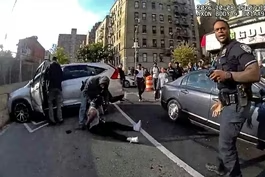
WILLIAM BRANGHAM: Bodycam footage released today shows New York City police arriving at the scene of the ICE shooting finding plainclothes ICE officers, one seemingly dressed as a construction worker, carrying a long gun, another tending to Oscar Belgal, the man they'd shot in the neck minutes before, in the background, the car Belgal was driving with his 5-year-old son.
The boy was unharmed and is now with family members.
MAN: It was really quick.
It was boom, boom, boom, boom, boom.
ZOHRAN MAMDANI (D), Mayor of New York City: Let me say this plainly.
WILLIAM BRANGHAM: New York's mayor, Zohran Mamdani, called the shooting an outrage.
ZOHRAN MAMDANI: Tonight, a 5-year-old child sits traumatized and terrified.
Tonight, millions of our neighbors are wondering whether they will be safe on our streets, in our schools, at their worksites.
WILLIAM BRANGHAM: That night, protesters gathered at the site.
PROTESTER: Whose streets?
PROTESTERS: Our streets!
PROTESTER: Whose streets?
PROTESTERS: Our streets!
WILLIAM BRANGHAM: The growing crowd clashed with police.
Federal authorities say ICE agents were attempting to arrest Belgal when he tried to flee, and agents shot at least seven rounds at his car believing their lives were in danger.
They said agents were unaware a child was in the back seat.
MARCOS CHARLES, U.S.
Immigration and Customs Enforcement: Mr.
Belgal was struck by one of the bullets or fragments superficially in the neck.
He stopped his vehicle.
We arrested him, rendered first aid information and then took him to the hospital.
WILLIAM BRANGHAM: DHS said the 28-year-old suspect has now been transferred to an undisclosed detention facility outside New York.
MARKWAYNE MULLIN, U.S.
Homeland Security Secretary: It is shameful that we're giving this particular case so much attention when this was a thug.
WILLIAM BRANGHAM: Homeland Security Secretary Markwayne Mullin said Belgal had a criminal history and blamed this escalation on the actions of New York officials.
SEN.
MARKWAYNE MULLIN: Sanctuary politicians, they create an environment for criminal activity to thrive, not for the American citizens to be safe.
Underneath President Trump, he made it very clear he was going to restore law and order in our cities and our towns and our states, despite what happens with career politicians that put criminals in front of law-abiding citizens.
WILLIAM BRANGHAM: Mayor Mamdani and New York Governor Kathy Hochul both talked with President Trump trying to negotiate Mr.
Belgal's release and pressed him to stop immigration enforcement operations in New York.
In a statement posted to social media, Governor Hochul wrote -- quote -- "New Yorkers have witnessed far too many acts of violence by a rogue federal agency and untrained agents that operate with impunity."
Federal immigration agents have now reportedly shot at least two dozen people since the start of the Trump administration's immigration crackdown in January 2025.
For the "PBS News Hour," I'm William Brangham.
AMNA NAWAZ: Also today, President Trump says he struck a deal with Russia to get millions of tons of diesel in a bid to lower U.S.
energy prices ahead of the midterm elections.
Writing on social media, he said that President Vladimir Putin agreed to -- quote -- "immediately supply over 300,000 tons of diesel fuel to the American and global marketplace" and that more would follow.
But neither Washington nor Moscow provided further details on how the deal would work, and analysts question whether it can indeed help to tame oil prices.
Just last month, Mr.
Trump signed a sweeping sanctions law targeting Russia's energy revenues, which Russia uses to help fund its war in Ukraine.
Named for the late Senator Lindsey Graham, the law gives the administration the authority to impose steep tariffs on countries that import Russian oil and gas.
President Trump also used his social media platform today to announce his new White House press secretary, Katie Zacharia.
The conservative lawyer and commentator is a senior communications adviser at the company that runs TRUTH Social.
She also served briefly as a spokesperson for the Department of Homeland Security.
She will replace Karoline Leavitt, who left the position in August and is now joining FOX News.
There's been a strong but mixed reaction to the Pentagon's plans to livestream the firing squad execution of Nidal Malik Hasan.
He's the former Army major who shot and killed 13 people at Fort Hood military base in 2009.
Yesterday, Defense Secretary Pete Hegseth said he will -- quote -- "make sure" that people are able to watch it.
The execution is scheduled for early December.
It would be the nation's first state-sanctioned public execution since the 1930s.
Some death penalty experts say it could bring transparency to a process that's long been shrouded in secrecy, but many Americans consider it inhumane.
ISAIAH WILSON, American: People should definitely have to -- quote, unquote -- "pay for their crimes," for lack of better words, but, at the end of the day, there's a way to do it.
And we have to not become desensitized to horrendous acts of violence in any aspect.
AMNA NAWAZ: Vice President J.D.
Vance told reporters today he's not sure the livestream will actually happen.
And even if it does, Vance said -- quote -- "I'm not going to be watching it."
President Trump is launching a new effort to fire Federal Reserve Governor Lisa Cook.
He signed a memorandum today to open what the White House is calling a committee of inquiry into whether she made false statements on her mortgage applications.
The inquiry will include a hearing at the White House next month and says Cook is expected to attend.
In June, the Supreme Court ruled that Cook could keep her job, but did not permanently block Trump from firing her.
Cook has denied any wrongdoing and has not been charged with a crime.
Authorities in Saudi Arabia say three people were killed at Riyadh's airport today in an attack claimed by Iran-backed Houthi rebels in Yemen.
At King Khalid International Airport, eyewitness video shows smoke billowing from a plane.
It was the deadliest attack in Saudi Arabia since the kingdom's major offensive against the Houthis last weekend.
Meantime, in Yemen's capital of Sanaa today, a large crowd rallied to show support for the Houthis in their fight against Saudi forces.
A Houthi spokesperson says that Saudi airstrikes hit the city overnight, injuring at least six people.
Saudi authorities have not confirmed the attacks.
In France, local authorities say they have recovered two Renoir paintings that were stolen from a museum last month.
Six people have also been arrested.
Two works, Portrait of Madame Colonna Romano and Young Woman at the Well, had been on loan from the d'Orsay Museum in Paris.
They were stolen from a museum in Southern France, which used to be a home of the impressionist artist.
The theft revived concerns for the nation's cultural treasures after the heist at the Louvre Museum last year.
The French culture minister described today's recovery as a huge relief.
On Wall Street today, stocks managed to end the week with decent gains.
The Dow Jones industrial average rose more than 400 points.
The Nasdaq added more than half-a-percent.
The S&P 500 also closed in positive territory.
And NFL legend, pitchman, and Chicago fixture Mike Ditka has died.
Da Coach, as he was widely known, led the 1985 Chicago Bears to a dominant Super Bowl win.
Before that, he transformed the role of tight end and was known as Iron Mike for his toughness on the field.
In 1988, he was inducted into the Pro Football Hall of Fame.
With his trademark mustache, swept-backed hair, and gruff demeanor, Ditka went on to make his mark on pop culture.
AMNA NAWAZ: He was worshipped by the superfans in the famous "Saturday Night Live" sketches and even appeared as himself.
MIKE DITKA, Former Chicago Bears Coach: Live from New York, it's "Saturday Night."
AMNA NAWAZ: And he poked fun at his tough guy persona on film.
Actor: Do you know even Sammy Sosa?
MIKE DITKA: Hey, zip it, kid.
I'm a coach that knows about winning.
I eat quitters for breakfast and I spit out their bones.
Delicious.
AMNA NAWAZ: Along with his commercial endeavors, Ditka was also a fierce advocate for better health and retirement benefits for former players.
In a statement, his family called him the -- quote -- "heart" of our family.
Mike Ditka was 86 years old.
Still to come on the "News Hour": human rights attorney Navi Pillay wins the Nobel Peace Prize after a long career investigating war crimes; a top Trump donor accuses U.S.
ambassador to Greece Kimberly Guilfoyle of asking for money in exchange for access to the administration; and David Brooks and Jonathan Capehart weigh in on the week's political headlines.
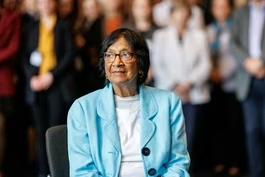
AMNA NAWAZ: Today, international human rights lawyer Navanethem or "Navi" Pillay won the Nobel Peace Prize.
In its announcement, the Nobel Committee said it chose her as -- quote -- "Institutions of international law are under political attack."
Just hours later, the Trump administration sanctioned the International Criminal Court, where Pillay was a judge.
Here's Nick Schifrin with more.
NICK SCHIFRIN: Today, the Nobel Committee called Pillay a legal pioneer with exceptional courage and integrity who has led the way toward a more comprehensive global legal order.
She is currently a judge on the International Court of Justice and a former U.N.
human rights commissioner.
She once served as a judge on the ICC and on the International Criminal Tribunal for Rwanda.
She also recently led the U.N.
Independent Commission of Inquiry that accused Israel of genocide in Gaza.
But her career began decades ago.
She's of Indian descent, born into apartheid South Africa, and confronted deep structural discrimination, Allan Ngari, the Africa advocacy director at Human Rights Watch, told us earlier today from Johannesburg.
ALLAN NGARI, Africa Advocacy Director, Human Rights Watch: To see Navi Pillay, who has overcome all the odds of what the apartheid government meant for people who were previously disadvantaged, rising up and going up to the highest echelons of the legal industry, not just in South Africa, but in the world.
And this really is quite inspirational and should be inspirational to every person that lives in the Global South that might come from a community that is disadvantaged that all is possible.
NICK SCHIFRIN: And to talk about Pillay's legacy and the responses to today's announcement, I'm joined by Stephen Rapp, ambassador at large of the State Department's Office of Global Criminal Justice under the Obama administration, and former prosecutor on the Special Court for Sierra Leone and International Criminal Tribunal for Rwanda.
He was also with Pillay this morning as she learned the news.
Ambassador Rapp, thank you very much.
Welcome back to the "News Hour."
Let me just ask this.
What is the significance of the Nobel Committee choosing her for this prize?
STEPHEN RAPP, Former U.S.
Ambassador-at-Large for War Crimes Issues: Yes, well, they have chosen someone, as they said, of great courage and vision and determination, who's been a real leader in the field of human rights and international justice.
It was appropriate that it was an announced when she was at the Nuremberg Academy this morning, where she was the founding president, in the courtroom where just 80 years ago this month we had the first judgments against the Nazi leaders.
And it's that commitment to end impunity and to hold powerful people to account that's motivated her throughout her life.
I came to know her 25 years ago in the courtroom.
I was prosecuting a media trial, and she was presiding against -- the mass media against the leaders of Rwandan hate radio, and won an historic judgment.
It was hard fought.
And that's the way she's been.
It's based on the facts.
It's based on the law, and always enormous respect for the victims and the survivors of these horrendous crimes.
NICK SCHIFRIN: As I said today, the committee called her a -- quote -- "legal pioneer."
How is she a legal pioneer?
STEPHEN RAPP: Well, before I got there, she was most famous for being involved in our the first judgment at the Rwanda Tribunal that found that rape was a crime against humanity.
That never happened before.
And she also found that rape was a way in which genocide was committed because of the way in which it inflicted serious mental and physical harm on women with the intent to destroy the whole group, because, before her, frankly, the attitude was that women and often children and girls were collateral damage and conflict, and that women's bodies were the reward for brave soldiers.
And we didn't have the crime even talked about.
And, finally, because of her, we had convictions.
And since then, we have a global movement to stop this scourge against women and girls.
And so that's -- for that, she's entitled to the Nobel Prize alone.
But that was something she accomplished back in 1998.
And, since then, she's accomplished so much more.
NICK SCHIFRIN: As noted at the top, the committee awarded her the Peace Prize as it said -- quote -- "Institutions of international law are under political attack."
Just today, the Trump administration once again sanctioned the International Criminal Court, where she used to be a judge.
And here's how Pillay responded when she heard this morning.
NAVI PILLAY, Nobel Peace Prize Winner: Thank you very much.
If you clap a little bit more, I may share this prize with Trump.
NICK SCHIFRIN: That's a reference, of course, to Maria Corina Machado, Venezuelan opposition leader, last year sharing her prize with President Trump.
How much of what the Nobel Committee said today, and perhaps her as well, is about the Trump administration's policies today, especially against the ICC?
STEPHEN RAPP: And they put it in their statement.
They specifically spoke of the outrage of the administration sanctioning judges, sanctioning people that are upholding the rule of law, treating them like terrorists.
Now we have the announcement that the whole court, every janitor in the place is going to be sanctioned.
And there is no threat of any case against the United States.
And even the case on Israel is still pending on a jurisdictional issue.
This court will not be destroyed by this administration.
It will survive Donald Trump and Rubio and the principles that we fought for at Nuremberg and that Navi Pillay upholds today will live on far longer than this administration that's really abandoning American principles of accountability.
NICK SCHIFRIN: The Trump administration, of course, would argue the ICC itself is the one who's not accountable.
But I want to keep going, because, as I mentioned, Pillay also led the U.N.
Independent Tribunal that has accused Israel of genocide in Gaza.
And, today, Israel's Foreign Ministry released this statement -- quote -- "Awarding Pillay the Nobel Peace Prize is not a recognition of justice.
It's the grotesque weaponization of an award to legitimize anti-Israel hatred and prejudice.
Now that the Nobel Commission has awarded the biggest lie of the 21st century, Joseph Goebbels is currently applauding from hell."
Of course, Goebbels was, of course, the Nazi minister of propaganda.
Apart from the rhetoric, is there not a legitimate debate and defense against Israel's actions in Gaza?
STEPHEN RAPP: I'm a strong believer in Israel's right to exist, and I want to see Israel achieve accountability, as it has as in its past when it is accused of international crimes, because that's the primary responsibility.
And, sadly, we have seen very little of that out of the current government, where we had seen a lot of it in the past.
But, that said, this is not -- this commission, and I know Navi and I know the methodology.
They were basing their findings on reasonable grounds to believe that there is a case to answer for international crimes.
That's not a judicial determination.
And in doing this process, they did it fairly.
And what we're hearing is this political rhetoric, a government that didn't protect its own people drawing attention to this woman who's, frankly, been courageous all her life.
And when -- but when similar crimes or even lesser crimes that occur that are international crimes, there needs to be accountability.
NICK SCHIFRIN: And, finally, Ambassador Rapp, just quickly while -- in the time we have left, is the international cooperation that defines Pillay's career, that defines your career, that created these legal tribunals, these international institutions over decades, is that even possible today, do you think?
STEPHEN RAPP: I mean, there is a lot of international cooperation, but we don't have the sort of top-down -- I mean, obviously at Nuremberg, we had Russia and the United States and France and the United Kingdom working together to prosecute.
In the '90s, we had the U.N.
Security Council operating unanimously to have tribunals for Yugoslavia and Rwanda.
We don't have that anymore.
But you have other states like our Canadian friends, like Germany, like the Netherlands, together with countries north and south, that support human rights and that are pushing back against dictators and authoritarians.
And I think that will prevail in the end.
NICK SCHIFRIN: Ambassador Stephen Rapp, thank you very much.
STEPHEN RAPP: Good to be with you.
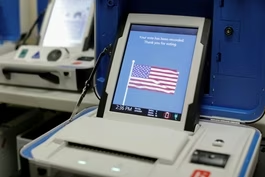
AMNA NAWAZ: Midterm election season culminates on one important Election Day, but, in many states, voting is already under way.
For the local officials who run elections, the work started even earlier.
Liz Landers has a closer look at how they prepare for voting and why they say you should trust the process.
BRIAN MCKENZIE, Davis County, Utah, Clerk: We're testing the overvote function of the machine to make sure it accurately identifies those.
LIZ LANDERS: Before a single real ballot is counted in Davis County, Utah, workers run stacks of pre-marked test ballots through the machines.
Some are marked wrong on purpose.
It's called logic and accuracy testing, and it confirms the machines count ballots correctly and catch errors like a voter picking too many candidates.
Utah is one of a handful of states that votes mostly by mail.
County clerk Brian McKenzie explains the path a mail ballot takes.
BRIAN MCKENZIE: This is Mickey Mouse and Donald Duck, that their envelopes have come in, right?
LIZ LANDERS: Every envelope carries its own bar code.
If a voter needs a replacement ballot, the old code is canceled, a check McKenzie says keeps anyone from getting more than one ballot.
Return ballots are picked up by at least two election workers, logged and brought here under around-the-clock video surveillance.
Each envelope is scanned, date-stamped, and photographed.
Workers compare the signature to as many as five on file, all that before a machine even opens the envelope.
BRIAN MCKENZIE: That machine creates that separation from your personal identifiers and anything that you voted, maintaining your constitutional right to a secret ballot.
LIZ LANDERS: Ballots move through the process in batches of 200, counted at every step.
Vote tallies are loaded onto encrypted memory sticks.
BRIAN MCKENZIE: Nothing is wireless.
Nothing is Web-based.
It's all physical, manual process to transfer that data from one place to another.
LIZ LANDERS: McKenzie's first election in 2004 used punch cards.
Now he's the county's clerk elected in 2022.
Over that time, the job has gotten a lot more public.
BRIAN MCKENZIE: Early years, it was a successful election if you never made the front-page news, right?
But there is a lot more focus on it.
There's a lot more engagement to it.
LIZ LANDERS: This year, that focus included a fight in Washington over voting by mail, which President Trump has tried to curtail.
At his direction, the United States Postal Service announced new rules to regulate mail ballots before the Supreme Court stepped in last month to block it.
The uncertainty had McKenzie's team drawing up backup plans.
He says the big risk is always change that comes too close to an election.
BRIAN MCKENZIE: I have found that, with enough time and information that, yes, our voters do adapt and they do adjust.
The concern is when it's short.
Short notice, significant changes, that creates disruption.
That creates question.
And when you have questions like that creates doubt.
When people have doubt, they disengage.
JOSEPH KIRK, Election Supervisor, Bartow County, Georgia: Well, crews come in, pick up everything, deliver it to the polling place.
LIZ LANDERS: Doubt is what also worries Joseph Kirk.
He's the election supervisor in Bartow County, Georgia, northwest of Atlanta, and he's readying the machines that will go out to polling places.
JOSEPH KIRK: Seal it up.
LIZ LANDERS: He says the bigger danger may not be someone changing votes.
JOSEPH KIRK: There are so many ways to cast doubt on the election through that process, and I think that's the true danger.
I don't know that anybody is going to try to, like, say, hack the voting system and change the votes.
But they might try to convince people it's not worth voting, that there's no need to participate, it's just a show game.
LIZ LANDERS: Defending those systems against foreign governments is another matter.
Kirk says some of the federal help his office once relied on has all but evaporated since the Trump administration has scaled back the agency that oversees election security.
JOSEPH KIRK: Maybe the easiest way to describe the need is, it takes a nation-state to fight a nation-state.
I have a great I.T.
director, but he can't fight China or any other country, and he shouldn't be expected to.
And we had a lot of resources available to us through the federal agencies that either are not available anymore or available in different ways that are hard to participate in.
LIZ LANDERS: In Western Colorado, Mesa County's Republican clerk, Bobbie Gross, is trying to build trust by bringing the public inside.
BOBBIE GROSS, Mesa County, Colorado, Clerk and Recorder: We have started since 2023 bringing the public in for election tours and also doing a lot of community engagement, going out and speaking with different organizations.
And we just really focus on elections and building that trust within our community.
LIZ LANDERS: That trust took a hit here.
After the 2020 election, the county's former clerk, Tina Peters, allowed unauthorized access to its voting equipment.
She was trying to prove fraud claims that were unfounded.
She was convicted and sentenced to nearly nine years in prison.
This spring, after pressure from President Trump, Colorado's governor commuted her sentence.
She was released in June and has kept pushing unproven claims that Colorado's elections aren't secure.
Gross says trusting an election doesn't depend on liking how it turns out.
BOBBIE GROSS: There's never an election where you voted for everything you wanted and everything won, right?
It just doesn't happen.
We're going to be disappointed in outcomes, but we need to be able to trust those outcomes and know that there's nothing nefarious going on behind the scenes.
LIZ LANDERS: Back in Utah, ballots go out to voters about three weeks before Election Day.
McKenzie says the speed of the count isn't how he measures success.
BRIAN MCKENZIE: Of course, we'd love to have ballots counted just as quickly as possible and all of that, but ultimately it comes down to the voter experience, making sure that that's a great experience for our citizens.
LIZ LANDERS: With Election Day around the corner, local officials across the country hope more transparency will mean more trust.
For the "PBS News Hour," I'm Liz Landers.
AMNA NAWAZ: A Republican donor is accusing U.S.
Ambassador to Greece Kimberly Guilfoyle of asking for a $100,000 payment in exchange for access to top Trump administration officials.
I spoke a short while ago with Eric Deters, a former Kentucky congressional candidate, about those requests for payment and the access he was promised in return that he argues Guilfoyle never provided.
Eric Deters, welcome to the "News Hour."
Thank you so much for joining us.
ERIC DETERS, Former Attorney: Thanks for having me.
AMNA NAWAZ: So, you have known Kimberly Guilfoyle for years.
You have known the Trump family for years.
You support President Trump.
You're now distributing a nearly 300-page document with text messages and other documents claiming that Kimberly Guilfoyle asked you to pay her $100,000 American Express credit card bill.
And, in exchange, she would provide White House access for you.
Why are you coming forward with all this now?
ERIC DETERS: I'm doing so because I have given the Trump administration from the top all the way down, J.D.
Vance, Susie Wiles, Don Jr., Todd Blanche, Pam Bondi, Kash Patel, Kimberly Guilfoyle, an opportunity to help me help the Dr.
Durrani victims, 580 spine surgeries that were not necessary, 185 children, 100 that have died.
And I decided.
I gave them one last chance last Thursday.
I sent an e-mail to Susie Wiles, Kimberly Guilfoyle, and Don Jr.
and I said: "If you do not set in motion some assistance to extradite Dr.
Durrani back from Pakistan to face justice for these folks, I'm going to go to the media and see what happens."
So that's what I did.
My motive in all of this is revenge, for lack of a better word, for their not helping the Dr.
Durrani victims.
AMNA NAWAZ: I want to clarify here for folks who are catching up, Dr.
Durrani was an Ohio doctor.
He fled to Pakistan, and you represent, I understand, a number of his former patients who were harmed, they claim, and want to sue him for malpractice.
So you have said very clearly here, you believe this was a quid pro quo, that Kimberly Guilfoyle asked you to pay her $100,000 American Express bill, and, in exchange, she would help you with this request.
Is that correct?
ERIC DETERS: That's absolutely correct.
She told me that if I paid -- after I'd already paid her $300,000, and she knew I was going to give her another million dollars if she helped me with this cause, which she didn't.
So when she asked me for another $100,000, I said, Kimberly, you haven't done anything for me yet.
And she promised me that she would be my ride or die in the Trump administration, no request too big, too small, as many requests as I wanted.
She would do anything and everything to help me.
And she was -- she wanted to cover it up.
She wanted to keep it secret.
She wanted me to use Signal.
She wanted me not to paper it.
She got mad at me because I would send e-mails and text messages that she didn't want me to send.
The bottom line was, is, it was a definite quit pro quo.
That was what she was offering me.
AMNA NAWAZ: You write that -- you share, rather, in these text messages too.
A few of those messages from her on July 3, she wrote to you and said, "Honey, please, I need you to get this done for me today," referencing the payment, and then sends an American Express portal to make that payment.
And she also, as you mentioned, asked you to not put things in writing, saying: "What a nightmare.
You will literally cost me my ambassadorship.
Stop writing."
I do have to ask you too, Eric, because you faced your own legal issues, right?
You have had the Kentucky Bar Association suspend you twice for making false court statements and frivolous claims.
Some people will say, why should we believe you now?
ERIC DETERS: Well, first off, I dispute all of that.
We can't do it at this time frame here, but I just -- suffice it to say this.
I'm a retired lawyer because I got tired of the lawyer game.
I got tired of the system.
AMNA NAWAZ: You say in this letter as well that you're calling out President Trump for what you call the open grifting and enrichment.
Are you saying it's not just Kimberly Guilfoyle who's engaging in this?
ERIC DETERS: You have Donald Trump Jr.
and Eric Trump doing crypto, getting on boards, Jared Kushner's $3 billion Saudi fund.
AMNA NAWAZ: If I may, those are all legal and open business ventures, right?
What you're alleging here with Guilfoyle is that you were going to pay her credit card bill in exchange for access.
That's something different.
ERIC DETERS: Well, I agree with you, but that was her request, not me.
I wasn't doing anything wrong.
AMNA NAWAZ: So you said that this is revenge for Guilfoyle not making good on her promise.
What do you want to see happen now?
Why come forward with all this information?
ERIC DETERS: I sent an e-mail today to Kimberly Guilfoyle, Susie Wiles, and Don Jr., and I sent them a message and I told them, I am going to keep talking about the extradition of Dr.
Durrani back to the United States until the cows come home.
AMNA NAWAZ: Eric Deters, thank you so much for joining us today.
We appreciate your time.
ERIC DETERS: Thanks for having me.
I appreciate it.
AMNA NAWAZ: Candidates for U.S.
Senate in three battleground states faced off in fiery debates last night that frequently veered into personal attacks.
In Michigan, Republican Mike Rogers tried to tie Democrat Abdul El-Sayed's family to terrorism, despite there being no evidence.
ABDUL EL-SAYED (D), Michigan Senatorial Candidate: You go after my mom?
MIKE ROGERS (R), Michigan Senatorial Candidate: I'm not going after your mom.
ABDUL EL-SAYED: That's exactly what you're doing.
MIKE ROGERS: What your mom was working at, I was going after that organization that was indicted for funneling money to al-Qaida.
AMNA NAWAZ: In Georgia, Democratic Senator Jon Ossoff accused Republican Congressman Mike Collins of bigotry and racism.
SEN.
JON OSSOFF (D-GA): It's not just that you have hired half the Third Reich to staff your congressional office and you have promoted neo-Nazi content online.
It's that you're robbing your constituents to subsidize your donors.
If John Lewis were marching today from Selma to Montgomery, Mike Collins would be grabbing a billy club.
REP.
MIKE COLLINS (R-GA), Senatorial Candidate: I have condemned racism, antisemitism, hate.
I don't care where the source is.
And I tell him that too.
It's wrong.
We have no place in this world for that.
AMNA NAWAZ: And, in Maine, Republican Senator Susan Collins demanded that Democrat Troy Jackson apologize after he accused her of corruption.
TROY JACKSON (D), Maine Senatorial Candidate: She could use her leverage to stop this war, but instead they're making money.
I mean, Senator Collins and her husband are making money more off of this war, and so is a whole bunch of other people, and that's why this doesn't stop.
SEN.
SUSAN COLLINS (R-ME): That is absolutely outrageous, and you owe me an apology.
TROY JACKSON: No, you owe me an apology.
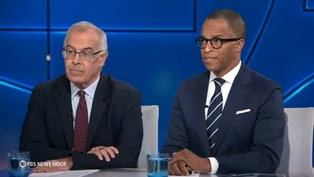
AMNA NAWAZ: For more on the battle for control of Congress, we turn now to the analysis of Brooks and Capehart.
That is "The Atlantic"'s David Brooks and Jonathan Capehart of MS NOW.
Good to see you both.
JONATHAN CAPEHART: Hey, Amna.
AMNA NAWAZ: Speaking with those debates last night, some policy discussions, but very heavy on the personal attacks.
And in the context of this, we should say The Cook Political Report just this week shifted eight house races and three Senate races in Kansas, North Carolina, and New Hampshire toward Democrats.
Jonathan, Senate control is on the line here.
Is that why these are getting so heated?
JONATHAN CAPEHART: Yes.
I mean, I have said many times -- excuse me -- I have said many times here that this election cycle, midterm election cycle, reminds me of 2006, exactly 20 years ago.
These same conversations were happening, particularly with the Senate.
The Senate map then and now was supposed to be extremely difficult, if not impossible for Democrats to retake the majority.
And here we are in just Georgia, Michigan, Maine.
I mean, Maine would be the only pickup of the three.
But the fact that these debates are so nasty and personal shows that Democrats feel they are within striking distance.
Republicans feel perhaps that they are on their on their back foot -- on their back feet.
And, I mean, given who the president is, same -- president of their party, they should feel that they're on their back feet.
AMNA NAWAZ: David, you agree?
DAVID BROOKS: Some -- I agree with Jonathan, but I think something has changed since 2006, which is we have had 10 years of political, moral decay, and sound a lot -- the candidates used to be inhibited a bit by the sense that, if I lie, if I'm a total sleazebag, it might hurt me.
And now they realize it won't hurt me at all.
And, in fact, my partisans may actually like it.
And so you had -- I think, in those three cases, all three of those things were sleazy behavior, Troy Jackson.
Susan Collins has some Boeing stock in her portfolio.
And he calls her a war profiteer because of that?
That's ridiculous.
The insinuations that El-Sayed is involved in terrorism because he's Muslim, ridiculous.
Jon Ossoff, my advice to him is, if you start calling your political opponents Nazis, maybe it's time to shut up.
That's just not what we do here in this country.
And the Bull Connor stuff -- and a lot of these candidates have real weaknesses.
Like, Mike Collins, who's the Georgia Republican, I think what's accurate to say about him is, he has a disturbing number of young men on his -- around him who have ties to the alt-right and some of the vile antisemitic stuff online.
El-Sayed can... AMNA NAWAZ: Who have shared, we should say, white nationalist content online, right.
DAVID BROOKS: Right.
AMNA NAWAZ: That's the accusation.
DAVID BROOKS: El-Sayed, he can't tell the difference between Iran and Israel.
When asked whether -- which was a greater threat, he couldn't tell the difference.
Iran has killed thousands of Americans.
Iran is the leading cause of -- or leading sponsor of terrorism around the world.
If you can't tell the difference, then something's wrong here.
And so they could have gone after legitimate weaknesses.
But in each case, they took it to 11 and it was dishonest.
AMNA NAWAZ: Meanwhile, we know the cost of living, price of gas, these are the things at the top of all voters' minds.
And I want to ask you about what we heard from the president himself late today, which was a deal with Vladimir Putin to get diesel from Russia.
That reverses years of pressure on Moscow for their war in Ukraine.
It also flies in the face of new legislation that Congress just passed that would allow the president broad powers to punish countries that buy Russian oil.
It also follows Trump pledging that there would be no more strikes on Iran, David, until after the midterm elections.
These are all foreign policy flip-flops really geared towards getting oil prices down?
DAVID BROOKS: Yes.
Yes.
Maybe after the races are called, then Trump starts bombing.
It's ridiculous.
The important -- the most important thing that Trump is dealing with on these issues is that Russia cannot be allowed to win this war.
If Russia's allowed to win this war, then America becomes and the world becomes more dangerous for a generation.
And to skip over that on some futile attempt to lower diesel prices strikes me as ridiculous, especially since it won't work.
In part, even if Russia could produce all the diesel it used to be capable of, it's a tiny percentage of the global supply.
Second, their capacity to refine and export diesel has been severely weakened by Ukraine.
And so this is not going to bring prices down.
It's just sort of a flamboyant gesture which has a corrosive effect by legitimizing Vladimir Putin and what he's doing in Ukraine.
JONATHAN CAPEHART: And also, at the same time, helping Russia to finance its war machine against Ukraine.
And Russia can -- you were saying Russia cannot be allowed to win this war.
You are absolutely right, and yet the president is doing nothing, it seems, to help bring that -- bring that goal to fruition.
AMNA NAWAZ: Meanwhile, you heard my interview earlier with Eric Deters.
He's a former Trump donor.
He alleges that the U.S.
ambassador to Greece, Kimberly Guilfoyle, asked him for 100,000 dollars to pay off her American Express credit card bill in exchange for White House access.
He's looking to get to people to try to extradite an Ohio doctor who fled to Pakistan.
What did you make of that interview, of what his allegations are?
Do you believe what he has to say?
And do you believe those allegations should be investigated?
JONATHAN CAPEHART: Yes, yes, and yes.
The original story in The Washington -- in -- I'm sorry -- in The Wall Street Journal was just -- even for this administration, had me slack-jawed at just the brazenness here.
Yes, I believe him because past is prologue.
We have seen this kind of behavior throughout particularly this second Trump administration, where the grifting is out in the open, it is brazen.
And he's been all over television.
He was at MS NOW.
He was at another place that I can't remember right now.
He was just... AMNA NAWAZ: He's given a number of interviews.
JONATHAN CAPEHART: Was just with you.
He's going to be on later tonight on another program on MS NOW following through on what he said to you, that this is revenge, and I'm going to keep speaking out until they do what I want.
Well, why would a man think that he could go toe-to-toe with the chief of staff and all of these high-ranking people in the Trump administration?
Because that's been the pattern.
You ask for things, you pay for things, you get things.
And he tried -- he paid for or tried to pay for this from Kimberly Guilfoyle, and didn't receive the services back.
And so now he's going out into the open.
And so, in this case, it's sort of like they reap -- they're sowing what they reaped, or whatever the saying is.
You know what I mean.
AMNA NAWAZ: David, you have seen -- you may have seen some of the text messages he's alleging are real.
We know Guilfoyle's lawyer says they're not all real, but there's essentially like a 300-page document he is circulating with all of these messages and all of these documents, and you see what's alleged to be Guilfoyle saying, please just pay this.
I need this done right away.
It would have been right before her confirmation hearing to be ambassador to Greece.
DAVID BROOKS: Yes, one of my favorite writers is Tom Wolfe, the author of "The Me Decade" and "The Man in Full" and "Bonfire of the Vanities."
I have been basing my career on the idea that his spirit and ghost will some time -- somehow infuse me, and I will write a novel about the current moments.
And when I do write that novel, Kimberly Guilfoyle is going to be one of my main characters, because, if you start with the Gavin Newsom marriage, then the Don Jr.
engagement, and then this... AMNA NAWAZ: There's a lot of twists and turns.
DAVID BROOKS: There's a lot of -- she's the epitome of American culture in 2026.
And those text messages, it's like -- she's like -- I used the word -- I learned from her that papering is a verb.
DAVID BROOKS: She's saying, stop papering this, and apparently it means leaving a paper trail to the corrupt thing we're all involved in right here.
And so she's like quite out in the open.
And so, if you're going to be a grifter, you have got to deliver on the influence.
And so I think it's appalling that they accept this bogus money and didn't deliver for the guy.
And so there's no honor among thieves.
JONATHAN CAPEHART: Well, I will say this.
In the text messages, we do see that she did try.
She did try and told him... AMNA NAWAZ: To get him the access that she promised.
JONATHAN CAPEHART: To get him the access, and followed up and made sure he knew all the steps she was taking.
But I left -- I didn't answer one of the questions you asked me initially, and that was, should Congress investigate?
JONATHAN CAPEHART: In a normal administration with a normal Congress that is a co -- acting as a co-equal branch of government, you better believe there would be hearings.
She would be brought back from Greece and before the Senate Foreign Relations Committee and all the other committees of jurisdiction and asked to explain herself.
And that's just the minimum.
A properly functioning Department of Justice would also be looking into what she did or didn't do, Mr.
Deters, and whether his allegations are true or false, and then take the appropriate action.
But with this DOJ, that is not going to happen.
The president does the -- well, yes, the president does not go after his friends.
AMNA NAWAZ: David, separate from your novel, you think Congress should look into this?
(LAUGHTER) DAVID BROOKS: Yes.
I don't know.
I think Trump may crack down.
I think grifting is a family business.
And when people outside the family get in -- horn in on the family business, Trump tends to get upset.
So we might see something.
AMNA NAWAZ: Finally, I want to end on something I know we have all been paying attention to this week, and that is the Pentagon's announcement that it's going to publicly livestream the early December firing squad execution of the convicted Fort Hood mass shooter Nidal Malik Hasan.
He killed 13 people.
He injured over 30 more in that brutal 2009 attack.
I want to play for you what the defense secretary, Pete Hegseth, had to say on why he thinks it should be broadcast live.
Take a listen.
PETE HEGSETH, U.S.
Defense Secretary: It was a radical Islamist attack in uniform inside the ranks.
And so he's going to get a firing squad of soldiers, as it should be.
And we will make sure that people are able to watch it, that it's public, because people need to understand that this is -- there's serious consequences for these types of things.
AMNA NAWAZ: Jonathan, this would be the first state-sanctioned public execution in the United States since 1936.
What do you make of this?
JONATHAN CAPEHART: It is a grim new chapter in our nation's history.
It used to be that just being sentenced to death was supposed to be the deterrent.
And now, according to this administration, no, people need to see it, and maybe that will be a part of the deterrent.
But there's another thing here.
This administration has cultivated an atmosphere of menace and violence.
We see it all around us, and this will just be yet another manifestation of that.
And I would hope that more members of Congress -- and I'm happy to see that there's been a bipartisan outcry over this -- that more people will step forward and say, yes, there needs to be accountability, but this isn't the way to do it.
This does not need to be livestreamed.
DAVID BROOKS: Saint Augustine was a fifth century, I guess, scholar, theologian, bishop of Hippo.
And he had a friend who went to the Roman Colosseum and could not resist watching the blood of human suffering.
And the point of this story, which Augustine tells in I think "The Confessions," is that it is seductive and dehumanizing and degrading to have to watch this.
And so, over the course of Western history, of course, over centuries, people watched people getting drawn and quartered.
People watched getting people getting burned to the stake.
People watched people getting hung.
And they finally discovered that we can make some moral progress by not turning the death of a human being into a something that's degrading for the spectators.
It has a perverse, dehumanizing effect on how they see people ever since.
Seeing someone die is a vicious thing.
I don't care what the cause is.
And you do not walk away from that without having been affected in some really brutal way.
And so the reason we stopped having public executions was this effect, and then it created this perverse circus atmosphere where you got all the flotsam and jetsam of humanity watching this stuff.
And so what Hegseth is doing is just -- is amoral beyond -- beyond reckoning.
We make moral progress in this world, and we no longer torture people in public.
Yet we seem to be going back to something.
So we make moral regression, as well as moral progress.
AMNA NAWAZ: We heard the vice president say he's not sure it will even happen.
We will continue to follow that story, of course.
David Brooks, Jonathan Capehart, great to see you both.
Thank you.
JONATHAN CAPEHART: Thanks, Amna.
AMNA NAWAZ: Actor Ke Huy Quan went from arriving in America as a refugee to starring in "Indiana Jones" and "The Goonies."
Decades later, he made an Oscar-winning comeback.
In the latest episode of our PBS News podcast "Settle In," I spoke with him about his debut memoir, "Never Say Die," which starts with his family's harrowing attempts to escape postwar Vietnam.
KE HUY QUAN, Author, "Never Say Die": My parents have nine kids, so there's 11 of us.
So their whole idea was that if we were to all escape at the same time, the chance of us making out, it's unlikely.
So, very early on, they decided we're going to separate.
So my mom took three of my siblings, including my best friend, David.
They got on a boat and went to Malaysia.
And they made it on the first attempt.
And so my mom and three of my siblings were separated for more than a year-and-a-half.
AMNA NAWAZ: I mean, for a parent to have to make that kind of decision, I can't even imagine.
Have you talked to your parents about that, about that moment and having to make those kinds of decisions for your family?
KE HUY QUAN: Interestingly, no.
We never spoke about it.
I think that's why I love that quote that I put in the very beginning of the boat.
"No one ever puts their kids on a boat unless the unless the water is safer than land," from Warsan Shire.
AMNA NAWAZ: Yes, the poet, yes.
KE HUY QUAN: And that really speaks volumes to what my parents were going through, the incredibly difficult decision that they had to make.
AMNA NAWAZ: I love you quoted Warsan Shire as well that line from the poem about no one leaves home unless home is the mouth of a shark.
Is that what it felt like?
KE HUY QUAN: Yes.
It was really incredible, and I didn't really know -- it was -- believe it or not, it's been almost 50 years.
None of our family members ever talked about it, and because... AMNA NAWAZ: Never?
KE HUY QUAN: Never.
And because they were so -- such distant memories, I wanted to make sure that what I remembered is accurate.
KE HUY QUAN: So, right before I sat down to write this book, I actually called some of my older siblings, which I know because of they were -- they were at a -- at that age where they remember much more than I did.
AMNA NAWAZ: And did they?
KE HUY QUAN: They were older.
And they did.
So, having that conversation with them was unbelievable.
And it was just as traumatic for them, but I -- each of us dealt with that trauma in our own separate and individual ways.
And what they told me was exactly how I remembered it.
But they had it even more tough because they were older.
I was 7.
I was well protected, even though, being in that circumstances, they did everything they can to shield me from, honestly everything, that was going on.
I just -- I didn't know much of it.
So, having that conversation with them was really unbelievable, and I'm glad I did.
Now I get to understand a little bit of what they went through.
And, interestingly enough, they have -- they have to read the book to fully understand what I went through, because we never shared.
AMNA NAWAZ: And you can watch that full conversation and more episodes of "Settle In" on our YouTube page or wherever you get your podcasts.
Remember, there's always a lot more online, including a look into rule changes making it easier for Justice Department appointees to participate at political events.
That's at PBS.org/NewsHour.
And on "Washington Week" tonight, Jeffrey Goldberg and his panel analyze the expanding battleground map and what President Trump is doing to prevent a blue wave.
So, be sure to tune into "Washington Week With The Atlantic" later tonight, right here on PBS.
Meanwhile, on "Compass Points" this weekend, Nick Schifrin talks with former U.S.
diplomat Brett McGurk for an inside look at the intense negotiations to free the October 7 hostages.
And, on "Horizons," William Brangham sits down with a neurologist to examine new guidance on ways to shrink the risk of dementia.
You can watch both "Horizons" and "Compass Points" on our YouTube channel, wherever you get your podcasts and on your local PBS station.
Check your local listings.
And that's the "News Hour" for tonight.
I'm Amna Nawaz.
On behalf of the entire "News Hour" team, thank you for joining us, and have a great weekend.
 New
NewBrooks and Capehart on the midterm fight for Senate control
Video has Closed Captions
Brooks and Capehart on the fight for Senate control in battleground states (14m 15s)
 New
NewGOP donor who accused Guilfoyle of corruption speaks out
Video has Closed Captions
‘It was a definite quid pro quo.’ GOP donor who accused Guilfoyle of corruption speaks out (5m 15s)
 New
NewHow voting machines are tested to ensure election integrity
Video has Closed Captions
How local officials are testing voting machines to ensure election integrity (6m 8s)
 New
NewHuman rights attorney Navi Pillay wins Nobel Peace Prize
Video has Closed Captions
Navi Pillay wins Nobel Peace Prize after long career of investigating war crimes (8m 13s)
 New
NewICE shooting of man in New York City sparks outrage
Video has Closed Captions
ICE shooting of man in New York with child in his car sparks outrage (3m 28s)
 New
NewKe Huy Quan reflects on escaping Vietnam on ‘Settle In’
Video has Closed Captions
Ke Huy Quan reflects on his family’s escape from post-war Vietnam on ‘Settle In’ (3m 44s)
 New
NewNews Wrap: Trump announces diesel deal with Russia
Video has Closed Captions
News Wrap: Trump announces diesel deal with Russia (5m 58s)
 New
NewWhat to expect as Hurricane Isaias bears down on Gulf Coast
Video has Closed Captions
What to expect as Hurricane Isaias bears down on the Gulf Coast as a major storm (4m)
Providing Support for PBS.org
Learn Moreabout PBS online sponsorship
- News and Public Affairs

FRONTLINE is investigative journalism that questions, explains and changes our world.
 New Episode
- News and Public Affairs

Today's top journalists discuss Washington's current political events and public affairs.

 New Episode
 New Episode
 New Episode
 New Episode
 New Episode
 New Episode
 New Episode
 New Episode
Support for PBS provided by:
Major corporate funding for the PBS News Hour is provided by BDO, BNSF, Consumer Cellular, American Cruise Lines, and Raymond James. Funding for the PBS NewsHour Weekend is provided by...