
May 19, 2026 - PBS News Hour full episode
5/19/2026 | 57m 46sVideo has Closed Captions
May 19, 2026 - PBS News Hour full episode
May 19, 2026 - PBS News Hour full episode
Problems playing video? | Closed Captioning Feedback
Problems playing video? | Closed Captioning Feedback
Major corporate funding for the PBS News Hour is provided by BDO, BNSF, Consumer Cellular, American Cruise Lines, and Raymond James. Funding for the PBS NewsHour Weekend is provided by...
May 19, 2026 - PBS News Hour full episode
5/19/2026 | 57m 46sVideo has Closed Captions
May 19, 2026 - PBS News Hour full episode
Problems playing video? | Closed Captioning Feedback
How to Watch PBS News Hour
PBS News Hour is available to stream on pbs.org and the free PBS App, available on iPhone, Apple TV, Android TV, Android smartphones, Amazon Fire TV, Amazon Fire Tablet, Roku, Samsung Smart TV, LG TV, and Vizio.
Providing Support for PBS.org
Learn Moreabout PBS online sponsorshipGEOFF BENNETT: Good evening.
I'm Geoff Bennett.
Amna Nawaz is away.
On the "NewsHour" tonight: Authorities work to establish a motive in the fatal shooting at a San Diego Islamic center that's being investigated as a hate crime.
The Trump administration seeks to roll back regulations on toxic forever chemicals in drinking water.
And the higher education landscape continues to evolve, with a growing number of colleges offering students the chance to graduate in three years.
RICHARD WISCOTT, Provost, Johnson & Wales University: Higher education is in time of crisis right now.
People are struggling to find the value in a college education.
(BREAK) GEOFF BENNETT: Welcome to the "News Hour."
Investigators are looking deeper into the motives of two suspected teen gunmen who opened fire at an Islamic center in San Diego yesterday.
Law enforcement officials say they were radicalized online.
More than 30 guns along with a crossbow were found at their residences, as was a manifesto with hateful and white supremacist views targeting a range of groups.
All of this comes as the community there grieves its losses.
The growing memorial in San Diego's Clairemont neighborhood reflects a community in mourning after a deadly attack on the city's largest mosque.
The attack on the Islamic Center of San Diego began yesterday just before noon local time, when two teenagers opened fire, killing three people.
Authorities said today the two gunmen met online and that law enforcement had found a manifesto targeting many groups, including Muslims.
MARK REMILY, FBI Agent in Charge: We also identified writings and various ideologies outlining religious and racial beliefs of how the world they envisioned should look.
These subjects did not discriminate on who they hated.
And let me be very clear.
To anyone that thinks that they can end the world through violence, they are sorely mistaken.
GEOFF BENNETT: Imam Taha Hassane paid tribute to the three victims, Mansour Kaziha, Nader Awad, and Amin Abdullah.
All, he said, were closely tied to the mosque.
IMAM TAHA HASSANE, Islamic Center of San Diego: My community is mourning.
My community is keeping our three heroes in their prayers.
My community is around the three families, trying to show support and sympathy.
GEOFF BENNETT: According to police, mosque security guard Amin Abdullah initiated a lockdown before he died in a shoot-out with the suspects.
SCOTT WAHL, San Diego, California, Police Chief: His actions, without a doubt delayed, distracted and ultimately deterred these two individuals from gaining access to the greater areas of the mosque, where as many as 140 kids were within 15 feet of these suspects.
GEOFF BENNETT: Law enforcement arrived within minutes, escorting students from the center's day school to safety; 9-year-old Odai Shanah was among the dozens of children forced to hide in classrooms as gunfire echoed through the complex.
ODAI SHANAH, Student, Bright Horizon Academy: I heard like a bunch of bad stuff like gunshots.
And, plus, I went out -- I went inside the closet with my whole class.
We heard like 12 or like 16 gunshots.
And then the SWAT team said, "Open up."
Then they opened the door.
GEOFF BENNETT: Police say the gunmen, aged 17 and 18, also fired at a landscaper working down the street, though he was not hit.
Authorities later found both teenagers dead inside their vehicle from apparent self-inflicted gunshot wounds.
San Diego police say they received a call two hours before the shooting from the mother of the 17-year-old gunman.
SCOTT WAHL: And she's beginning to provide that information to us, and it went from a runaway suicidal individual to homicidal, potentially homicidal two suspects.
GEOFF BENNETT: The attack came just days before one of Islam's holiest holidays.
Many in the community say they are now living with immense fear.
SARAH ELFEKY, Member, Islamic Center of San Diego: Immense shock, panic of, oh, my God, like, are my kids safe, are our kids safe?
Because these are our kids.
These are my sisters and brothers in humanity.
GEOFF BENNETT: Attacks on houses of worship remain relatively rare in the U.S., but incidents targeting religious communities have risen in recent years.
Last year, six people were killed in shootings at churches in Michigan and Minneapolis.
Temple Israel Synagogue in Detroit, which was targeted in an attack two months ago, said in a statement: "The images coming from San Diego are all too familiar to us."
The synagogue also called for $1 per month to protect houses of worship.
As the community mourns, the San Diego Sheriff's Department says it has increased security around houses of worship across the region.
This shooting at San Diego's Islamic Center has understandably sent shockwaves to the Muslim community here in the U.S.
For more, we turn now to Edward Ahmed Mitchell, deputy director of the Council on American-Islamic Relations.
Thank you for being with us.
EDWARD AHMED MITCHELL, Council on American-Islamic Relations: Thank you for having me.
GEOFF BENNETT: How has this shooting in the broader rise in anti-Muslim incidents across the country affected Muslim communities psychologically and emotional?
EDWARD AHMED MITCHELL: Anti-Muslim bigotry in the United States is completely out of control.
We have elected officials, members of Congress, governors who have in recent months said that American Muslims should be destroyed, that Islam has no place in America, that we should ban the practice of Islam, that mosques are military outposts.
Just last week, at a congressional hearing, that language was used.
And so, when you see that sort of anti-Muslim hate, it's no surprise that someone took it very seriously and engaged in a horrific act of violence.
So American Muslims, sadly, are accustomed to this.
This mosque had security there for a reason, because we know about the potential threat.
Now we feel, after this incident, it's time for this to end.
It's time for Islamophobia to no longer be the last publicly acceptable form of bigotry in our country.
And that starts from the top down.
GEOFF BENNETT: To your point about the level of security, we heard from the imam of the Islamic Center.
He said the center had done everything possible to prevent that kind of attack.
They applied for DHS grants.
They employed armed security.
They conducted drills.
They had cameras inside and out.
What challenges do mosques, houses of worship face when it comes to protecting themselves in this day and age?
EDWARD AHMED MITCHELL: Yes.
Well, look, a house of worship is not a military fortress.
It's a place where people come to worship, whether you're going to synagogue, a church, or a mosque.
And so it's very difficult to impose significant security restrictions without interfering with its ability to be welcoming to people of different faiths and, of course, the people there to worship.
Having said that, it's absolutely a must, especially for mosques and other targeted houses of worship, to have security cameras, to have an armed guard, especially for major events, and especially if there's a school there.
And we saw the benefit of this.
Amin Abdullah, the security guard there, saved countless lives by combating these attackers, by engaging in a firefight with them, and scaring them away, and losing his life in the process.
And so I can only imagine what would have happened if he hadn't been there at all.
But it just goes to show you that even a security guard cannot stop the violence.
That's why we have to stop the root of it, which is anti-Muslim hate, rampant anti-Muslim hate, tolerated by our government, spread by our government and certain media personalities.
Addressing that is the best way to stop this ongoing threat to mosques.
GEOFF BENNETT: You mentioned the security guard.
When tragedies like this happen, we all too often focus on the gunmen, the motives.
There's usually less attention on the victims.
What more should we know about Amin Abdullah, this father of eight?
EDWARD AHMED MITCHELL: Well, there were three members of the San Diego Muslim community murdered in this incident.
Amin Abdullah, obviously, as the security guard, has been widely recognized for saving lives, but also the other two gentlemen there.
One of them actually, we're told, ran into the building after Amin was killed and went into the building trying to help, and he himself was killed as well.
Another brother there was just killed as a bystander.
And so all three of these men were beloved, respected members of that community.
The Islamic Center of San Diego is one of the most prominent mosques in California and across the country.
And so this attack is horrific, and that's why the community is standing strongly with the families of the victims and doing everything they can to make sure that they are supported in this horrible time, and also to make sure that this doesn't happen to anyone else again in the future, God willing.
GEOFF BENNETT: In the roughly 30 seconds we have left, the Associated Press reports that the manifesto that was left behind had hateful rhetoric toward Jewish people, Muslims, Islam, the LGBTQ community, Black people, women, the political left and right.
At this point, what's the path forward here?
What's it going to take to really lower the temperature?
EDWARD AHMED MITCHELL: Yes, look, this starts from the top down.
As I said, if the president of the United States is engaging in open bigotry against various communities and members of Congress and governors in Texas and Florida, other states are doing that, it's no surprise you're going to see hateful rhetoric turning to hate crimes.
So we have to start with our political leaders.
They have got to stop fomenting hate against various Americans.
This is all our country.
Everyone has the right to be here and live in peace and worship in peace.
And so we need our political leaders to stop spreading hate, because it is endangering lives.
GEOFF BENNETT: Edward Ahmed Mitchell, thank you for your time this evening.
We appreciate it.
EDWARD AHMED MITCHELL: Thank you.
GEOFF BENNETT: Well, there are new details on that deal the IRS and Justice Department struck with President Trump.
The U.S.
government has agreed to drop any tax claims and audits of the president, his sons, the Trump Organization, to include -- according to a letter signed by acting Attorney General Todd Blanche.
It comes a day after the government announced a $1.8 billion so-called anti-weaponization fund to compensate some of the president's allies.
Our justice correspondent, Ali Rogin, joins us now with the latest.
So, Ali, let's talk about this provision that bars the IRS from looking into the president and his family.
What more do you know about it?
ALI ROGIN: Yes, this document appears to have been released this morning.
It says that the IRS is -- quote -- "forever banned and precluded from reviewing any tax returns filed by the president, his family members, or his businesses."
This, Geoff, is part of that larger agreement that President Trump agreed to drop this $10 million lawsuit against the IRS after leaks of his confidential tax returns several years ago.
The document says that this applies to -- quote -- "any matters currently pending or that could be pending."
That's definitely not language that is very clear.
I spent part of this afternoon trying to figure out what that meant.
The DOJ told me this afternoon that it means that this agreement only applies to tax returns that have already been filed, not to future returns.
I also spoke this afternoon to former IRS Commissioner John Koskinen, who said the language in this document was - - quote -- "designed to be impenetrable."
And the fact that it was released a day after the DOJ made this big announcement about this settlement and this $1.8 billion anti-weaponization fund suggests that they were trying to sneak it by the public, as Koskinen told me.
It's worth mentioning, though, that President Trump has long complained and claimed that the IRS has been auditing him even well before he became president the first time.
It's standard for the IRS to audit presidents each year.
But a House Judiciary -- a House Democratic investigation a few years back actually found that, during President Trump's first term in office, the IRS only began one audit of one year of his tax returns, Geoff.
GEOFF BENNETT: OK, Ali Rogin, our thanks to you.
ALI ROGIN: You bet.
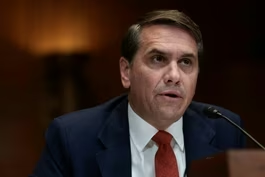
GEOFF BENNETT: On Capitol Hill today, acting Attorney General Todd Blanche defended the creation of the nearly $1.8 billion so-called anti-weaponization fund as part of that IRS settlement.
It's meant to compensate Trump supporters who say they have been unfairly treated by the U.S.
justice system.
SEN.
JACK REED (D-RI): And you're the president's consigliere.
TODD BLANCHE, Acting U.S.
Attorney General: Your perspective is completely wrong, Senator, respectfully.
SEN.
JACK REED: Well, I think the facts will prove me right.
GEOFF BENNETT: During an at times contentious Senate hearing, Blanche pledged what he called full transparency on who will receive payments.
But Democrats slammed the fund as an illegal abuse of power.
Maryland Senator Chris Van Hollen called it an illegal, corrupt self-dealing scheme that could even benefit January 6 rioters, among others.
SEN.
CHRIS VAN HOLLEN (D-MD): Yesterday you created a $1.8 billion slush fund to dole out taxpayer dollars to the president's supporters, including those who attacked this Capitol on January 6.
That is pure theft of public funds.
TODD BLANCHE: And, by the way, it is true that this is unusual.
That is true.
But it is not unprecedented.
And it was done to address something that had never happened again either.
GEOFF BENNETT: During a White House briefing, Vice President J.D.
Vance was also asked about the fund and the possibility of taxpayer money going to those convicted of January 6 and related crimes.
J.D.
VANCE, Vice President of the United States: We're just going to look at every case, case by case.
That's all I'm saying.
I'm not committing to giving anybody money or committing to giving no one money.
What I'm committing to is a legal process to review these claims and to make sure that people who were mistreated by their government get a little bit of compensation because of it.
GEOFF BENNETT: But even some top Republicans say they need more details about how this fund will work.
Senate Majority Leader John Thune told reporters today that he is -- quote -- "not a big fan."
President Trump is throwing his support behind Texas Attorney General Ken Paxton in next week's Senate run-off, rather than the Republican incumbent, John Cornyn.
In a lengthy social media post, Mr.
Trump called Paxton a true MAGA warrior and said that he "has gone through a lot, in many cases very unfairly, but he is a fighter and knows how to win."
Mr.
Trump is backing Paxton despite his numerous scandals.
He's been indicted for fraud and was impeached and later acquitted by Texas state legislators.
The winner of next week's run-off will face Democratic nominee state Representative James Talarico in November.
In California, more than 17,000 people were still under evacuation orders today, as a wildfire threatens homes northwest of Los Angeles.
The so-called Sandy Fire has now burned at least 1,300 acres in the hills above Simi Valley.
And at last check, it was only about 5 percent contained.
The blaze erupted yesterday and quickly spread due at least in part to wind gusts topping 30 miles per hour.
The cause of the fire is under investigation.
The head of the World Health Organization says he is deeply concerned about the scale and speed of the Ebola outbreak in the Democratic Republic of Congo and Uganda.
During their latest update in Geneva, authorities said there are now more than 500 suspected cases of the rare type of the disease and more than 130 suspected deaths.
Health experts and aid workers say the virus went undetected for weeks as authorities tested for another more common type of Ebola.
And that's left residents there living in fear.
LEGENDE BUHENDWA, Motor Bus Driver (through translator): I'm afraid of bringing the disease home to my family, because I spend the whole day transporting people.
I'm afraid of dying.
That is what scares me so much.
GEOFF BENNETT: The U.S.
State Department announced a fund today to establish up to 50 Ebola response clinics in the DRC and Uganda.
Americans are advised to avoid travel to affected areas, and the CDC says the risk to the U.S.
remains low.
Federal agents can no longer make arrests in and around New York City's immigration courts after a federal judge largely banned the practice from three Manhattan buildings.
In the ruling, the court wrote that while -- quote -- "There is a strong governmental interest in enforcing immigration laws, there is also a serious interest in allowing migrants to pursue asylum claims without fear of arrest."
The decision follows months of dramatic scenes in courthouse hallways as individuals were arrested as they showed up for their immigration proceedings.
But the court made clear federal agents can still make arrests if there is a threat to public safety.
The nation's largest commuter rail system is up and running again after a tentative deal was reached to settle a strike at the Long Island Railroad.
The first trains left shortly after noon today.
Before that, tens of thousands of commuters faced a second day of travel headaches.
The strike started on Saturday with workers calling for a pay raise in their long-running contract negotiations.
The walkout was the first for the LIRR since the 1990s.
The rail system serves around 250,000 riders each weekday between New York City and Long Island.
On Wall Street today, stocks pulled back further from their recent highs.
The Dow Jones industrial average fell more than 300 points on the day.
The Nasdaq gave back more than 200 points.
The S&P 500 posted its third straight loss.
Still to come on the "News Hour": a look at the thousands of children whose immigrant parents have been detained under the Trump administration; one of the world's leading historians on Cuba releases a memoir at a pivotal time for U.S.-Cuba relations; and a twist on a classic play from two Russians who left their country after the invasion of Ukraine.
The Trump administration is moving to roll back limits on some PFAS, the toxic forever chemicals found in the drinking water of millions of Americans.
The Biden era rule set the first national drinking water limits for several PFAS compounds, but industry groups argued the standards were legally flawed and too costly to meet.
EPA Administrator Lee Zeldin says the chemicals still need to be addressed, but that the previous administration overreached.
LEE ZELDIN, Environmental Protection Agency Administrator: There are two ways to act on PFAS.
You can do it the way that the last administration did, where a regulation would be rushed out the door.
Certain steps were skipped as the law had required, and water systems were giving deadlines that many of them have communicated to us that they're going to have trouble meeting.
And we left the rule open to be struck down in court.
That approach makes for a good press release, and doesn't make for cleaner water.
GEOFF BENNETT: William Brangham has been reporting on this and joins us now.
So, William, before we get into these changes, remind us what these chemicals are and why scientists are so concerned about them.
WILLIAM BRANGHAM: PFAS are these remarkably resilient, durable chemicals.
I mean, they're kind of a wonder of chemistry.
They are in dental floss and couches and Gore-Tex and nonstick pans.
They have helped revolutionize certain industries.
But they are also some of the most insidious pollutants on the planet.
We call them forever chemicals, as you mentioned, because they just do not break down out in nature, and they have spread everywhere on Earth.
I can't think of a place that they have tested and looked for them where they have not found them all over the globe.
They get into us by us eating food that has PFAS in them, by products in our own lives, and by drinking water that is contaminated with that.
I mean, it is estimated that almost all of us, humans on Earth, have PFAS building up in our bodies.
That's the concern.
GEOFF BENNETT: And the Biden administration sought to restrict the amount of these chemicals in drinking water.
We heard the EPA administrators say that, yes, this is an issue, but they still are overturning the Biden era rule.
So what's the EPA's argument?
WILLIAM BRANGHAM: They argued that the Biden administration went too far, too fast, and that, according to the Clean Water Act, they didn't follow all the appropriate procedures, and thus these rules could be struck down in court, which the industry was trying to do.
The chemical industry and associations of water municipalities have argued that the cost of filtering PFAS out of drinking water, which we can do, they argued that it was much too expensive and that the benefits were just not there for the public.
The chemistry industry has also argued that they have really reduced the use of PFAS in a lot of different products, but that certain types of PFAS are still essential to certain industries and that they have got to keep them.
GEOFF BENNETT: So, what have the supporters of the Biden era rule said in response?
WILLIAM BRANGHAM: I mean, as you can imagine, Geoff, they are livid.
They argue, yes, it might be expensive to filter chemicals out of the water, but that is a cost that the companies that polluted the water in the first place ought to be paying, and that the benefits, that, if we get reduced levels of cancer and thyroid disease and obesity and all these other health implications that are linked to PFAS, that is worth the cost.
This is how Ken Cook, who runs the Environmental Working Group, put it about this move today.
He said - - quote -- "The Trump EPA is caving to chemical industry lobbyists and water utility pressure.
And, in doing so, it is condemning millions of Americans to drink contaminated water for years to come.
The price of this decision will be paid by ordinary people in the form of more PFAS-related diseases."
The interesting thing about this, Geoff, is that the criticism is not just coming from environmental groups.
A big slice of the president's own base, the MAHA, the Make America Healthy Again, movement spearheaded by RFK Jr., they have pushed very hard to get chemicals out of our food and water.
And they have been resistant to any attempt to roll back rules about things like this.
In fact, RFK Jr.
was at this announcement with the EPA administrator yesterday.
And, at times, he sounded like the RFK Jr.
of old, the sort of champion decrying chemical contamination of our water supply.
But he and this administration argue, they will protect us from PFAS, but just not the way the Biden administration did.
That is the test.
We have yet to see how they're going to do it.
GEOFF BENNETT: William Brangham, thanks, as always, for this reporting.
Appreciate it.
WILLIAM BRANGHAM: Thanks, Geoff.
GEOFF BENNETT: Since the start of President Trump's second term, the administration has detained nearly half-a-million immigrants in the U.S.
That's according to a new report.
But the number of children they leave behind and what happens to them, most of whom are U.S.
citizens, is largely unknown.
Our White House correspondent, Liz Landers, has more -- Liz?
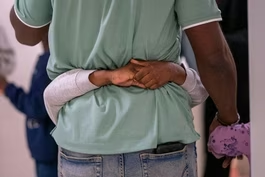
LIZ LANDERS: Geoff, that new research from the Brookings Institution finds that, by detaining 400,000 immigrants over the past 14 months, the Trump administration also stripped about 145,000 American children of at least one parent.
Data from the Department of Homeland Security calculates a much smaller number, 60,000.
Tara Watson is one of the Brookings' studies authors, and she joins us now to discuss that discrepancy and more.
Tara, thank you so much for joining us.
TARA WATSON, Senior Fellow, Brookings Institution: Glad to be here.
LIZ LANDERS: The Washington Post recently reported a story about a woman who was in the United States illegally and was deported without her toddler, Orlin Hernandez Reyes, who was a U.S.
citizen.
The child was left with a violent uncle, who allegedly murdered him.
How much information is the government collecting on cases where a U.S.
citizen child is left without their parent?
TARA WATSON: There's surprisingly little information provided by the government about the children of people who are detained or deported.
The government does produce annual statistics, but we believe those to be quite an undercount.
Probably only about half of children are recorded in that way, both because ICE doesn't always follow the directive to ask people whether they have children in the U.S., but also because immigrants don't always feel comfortable sharing that information, for fear of further enforcement against their family.
LIZ LANDERS: You mentioned ICE asking those questions.
They're supposed to ask detainees about their parental status.
Why doesn't that always happen?
TARA WATSON: I think ICE isn't really in the business of child welfare.
That's not their primary mission.
And when we're talking about citizen children who they wouldn't be doing an immigration enforcement related to, they would prefer to just move on.
And if the person that they're arresting or detaining doesn't bring up a child, they may have an incentive to not ask the question.
LIZ LANDERS: How common is it for the children to remain here when their parent does get deported?
TARA WATSON: We don't have perfect information about that.
Again, this is an area where there isn't enough transparency.
We believe that, in most cases, the children, especially the citizen children, are staying in the U.S.
with friends and family.
Unfortunately, sometimes, as in the case you mentioned earlier, there isn't a great option for a parent to leave the child with, and they end up choosing a situation that may not be great for the child in the long run.
LIZ LANDERS: Who are these citizen children that get separated from their parents?
I know you guys gathered some information about what parts of the country they're from, how old they are, the parents' country of origin that they're deported back to.
Paint that picture for us.
TARA WATSON: Sure.
So the children are all ages.
About a third of them are under age 6.
And, of course, it goes up all the way up to age 17, which is the oldest age we consider to be a child.
They're largely U.S.
citizens, as was said earlier.
And their parents come from a range of countries, but the most dominant countries are in Latin America and Central America.
LIZ LANDERS: What happens to these children when their parents are detained?
What are the welfare systems in place and what's the emotional support for these kids that supposed to be offered?
TARA WATSON: So, really, there is no system in place, which is part of what motivated us to do this study and try to better understand, at a minimum, how many children we were talking about.
The -- ICE doesn't have an obligation to provide for the welfare of those children, as long as someone is taking care of them.
The child welfare system also doesn't have an obligation to get involved unless there's an accusation of abuse or neglect.
So, really, there is no system that is looking out for these kids, making sure the placements they're in are safe.
And I think that's a problem.
LIZ LANDERS: You mentioned that there are potential gaps in the government data right now.
How confident are you in your data?
Explain this methodology.
TARA WATSON: I can explain how we came up with these estimates.
Since we didn't have numbers from the government, what we had to do is take information on the detainees, which we do have access to.
We know things like what country they're from, how old they are, whether they're male or female, whether they're married.
And then we turn to survey data.
We look at survey data of undocumented immigrants who are living in the U.S.
And we say, well, we know a certain fraction of people who have a certain age or marital status have kids, and they have a certain number of kids per parent, and so we applied those numbers to the detainee population which we do know about.
LIZ LANDERS: Why is this research necessary?
What's important for the public to understand about your findings?
TARA WATSON: I think the most important thing is that the children that we are deciding collectively to separate from a parent or both parents need to have their well-being ensured, and we don't have a system in place for that.
As a first step, the government should be providing data on how many children and what's happening to those children.
For example, some children are being put on deportation planes even as U.S.
citizens.
They're not being formally deported because they're citizens, but they may be going with their parent's request to the country of origin of the parent.
We don't have any statistics that are publicly released about this.
So the government should be sharing what they know, and they should be ensuring that the data on the children is collected, so we can make sure that the kids are in good situations.
LIZ LANDERS: Tara Watson, thanks so much for joining us.
TARA WATSON: Thanks.
GEOFF BENNETT: Only about a third of Americans now believe a four-year college degree is worth the cost.
And, increasingly, students and families are questioning it too.
As many colleges across the country face shrinking enrollments, more than 60 institutions are now offering students a faster path to graduation.
Fred de Sam Lazaro reports as part of our series Rethinking College.
FRED DE SAM LAZARO: At Johnson & Wales University in Providence, Rhode Island, signs of a typical spring are everywhere.
(CHEERING) FRED DE SAM LAZARO: The graduating class is honored as they prepare for their next stage in life.
Some students play catch on campus green space, while others, like sophomore Jadyn Stuart, begin shifts at summer jobs.
JADYN STUART, Student, Johnson & Wales University: I felt like I needed to be in hospitality, and that's kind of why I went here because I knew it's what I wanted to do.
FRED DE SAM LAZARO: Stuart, a hospitality management major, represents something entirely new at Johnson & Wales, however.
After transferring from the University of Maine last fall, Stuart became part of an inaugural class of more than 90 students now on track to graduate with a bachelor's degree in three years.
JADYN STUART: Even though it's three years, I'm still taking the classes that I need to take.
I'm still doing the work that I need to do.
And, yes, I'm taking major-specific courses with less electives, but there's still going to be specific to what I need to do in the work force.
FRED DE SAM LAZARO: Freshman Katie McPartlin is also a three-year student majoring in criminal justice.
KATIE MCPARTLIN, Student, Johnson & Wales University: None of the schools I applied to offered that, and I think it was a big factor in coming here, because I really just want to work in the field as soon as I can and get the internships and get the experience.
FRED DE SAM LAZARO: McPartlin hopes to one day work as a forensic psychologist interviewing and advocating for victims of crime.
She says, for most students who pay around $45,000 a year in tuition, there's an immediate benefit to the three-year degree.
KATIE MCPARTLIN: The most obvious and universal benefit is that you save the tuition.
And then, for myself, I think it is being able to take the classes that I want that are targeted towards criminal justice students that really help you get engaged into what you will be going into.
FRED DE SAM LAZARO: Provost Richard Wiscott designed the three-year curriculum at Johnson & Wales, a university that now serves more than 8,000 students on two campuses.
He says the idea was to start by offering three-year degrees in fields with an immediate need for qualified workers.
RICHARD WISCOTT, Provost, Johnson & Wales University: The traditional four-year model is around 120 academic credits.
We have designed our programs to be between 90 and 94 to 96 credits, but that can still be completed in six academic semesters, so three years.
FRED DE SAM LAZARO: Wiscott says the three-year model also represents a much-needed rethinking for Johnson & Wales, whose student enrollment has dropped by about a third over the last decade.
The university was also forced to lay off more than 90 employees last year.
Across the country, more than 300 colleges have closed since 2008.
RICHARD WISCOTT: Higher education is in time of crisis right now.
Public perception is lower than it's ever been.
People are struggling to find the value in a college education.
Tuition increases year after year after year.
Families can't do it anymore.
And so we have a responsibility to look at creating new ways of educating our students.
FRED DE SAM LAZARO: The degree in three is rapidly gaining acceptance in the world of higher education.
Dozens of universities across the United States are now either offering it or planning to offer the option to students.
LORI CARRELL, Chancellor, University of Minnesota Rochester: There is nothing magical about four years.
FRED DE SAM LAZARO: Chancellor Lori Carrell says the three-year degree was rolled out during the pandemic at the University of Minnesota Rochester.
LORI CARRELL: Look at the statistics across the country of how many students take six years to do the four-year, of course, making it way more expensive.
And we cannot say that we're being successful.
FRED DE SAM LAZARO: This campus, which opened in 2009, has created a pipeline for the rapidly growing Mayo Clinic.
Half of all graduates across health care fields begin their careers here.
Its 1,100 students get paid internships and training alongside leading medical professionals, all while completing their undergraduate degrees one year earlier.
What did you presumably cut out and how did you compensate for that?
LORI CARRELL: Nothing was cut out, but the design was to use summer to embed paid internship that was a yearlong and have that supported in such a way that it was credit-bearing and to teach the courses in seven-week blocks, rather than the traditional 14-week semester.
FRED DE SAM LAZARO: That means three-year students like Vaida Goplin still graduate with the traditional 120 credits.
VAIDA GOPLIN, Student, University of Minnesota Rochester: More students would come to these four-year universities if these three-year programs were offered or even advertised a little bit more, just because you do save a whole year.
And you save a whole year of time and money as well.
FRED DE SAM LAZARO: Goplin's three-year degree, which she completed this month, also guarantees her a spot in a master's program at UMR to become a physician's assistant, she hopes at the Mayo Clinic.
VAIDA GOPLIN: I am a big planner.
And to have kind of that peace of mind that I would be accepted into P.A.
school right out of high school was, like, just an absolute selling point for me.
VISHNURAM BALASUBRAMANI, Student, University of Minnesota Rochester: I think I will miss the flexibility of being a college student.
FRED DE SAM LAZARO: Vishnuram Balasubramani is about to graduate after three years, and he already has a paid job as a research technologist at Mayo.
He plans to eventually go to medical school.
And yet, he says, there are drawbacks to the faster pace.
VISHNURAM BALASUBRAMANI: I do wish I had the opportunity to stay for much longer.
I find being a college student opens up a lot of opportunities.
And so being on a three-year path kind of puts you on a limited time mode, and so you kind of have to suck up as many opportunities as possible.
And so I think that's a disadvantage of graduating in three years, which I have recognized now.
FRED DE SAM LAZARO: Critics also warn that losing a year cuts classes designed to expand students' world views and leaves them ill-prepared for a job market now being reshaped by artificial intelligence.
But back at Johnson & Wales, provost Richard Wiscott is optimistic, even though he admits questions still remain about how both employers and graduate schools will view three-year degrees.
RICHARD WISCOTT: I'm the first one to admit we still need to collect the evidence to make sure that we are adequately preparing these students.
But we have done the right planning and the right thinking, and everybody had enough positive things to say about this that it gave us even more energy to move forward.
FRED DE SAM LAZARO: Moving forward, Wiscott says he expects Johnson & Wales to start offering more students in more majors the opportunity to pursue a three-year degree.
But that doesn't mean he believes it'll be a silver bullet for all students, especially ones who might need more time in college to decide on a career path.
RICHARD WISCOTT: I am not advocating that three-year degrees should replace all four-year degrees.
I think there is enough space in the marketplace for both options.
But there's a whole other group of students who are very focused, who know what they want to do at their life, who don't want to spend the time exploring.
They want to jump right into their chosen field of study, get as much experience as possible, and be prepared to hit the job market running.
FRED DE SAM LAZARO: A volatile job market that universities are trying to keep up with, as they determine how best and how long to prepare their students.
For the "PBS News Hour," I'm Fred de Sam Lazaro.
GEOFF BENNETT: Historian and Pulitzer Prize winner Ada Ferrer has spent her career exploring history, identity, and memory.
In her new book, "Keeper of My Kin," she turns inward, tracing her own family story across generations, while examining the larger forces that shaped Cuba and the U.S.
alike.
I recently spoke with her about her family history and the stories that families choose to carry forward.
Ada Ferrer, welcome to the "News Hour."
ADA FERRER, Author, "Keeper of My Kin: Memoir of an Immigrant Daughter": Well, it's great to be here, Geoff.
GEOFF BENNETT: This book begins with this image you paint of your mother holding you in her arms as she leaves Cuba.
This was in 1963.
But she also leaves behind your brother, Poly.
And you write that your mother told and retold this migration story for decades, but she omitted that central fact.
Why do you think silence became such a key factor in your family history?
ADA FERRER: Yes.
Well, it's strange.
My mother was a storyteller.
She'd love telling stories and she would repeat them over and over again.
So the story of our leaving Cuba is -- the way I tell it in the book, the struggle at the airport, her heels, me in her arms weighing her down, the person in Mexico who helped us arriving in the Freedom Tower.
It goes on and on.
And yet in that narration, he was never there.
On some level, it makes no sense, because my brother, Poly, was never a secret.
He was always a part of our life.
I -- my mother used to send him presents.
She used to read me his letters.
I used to kiss his picture.
He was always there as an absence.
So it really made no sense for her to leave him out of the story, but I think it was her own guilt about having left him that meant that, when she tried to tell this story of her departure, her departure with me, it was a story about us, the two of us facing the world.
And to tell the story that way, adding my brother left behind just kind of interrupted it a little too much.
GEOFF BENNETT: And the most devastating part of that story is that she never said goodbye.
ADA FERRER: Yes.
GEOFF BENNETT: For folks who haven't read this book yet, help us understand why he didn't make the trip.
ADA FERRER: Well, my brother was 9 years old when we left, and he was her son from her first marriage.
So, Poly's father was a member of the Revolutionary Police.
This is year four of the Cuban Revolution led by Fidel Castro, and he didn't think it would look good for his son to leave for the U.S.
And so he denied permission.
And I think he was also kind of an vindictive man and just didn't want my mother to be happy.
And so he refused to sign the paperwork that was needed for Poly to get his passport and travel with us.
And everyone thought, my mother thought, my grandmother thought, my aunts thought, my father who left before we did and was already in New York, we all thought that when my mother and I left that Poly's father would see that he should give permission and that he would relent.
But he never did.
And so the separation kind of stretched on and on.
And then in terms of her not saying goodbye, I didn't -- that part of the story, I didn't learn until I was a little older.
But, for me, it was kind of crushing.
I just couldn't -- I couldn't imagine it.
And it just made it hurt that much more.
But then, as a historian, as a person, I always try to put myself in other people's shoes.
It was a different time.
GEOFF BENNETT: You mentioned that you're a historian.
I would add that you're one of the country's leading historians of Cuba.
What did it mean as you were writing this book, writing this memoir, putting the historian's lens on your own family?
You exist in this sort of dual context of historian and daughter.
What did that -- how did you negotiate that?
ADA FERRER: Yes.
There's a way in which I have been doing it all my life, or all my writing life, certainly.
I became a historian decades ago.
I have always worked on Cuba.
My decision to work on Cuba had everything to do with who I am and the story of our family and where we came from.
So I have always been a historian who feels herself and feels her family to be part of the story.
My family was a very humble family, and our story was made by history.
Everything that happened in our family, the migration, the family separation, unfolded in this broader historical context of the Cuban Revolution, of U.S.-Cuban relations, of U.S.
immigration policy.
And all those things, which we tend to think of in abstract geopolitical and bird's-eye kind of view, all those things have an enormous impact on families day to day.
GEOFF BENNETT: You know, what struck me about your story, is the way your mother preserved letters and photographs and greeting cards, I mean, small scraps of paper.
ADA FERRER: Right.
GEOFF BENNETT: This living archive for you.
Do you think that that was -- it struck me as an act of resistance against erasure?
ADA FERRER: Yes, yes, absolutely.
I mean, I think that's the perfect way to put it.
And she was doing it her whole life.
And then after she died, I mean, I knew she saved things, but the way she saved things was a complete surprise.
So she actually labeled artifacts around the house with masking tape on the bottom.
But the main thing that she saved and the thing that was most important for this book is that she -- and I didn't know these existed until after both my parents had died.
The main thing she saved was the letters that my brother had written to her after we left.
So we left on April 27, 1963.
His first letter is dated May 4, 1963.
And so these are letters written by my brother Poly.
He's a little boy., His handwriting's not good.
He makes lots of spelling errors, very little punctuation.
And he's writing her, writing to her about his life, about the family, about being left.
But he doesn't write -- it's interesting.
He doesn't write with a lot of emotion or a lot of palpable emotion.
But you read the letters carefully and the emotion is there.
So he will say things like -- there was one that just really got to me.
He said: "Mommy, if you only knew how happy I get when I receive a letter from there.
It makes me so happy.
I get so happy that sometimes it makes me sad."
He's a 9-, 10-year-old boy and the weeks are going by and the months are going by, and there's no re-encounter.
And those were brutal to read.
GEOFF BENNETT: The title of this book, "Keeper of My Kin," it feels like a declaration of responsibility.
Did you feel that you owed your family something?
ADA FERRER: Yes, in some ways, I feel like I owe them everything.
So it's interesting.
My mother saved all these things.
I think she knew -- I mean, she was saving it for all of us, but I think she always knew that I would do something with it.
I was always asking her questions.
She would roll her eyes.
She knew what it was about.
My father -- I talk about this in the book.
My parents both had sixth grade educations, right?
They both grew up in the countryside.
They came here and she worked in a clothing factory.
He worked as a short-order cook in a Manhattan hotel.
In his '70s, my father began to write.
And he wrote and he wrote and he wrote.
And he wrote letters to Fidel Castro and Latin American presidents and Katie Couric and George Bush and Bill Clinton.
You name it.
He just -- he wrote poems.
He wrote all kinds of things.
But I would see all the papers kind of get -- the pile of papers get bigger and bigger.
And I always said to him, you can't throw those papers out.
Those papers are mine.
No one threw them out.
I think they always knew that I would take those papers, that I would do something with them, at the very least that I would read them, you know?
GEOFF BENNETT: And write a book like this.
ADA FERRER: And write -- yes, I'm not sure about that.
(LAUGHTER) GEOFF BENNETT: I read a lot of memoirs in this job.
And this one, this is -- it's a triumph.
Congratulations.
ADA FERRER: Thank you.
Thank you.
GEOFF BENNETT: And thank you for speaking with me about it.
ADA FERRER: Yes, my pleasure.
GEOFF BENNETT: The book is "Keeper of My Kin: Memoir of an Immigrant Daughter."
Ada Ferrer, a real pleasure to speak with you.
ADA FERRER: Yes, great to be here.
Thank you.
GEOFF BENNETT: Now a different kind of migration story, one involving theater and two Russians who left their country after the invasion of Ukraine and are now rebuilding their lives and careers in the U.S.
Senior arts correspondent Jeffrey Brown reports on a recent production in New York for our Art in Action series exploring how art and democracy shape one another as part of our Canvas coverage.
JEFFREY BROWN: It's a play within a play, with cabaret humor, even slapstick, alongside the drama of loss of friends, family and country.
ALEXANDER MOLOCHNIKOV, Creator and Director, "Seagull: True Story": And I'm very thankful to all of you for allowing me to tell the personal, sometimes even dramatic story in a playful way.
JEFFREY BROWN: For Alexander Molochnikov, the creator and director of "Seagull: True Story," this is personal.
It's based on his own story.
What did you most want to bring out in this play?
ALEXANDER MOLOCHNIKOV: I think the value of art, the value of art as air and water for some people, and not only for people who make it, but sometimes for people who watch it.
With choosing between food and art, anybody would choose food if we are dying of hunger.
But, for me, I literally realized through this experience how, without doing theater, I start kind of dying inside.
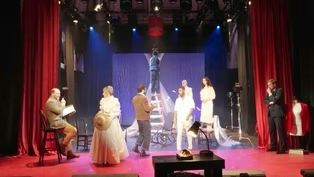
JEFFREY BROWN: "Seagull: True Story," recently at New York's Public Theater, plays off Anton Chekhov's classic "The Seagull" and tells of a young Russian theater director named Kon, Molochnikov's alter ego, about to achieve his dream of directing a play at the world-renowned Moscow Art Theater, when a very different kind of drama intervenes, Russia's invasion of Ukraine in February 2022.
ALEXANDER MOLOCHNIKOV: In the beginning, you don't think it's forever.
Or maybe some people understood.
I didn't.
JEFFREY BROWN: Four years later, Molochnikov, who in his 20s had already directed productions at leading Moscow theaters, including the Bolshoi... MAN: Happy birthday!
JEFFREY BROWN: ... celebrated his 34th birthday with the cast of "Seagull" in New York, where he now lives and works.
ALEXANDER MOLOCHNIKOV: Oh, wow.
WOMAN: Make a wish.
SOFIA KAPKOV, Producer, "Seagull: True Story": I had a team of 40 people who was working for me.
I signed all documents and I left.
JEFFREY BROWN: Also a new New Yorker, the producer of "Seagull: True Story," 47-year-old Sofia Kapkov.
SOFIA KAPKOV: I came here without any plan, so I stayed with my friend.
I told him I'm going to be there for a week.
I ended up for a month.
And then after a month, I realized that's it.
That life is gone.
JEFFREY BROWN: That former life included heading her own production company that put on prominent contemporary theater and dance performances in Russia and abroad, not overtly political art, but she says a form of activism nonetheless.
SOFIA KAPKOV: I wanted to open this window to the freedom to show them, OK, now the world exists.
There is different type of art, for example, or different forms of art.
And in a way, this is my type of activism to show something that is relevant, that it's timely.
JEFFREY BROWN: Russia's invasion of Ukraine ended that.
She left within days, taking her two younger children, joining an older daughter who was studying at NYU.
SOFIA KAPKOV: I had a nice life back then.
I had a comfortable life.
I have home, friends, projects, successful business.
But I had my doubts in my country.
I woke up in the reality that we are killing our neighbors.
For me, it was obvious I need to live for the sake of my kids.
I don't want them to get used to the idea that war is normal.
And it's a very hard decision, because you're not just changing your life from one comfortable life to less comfortable.
You're changing the destiny of your kids.
It's a very big responsibility.
JEFFREY BROWN: Huge changes, big struggles documented in a memoir titled "Arts Hustler: A Story of Resilience," along with some advantages, including having international experience and contacts.
And within two years, she had co-produced "Our Class," a play set in Poland during World War II about neighbors turning on neighbors.
It had successful runs in New York, Boston, and most recently San Francisco.
In prewar Moscow, Alexander Molochnikov had demonstrated in support of prominent Russian dissident and opposition leader Alexei Navalny.
And after the invasion of Ukraine, he registered his protest with a series of anti-war posts on social media and danced to Ukrainian music in the Russian version of "Dancing With the Stars."
His name was taken off production credits and he says he received death threats.
In August 2022, he left Russia, enrolling in a graduate film course at Columbia University.
From that came a short film titled "Extremist" based on the true story of a young Russian woman whose public protest of the Ukraine war, putting anti-war and anti-Putin messages on grocery items, led to her imprisonment.
The film would win various international awards and was also short-listed for an Academy Award for best live-action short.
Today, Molochnikov can see the positive impact of the upheaval he went through.
ALEXANDER MOLOCHNIKOV: Because collapse motivates you to rebuild and really develop as a person.
I didn't really want it to happen again.
We just, like, built something here.
I would love a few more years to build more.
But the feeling of apocalypse -- and, of course, I want to say that, like, this my little art apocalypse is nothing compared to what people lost in Ukraine.
But, still, you lose your career that you've been building for 10 years.
It's healthy sometimes to lose it.
JEFFREY BROWN: The second half of "Seagull: True Story" is partly based on Molochnikov's experience after coming to the U.S., including the overt commercialism of the theater world here and what he says were different kinds of restrictions on language and expression he encountered.
And the play includes a moment amid the crackdown in Russia in which one character asked the American audience: ACTOR: And something like could never happen in America, right?
ACTOR: Right?
ALEXANDER MOLOCHNIKOV: Right?
And there's always -- it's interesting.
It's not a laugh.
it's not a clap.
Everyone's like, oh.
SOFIA KAPKOV: It just is a concern.
ALEXANDER MOLOCHNIKOV: I hope that that this play, maybe not in everyone, but in somebody, it would leave some thought or some concern about what's going on in the U.S.
today, and I hear it a lot.
And many people who saw it a year ago, now they're like, wow, this is about Iran now.
JEFFREY BROWN: Molochnikov and Kapkov say New York is their home now.
Both have become U.S.
citizens and aim to further build lives here with their artistic work leading the way.
SOFIA KAPKOV: Theater is very similar to democracy.
It should be a free space.
There are people allowed to ask any questions.
I believe in democracy, and I love this country, and I have hope for America.
I'm American now, right?
I don't have any hope for Russia, unfortunately.
And what Putin did, he destroyed life of many generations.
I don't like a lot of stuff that's going on here in America, but America is even younger than the Bolshoi Theatre in Moscow.
JEFFREY BROWN: America, the country.
SOFIA KAPKOV: America, the country, United States.
JEFFREY BROWN: Good perspective from the theater world to today's political realities.
For the "PBS News Hour," I'm Jeffrey Brown in New York.
GEOFF BENNETT: And that's the "News Hour" for tonight.
I'm Geoff Bennett.
For all of us here at the "PBS News Hour," thanks for spending part of your evening with us.
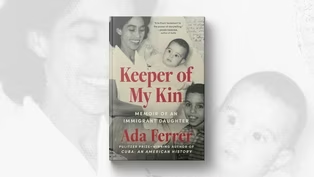 New
NewAda Ferrer reflects on family history, forces shaping Cuba
Video has Closed Captions
Ada Ferrer reflects on family history and forces shaping Cuba and the U.S. in new memoir (8m 49s)
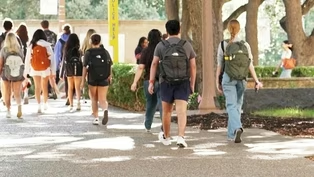 New
NewDegree in three: More colleges speed up graduation timelines
Video has Closed Captions
Degree in three: Why more colleges are speeding up graduation timelines (8m 14s)
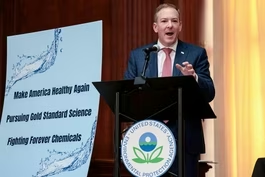 New
NewEPA moves to roll back limits on PFAS in drinking water
Video has Closed Captions
Trump administration moves to roll back limits on forever chemicals in drinking water (4m 48s)
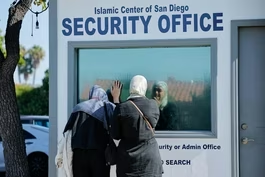 New
NewMosque attack heightens fears as anti-Islam rhetoric rises
Video has Closed Captions
San Diego mosque attack heightens fears as anti-Islam rhetoric rises in U.S. (9m)
 New
NewNews Wrap: Government to drop tax claims and audits of Trump
Video has Closed Captions
News Wrap: Government to drop tax claims and audits of Trump (8m 5s)
 New
NewRussian exiles stage fresh take on classic play in U.S.
Video has Closed Captions
Russians who fled after Ukraine invasion stage fresh take on classic play in U.S. (7m 34s)
 New
NewWhat happens to children when parents are detained by ICE
Video has Closed Captions
What happens to children when immigrant parents are detained by ICE (5m 49s)
Providing Support for PBS.org
Learn Moreabout PBS online sponsorship
- News and Public Affairs

Today's top journalists discuss Washington's current political events and public affairs.

- News and Public Affairs

FRONTLINE is investigative journalism that questions, explains and changes our world.












Support for PBS provided by:
Major corporate funding for the PBS News Hour is provided by BDO, BNSF, Consumer Cellular, American Cruise Lines, and Raymond James. Funding for the PBS NewsHour Weekend is provided by...