
June 3, 2024 - PBS NewsHour full episode
6/3/2024 | 57m 46sVideo has Closed Captions
June 3, 2024 - PBS NewsHour full episode
June 3, 2024 - PBS NewsHour full episode
Problems playing video? | Closed Captioning Feedback
Problems playing video? | Closed Captioning Feedback
Major corporate funding for the PBS News Hour is provided by BDO, BNSF, Consumer Cellular, American Cruise Lines, and Raymond James. Funding for the PBS NewsHour Weekend is provided by...
Support provided by:

June 3, 2024 - PBS NewsHour full episode
6/3/2024 | 57m 46sVideo has Closed Captions
June 3, 2024 - PBS NewsHour full episode
Problems playing video? | Closed Captioning Feedback
How to Watch PBS News Hour
PBS News Hour is available to stream on pbs.org and the free PBS App, available on iPhone, Apple TV, Android TV, Android smartphones, Amazon Fire TV, Amazon Fire Tablet, Roku, Samsung Smart TV, and Vizio.
Providing Support for PBS.org
Learn Moreabout PBS online sponsorshipGEOFF BENNETT: Good evening.
I'm Geoff Bennett.
AMNA NAWAZ: And I'm Amna Nawaz.
On the "NewsHour" tonight: Claudia Sheinbaum becomes the first woman to win Mexico's presidential election.
What that means for U.S. relations.
GEOFF BENNETT: A jury is selected in Delaware in the federal gun trial of President Biden's son, Hunter.
AMNA NAWAZ: And Dr. Anthony Fauci is grilled by House Republicans over the origins of and his response to COVID-19.
DR. ANTHONY FAUCI, Former Chief Medical Adviser to President Biden: I don't think the concept of there being a lab leak is inherently a conspiracy theory.
(BREAK) AMNA NAWAZ: Welcome to the "NewsHour."
Israel has confirmed the death of four more hostages that were taken by Hamas on October 7.
GEOFF BENNETT: Israel's military says the men were killed in the Gaza City of Khan Yunis while its forces were operating there earlier this year.
They have been identified as Amiram Cooper, Yoram Metzger, Haim Peri, and Nadav Popplewell.
Three of them had appeared in a hostage video last December pleading for their release.
AMNA NAWAZ: The cause of death is still under investigation.
And it comes as mediators wait for word from Hamas on a three-phase cease-fire proposal announced by President Biden on Friday.
State Department spokesperson Matthew Miller said today the ball is in Hamas court.
MATTHEW MILLER, State Department Spokesman: If you look at the major elements of this proposal, they are nearly identical to the major elements of the proposal that Hamas submitted several weeks ago.
This is a serious enough proposal that Hamas should just accept it, but if there need to be further negotiations, we think those are all imminently bridgeable if - - and this is the if -- if Hamas wants a deal.
AMNA NAWAZ: Meantime, in Central Gaza, families mourned the deaths of 11 people who were killed overnight in two separate Israeli airstrikes on refugee camps.
Three children were reportedly among the dead.
Ukraine's President Volodymyr Zelenskyy made a surprise visit to the Philippines today as part of a rare trip to Asia.
He's trying to drum up support for an upcoming peace conference on the war in Ukraine scheduled for mid-June in Switzerland.
Philippine President Ferdinand Marcos Jr. rolled out the red carpet for Zelenskyy and pledged to join the summit.
Zelenskyy announced that Ukraine would open an embassy in Manila, deepening ties between the countries.
VOLODYMYR ZELENSKYY, Ukrainian President: We are very thankful to be in your country, and which supports Ukraine, our territorial integrity and sovereignty.
Thank you so much for your big word and clear position about us, about this Russian occupation of our territories.
AMNA NAWAZ: Russia has not been invited to the Switzerland summit, and China says it won't attend either.
Vice President Kamala Harris will represent the United States.
President Biden is expected to issue an executive order tomorrow that would significantly limit the entry of migrants at the U.S.-Mexico border.
The "NewsHour" has learned the order would shut down asylum requests when the number of daily encounters between ports of entry reaches 2,500.
The border would then reopen only when that number falls to 1,500.
This effectively means that the border would be closed immediately, as current levels are above 2,500.
Biden is expected to announce the measure at the White House on Tuesday.
He will be joined by mayors of border cities who've been invited for the event.
A Georgia appeals court has set October 4 as the tentative date for a hearing on efforts to remove Fani Willis from Donald Trump's Georgia election case.
The Fulton County district attorney was allowed to stay on the case in March after admitting to a romantic relationship with a special prosecutor she hired.
Trump lawyers have appealed that decision.
The timing of the vote means that Trump won't face trial in Georgia before the November election.
Congresswoman Sheila Jackson Lee has announced that she has pancreatic cancer.
The Texas Democrat acknowledged in a statement that the -- quote -- "road ahead will not be easy."
But she added -- quote -- "I'm confident that my doctors have developed the best possible plan to target my specific disease."
The 74-year-old says she may miss some time in Congress while getting treatment, but aims to be present for votes.
Jackson Lee is seeking a 16th term in Congress.
Firefighters in California are reining in the state's largest wildfire of the year so far, now containing 75 percent of the blaze.
Over the weekend, the Corral Fire burned more than 22 square miles between San Francisco Bay and the Central Valley.
Thousands were ordered to evacuate, though they have since been allowed to return home.
One house was destroyed and two people were injured.
Firefighters hope to make more progress before a heat wave is expected to arrive tomorrow.
Toyota's chairman has apologized for widespread cheating on vehicle certification tests.
An internal investigation ordered by Japan's government found the company manipulated data in collision tests, airbag inflation tests, and more.
The automaker is suspending production of three of the affected models, the Corolla Fielder, the Corolla Axio and Yaris Cross.
The company says the findings do not affect the safety of vehicles already on the road.
At a press conference today, Toyota's chairman acknowledged that the correct certification process had not been followed.
AKIO TOYODA, President and CEO, Toyota (through translator): As the person responsible for the Toyota Group, I would like to sincerely apologize to our customers, car enthusiasts and all stakeholders for the problems that have occurred within the group.
I am truly sorry.
AMNA NAWAZ: Toyota's rival Mazda reported similar irregularities with its testing today and suspended production of two of its models.
CEOs at the largest publicly traded companies in the U.S. saw a healthy bump in pay raise last year.
That's according to data analyzed for the Associated Press.
The results found that the median pay package for CEOs rose to $16.3 million in 2023.
That is a 12.6 percent gain from the year before.
And it is far more than the average private sector worker, who saw a 4.1 percent bump.
One additional note from the survey.
Of the 341 CEOs surveyed, only 25 were women.
And on Wall Street today, stocks ended mixed after reports showed that U.S. manufacturing activity slowed for the second straight month in May.
The Dow Jones industrial average slipped 115 points to close at 38571.
The nest that gained 93 points.
And the S&P 500 tacked on five.
And the long-abandoned Michigan Central Train Station in Detroit has been given a new life.
The building fell into disrepair after the last train pulled out in 1988.
Many saw it as symbol of the Motor City's decline.
Today, it has been reborn thanks to a six-year multimillion-dollar renovation.
But, instead of trains, the building will be a center for technology as part of Ford Motor's new Mobility Innovation District.
Still to come on the "NewsHour": Tamara Keith and Amy Walter break down the latest political headlines; a new exhibit chronicles the prolific career of artist Michael Lindsay-Hogg; and a first-of-its-kind medical school for Native American doctors graduates its inaugural class GEOFF BENNETT: Mexico made history yesterday, electing its first female president and first president of Jewish heritage.
Claudia Sheinbaum won in a landslide, with more than 58 percent of the vote.
She will face many challenges as president, including security, organized crime, immigration, and the continuing, at times tense, relationship with the U.S. Pamela Starr is a professor at the University of Southern California, and a senior adviser at Monarch Global Strategies.
That's a business consultancy focused on Mexico and Latin America.
Thanks so much for being with us.
PAMELA STARR, University of Southern California: It's a pleasure to be with you this evening.
GEOFF BENNETT: So how do you view the significance of this moment, Mexico electing its first female president?
PAMELA STARR: I think it's enormously significant, especially for young women who are of Mexican heritage or living in Mexico.
It's extraordinarily important to see someone in a position of importance that is the same gender of you.
But at the same time, I don't suspect that Claudia Sheinbaum will be a feminist president, although she does self-identify as a feminist.
She's a traditional leftist.
And by that, I mean, she focuses on lifting up all of those who are in this lower socioeconomic strata and not focusing on individual minorities in society, or, in this case, women, who are the largest majority in Mexico, the largest segment of the population.
I do, however, think she's going to put a little more attention into violence against women, which Lopez Obrador didn't, the former president didn't give much attention to, and potentially to things like day care and such.
GEOFF BENNETT: Well, as we said, she won with a sweeping mandate, more than 58 percent of the vote.
Why was she so successful?
What was it about her, her background, her overall approach that seemed to resonate with the Mexican voting public?
PAMELA STARR: More than her, it's what she stands for.
She was chosen by Lopez Obrador, handpicked to be his successor.
The campaign was run as a continuation of Lopez Obrador's presidency.
As she said, she's going to build the second level on the transformation of Mexico that Lopez Obrador initiated.
So it wasn't so much a vote for Claudia Sheinbaum as a vote for continuity in Mexican politics.
GEOFF BENNETT: Let's return to the issue of violence, because these elections in Mexico have been historic for another reason.
They have been the most violent.
In the run-up to the elections, more than 30 candidates were assassinated.
Mexico has one of the highest homicide rates in the world.
What is she aiming to do to address it?
PAMELA STARR: Her overall proposal is try to adapt the strategies she implemented in Mexico City, which did significantly reduce crime and violence in the city, to a national situation.
In Mexico City, she increased the wages and working conditions for the police.
She used greater intelligence in police activities, and she more very carefully collaborated or guaranteed collaboration between law enforcement and the attorney general's office.
She will try to do something similar at the federal level.
That said, she's not going to return to civilian policing with regard to federal criminal problems, like organized crime.
She's going to rely on the militarized National Guard, although she is going to try to expand its size, increase working conditions and wages, and increase their use of intelligence and collaboration with the attorney general's office.
GEOFF BENNETT: What about immigration, which is a major issue in this election?
How does she plan to coordinate with the U.S., and has she articulated a plan for how to deal with the migrants who make their way through Mexico toward the U.S.?
PAMELA STARR: She didn't talk about -- much about foreign policy in the campaign.
Indeed, there was a debate segment that was focused on foreign policy, and really none of the candidates spoke a great deal about foreign policy.
In terms of migration, I suspect she will continue Lopez Obrador's strategy of trying to cooperate with the United States while protecting Mexican sovereignty, knowing that cooperating with the United States generates the goodwill of the U.S. administration, and gives Mexico more freedom of action areas of greater importance to Mexico like domestic politics.
GEOFF BENNETT: Pamela Starr, thanks so much for being with us.
We appreciate your insights.
PAMELA STARR: It was my pleasure.
AMNA NAWAZ: For the first time in U.S. history, the child of a sitting president is on trial.
President Biden's son Hunter Biden is facing federal charges related to his purchase and possession of a gun.
Separately, Hunter Biden faces several charges that he allegedly dodged more than $1.4 million in taxes.
The president did not attend court, where jury selection began today, but he did issue this statement, saying: "I am the president, but I'm also a dad.
Jill and I love our son, and we're so proud of the man he is today.
Hunter's resilience in the face of adversity and the strength he's brought to his recovery are inspiring to us. "
NPR justice correspondent Ryan Lucas was in the Wilmington, Delaware, courtroom today, and he joins us now.
Ryan, it's good to see you.
So let's just remind folks about the charges here.
Anyone using drugs or struggling with addiction is barred from buying or owning a gun.
Hunter Biden denied that he was a -- quote -- "unlawful user or addict" on his application to buy a gun back in 2018, but he's been open about his addiction struggles at that time.
So is this sort of an open-and-shut case?
RYAN LUCAS, Justice Correspondent, NPR: Well, certainly, the government thinks that it's an open-and-shut case.
They say that Hunter Biden, when he went to purchase a gun in October of 2018, was addicted to crack cocaine and alcohol, and then he lied about that on standard background check forms that you have to fill out when you purchase a gun.
So, in the government's perspective, this is very much an open-and-shut case.
Now, Hunter's attorneys certainly feel that it is not an open-and-shut case.
For them, they say that this is far more complicated.
They say, have said in filings, at least, that Hunter had completed an 11-day rehab program around the time that this all went down.
So they say that it is logical from his perspective that perhaps he didn't understand what a drug addict or drug user meant on that form and that he could think that he was not using drugs at that time.
Judge Maryellen Noreika has kind of boxed that argument into a degree by saying that federal prosecutors do not need to prove that Hunter Biden was actively using drugs when he was purchasing the gun.
But, again, this is very much something that's going to be up to the jury to decide based on the evidence that the government presents in the case.
AMNA NAWAZ: So, as we mentioned, jury selection began and ended today.
Tell us what we should know about that jury and what stood out to you about the selection process?
RYAN LUCAS: Well, the process moved very quickly.
It was actually less than a full day, and the judge was able to impanel this jury of 12 jurors, four alternates.
It is an even mix, six men, six women.
It's a majority-Black jury.
What was really interesting over the course of the jury selection process was, one, that several of the potential jurors said that Wilmington and Delaware generally is a small place.
There were several folks who had known the Biden -- the Biden family, whether it be Joe Biden, Jill Biden, or Hunter himself, or his late brother.
And there was also the issue of a lot of potential jurors had family or friends who had struggled with addiction.
There was one potential juror who said they had a friend who died of a heroin overdose.
So this is - - some of the issues that are very much central to this case are things that people in the community know and have experienced.
That said, the judge and both sides were able to whittle this jury pool down.
And all the jurors who ended up being impaneled were individuals who said that they could set aside their personal experiences, as well as their knowledge of the case, and judge it based on the facts and the evidence as they're presented in the courtroom.
AMNA NAWAZ: So, Ryan, walk us through the timeline ahead now.
What do we expect to happen next?
And, also, what possible penalty could Hunter Biden face here, if convicted?
RYAN LUCAS: Well, we will have opening statements tomorrow morning from both sides.
Then I believe that the government will call its first witness, which is expected to be an FBI agent who worked on this investigation into Hunter Biden.
As for penalties, in theory, up to 25 years is the maximum sentence for Hunter Biden in this case.
There are two charges that carry a maximum of 10 years and one charge that carries a five-year maximum sentence.
That said, Hunter Biden has no known criminal history.
He's a first-time offender.
So that maximum sentence is most likely not what he would end up being seen.
The sentencing guidelines would be much lower.
And, ultimately, it's going to be up to the judge to decide, if he is convicted, what the sentence would be.
AMNA NAWAZ: In 30 seconds or so I have left, do we expect Hunter Biden himself or any Biden to take the stand?
RYAN LUCAS: There's no word on whether Hunter Biden himself would testify, but prosecutors have said that they do expect to call Hunter Biden's ex-wife, Katherine (sic) Buhle, as well as Beau's widow, Hallie Biden, who Hunter Biden was involved with romantically at the time that this all went down in 2018.
So this is a case that is going to dig up some dark parts of Hunter Biden's life, his struggles with addiction, and certainly how that affected the Biden family.
AMNA NAWAZ: That is NPR's justice correspondent, Ryan Lucas, joining us from Delaware tonight.
Ryan, thank you.
Good to see you.
RYAN LUCAS: Thank you.
GEOFF BENNETT: The 2024 presidential election is now in unknown territory, with Donald Trump, the first former American president and first major party presumptive nominee found guilty of a felony.
Our Lisa Desjardins takes a closer look at the reaction in recent days.
MAN: Forty-five.
LISA DESJARDINS: The visuals certainly were clear.
Saturday, in New Jersey, former President Donald Trump strode into a match for the Ultimate Fighting Championship, watching mixed martial arts, a combat sport known for muscle and bloodshed.
This was his first public appearance after being found guilty of nearly three dozen felonies.
The crowd whooped it up, but, from Trump, the signal was serious and provocative.
Then, in a weekend interview with "FOX & Friends": DONALD TRUMP, Former President of the United States (R) and Current U.S. Presidential Candidate: You know, my revenge will be success.
And I mean that.
But it's awfully hard when you see what they have done.
These people are so evil.
LISA DESJARDINS: He lit another match over his upcoming sentencing.
QUESTION: The judge could decide to say house arrest or even jail?
How do you face what that could look like?
DONALD TRUMP: I'm OK with it.
LISA DESJARDINS: But, he warned: DONALD TRUMP: I think it would be tough for the public to take.
At a certain point, there's a breaking point.
LISA DESJARDINS: It was not his only warning shot.
Trump also said this about top Pentagon generals.
DONALD TRUMP: They want there to be woke.
But these guys aren't meant for woke.
I would fire them.
You can't have woke military.
LISA DESJARDINS: As Trump takes swings, his supporters are showering him with big dollars, $70 million fund-raised in the 48 hours after last week's verdict, according to the Republican National Committee.
Republicans in Congress now or who hope to be also seem eager to show allegiance and win base points for themselves.
In a letter, eight Senate Republicans vowed to block major bills and President Biden's nominees, saying -- quote -- "We are unwilling to aid and abet this White House in its project to tear this country apart."
In Montana: NARRATOR: It's lawfare, a state-sponsored political persecution led by Joe Biden and the radical left.
They want to throw Trump in jail.
LISA DESJARDINS: In a key U.S. Senate race, the first ad about the conviction from Republican hopeful Tim Sheehy, who repeated Trump's charges and lack of direct proof that his conviction was unfair.
But the question is still about Donald Trump, with events in Phoenix and Las Vegas later this week and which punches he throws next.
For the "PBS NewsHour," I'm Lisa Desjardins.
GEOFF BENNETT: For analysis of the political fallout to the Trump verdict and more, we're joined by our Politics Monday duo.
That's Tamara Keith of NPR and Amy Walter of the Cook Political Report With Amy Walter.
Great to see you both, as always.
So we have just seen the Republican strategy for dealing with Donald Trump's guilty conviction, discredit the process, discredit the outcome.
But, Tam, there seems to be something of a tactical disagreement among Democrats over just how much to lean in and how much to use this as a political cudgel.
Take us inside the thinking among the party.
TAMARA KEITH, National Public Radio: Yes.
So I have spoken to people on the Biden campaign, and they are in the camp of don't lean in too far, as in this is not their whole campaign.
Donald Trump, convicted felon, is not going to solve all of their problems.
They still need to run a campaign.
And the way they see it is, this is one of the -- one of the proof points in the case that they intend to make why Biden should be elected and Trump should not be elected.
But they don't see it as the key to their case.
And I think, based on very early polling and everything else, there's a reason it shouldn't be the key to their case.
And they know that they have a lot of work.
This is going to be a very close campaign.
And it turns out that having a conviction is not a game changer.
GEOFF BENNETT: And, Amy, here's how at least one Democrat, Congressman Adam Schiff, who served as an impeachment manager, a House impeachment manager, here's how he sees the potential impact of all this.
REP. ADAM SCHIFF (D-CA), Senatorial Candidate: This is another dangerous appeal to violence.
And it is yet another reason why Americans are going to decide they don't want a convicted felon in the Oval Office.
They don't want someone that has so little respect for the system of justice or our criminal laws that they're a convicted felon and then attack the system as a result.
GEOFF BENNETT: So with the caveat that it's still early days, how do you see this conviction shaking the dynamic, if at all, of the 2024 race?
AMY WALTER, The Cook Political Report: Yes.
So I'm with Tam that the polls aren't really telling us all that much right now, in part because they were taken immediately afterward.
And I think that folks still hadn't really processed that yet, but also because the election isn't in May.
It's in November.
And I think if you look at who the undecided voters are in this election, many of them are people who dislike both of these candidates equally.
And they are going to make their choice about whether to vote at all or which candidate to vote for probably as we get into September and October.
And where the focus, where the spotlight is in September and October is going to matter a lot more.
We also have some other cases that have yet to be delivered.
Obviously, the Supreme Court's decision on whether President Trump can claim presidential immunity, I think that has - - that could have an impact as well.
That's any day now we could see that case coming down.
Fundamentally, though, what Democrats do believe is that the focus less on maybe the case and the convicted felon piece, more on this idea that Trump is going to come back looking for a retribution, looking to foment violence, connecting it to a lot of the things that were helpful to Democrats in 2022, especially when they talked about January 6 and people who election deniers or who said that, if the elections don't go the way we want, we're going to overturn them.
GEOFF BENNETT: And, Tam, the level of support for Donald Trump is so intense among Republicans right now that Larry Hogan, the former Maryland governor who is running now for Maryland's open Senate seat, said that the American people should respect the verdict, and that was enough for fellow Republicans to jump all over him, including Lara Trump, the president's daughter-in-law who is the co-chair of the RNC.
Here's what she had to say when asked about it.
LARA TRUMP, Co-Chair, Republican National Committee: We, of course, want to win as a party, but that is a shame, and I think he should have thought long and hard before he said that publicly.
He doesn't deserve the respect of anyone in the Republican Party at this point, and, quite frankly, anybody in America.
GEOFF BENNETT: The co-chair of the RNC saying that Larry Hogan, one of their candidates, doesn't deserve the respect of anybody in this country?
TAMARA KEITH: One of their prime recruits, their best hope to win in a blue state, and now the chairman of the president's campaign, the former president's campaign, is saying that his campaign has ended because he said, respect the process, because it turns out saying respect the process is the same as betraying Trump, because they -- the Republicans very quickly, and basically before the -- before the verdict even came in, settled on the narrative.
And the narrative is that the process wasn't fair, that this was a political railroading.
And because they settled on the process isn't fair, if someone comes out and says, oh, respect the process, well, then you're saying that maybe Trump deserved to be convicted.
AMY WALTER: I'd argue that that might be an in-kind contribution, actually, to the Larry Hogan campaign.
If I were him, I would run that ad.
TAMARA KEITH: Yes.
AMY WALTER: He's running in Maryland, a state that Trump lost by more than 30 points.
And he has been very outspoken in his time as governor as sort of a voice against Donald Trump.
But this is the kind of messaging that actually helps him, though it also goes -- to Tam's point, as anybody else running in any state, whether it's purple or red, you have got to stick with Trump or suffer the consequences.
TAMARA KEITH: Yes, that's the signal, is you have got to stay in line.
GEOFF BENNETT: Well, while we're talking about Senate races, Amy, you wrote a piece for Cook Political Report where, I got to say, the headline tells it all: "Senate Democrats Are Running Strong."
Why Senate Democrats are running strong, even as Biden is struggling.
We know the 2024 Senate map favors Republicans.
Why are Democrats outperforming the president?
AMY WALTER: Yes, they are doing better, not just in their overall approval ratings, which looks stronger than Biden's, but they're leading their Republican opponents.
Now, some of that's just name identification, because these are incumbents and nobody knows the challenger, Republican challengers as well.
But some of it, too, is that they are actually getting a lot of those Democratic voters that Biden has yet to really solidify behind him.
But, also, they aren't getting dragged down by frustrations about the economy in the same way Biden is.
And when I talked to a Republican strategist about this, his point was, that's right.
So just making the case, as many Republicans would like to do that, hey, Senate Democrat X, you should fire them because they're part of the Biden economy.
That right now is not sticking.
It may as we move forward.
But what the argument of this strategist was, you have got to make a case for yourself still about how Republicans are going to make the economy better.
So they have been able to get some distance from Biden on the economy.
Republicans have not been able to get distance from Donald Trump with swing voters on some of the -- of his liabilities, especially on issues like abortion.
GEOFF BENNETT: Meantime, Tam, we have some late-breaking news, in that Senate Democrat Bob Menendez, who is facing -- he's under indictment for corruption.
He filed paperwork to run in New Jersey for the U.S. Senate as an independent.
Tell us more about that and the potential impact.
TAMARA KEITH: Well, he wasn't going to win a Democratic primary.
So there's that.
Being a declared candidate allows you to continue fund-raising for your campaign and your campaign fund-raising could potentially help some of your other problems.
That said, he doesn't appear to have a lot of staff.
And the bigger challenge for Senate Democrats right now is that he's in a courtroom and he's not in the Senate taking votes.
And their numbers are so narrow that that actually does create some challenges for them.
GEOFF BENNETT: And, Amy, the local paper the New Jersey, Globe, reported that Menendez is managing his own race and has no campaign staff, which suggests he's doing this based on name I.D.
alone.
AMY WALTER: Yes.
That's right.
He's doing it on name I.D.
alone and also to just keep being able to fund-raise while he is on trial.
GEOFF BENNETT: What does it mean for our politics, though?
AMY WALTER: Right.
Well and what do people hear when they see that we have a member of the United States Senate who's in court, by the way, for a second time, on charges related to this bribery issue?
I think, for so many -- and this is -- I'm hoping this isn't the case, but I think a lot of people have this belief that the system itself is so corrupt, this is how most politicians act, it's just a matter of time, and that they -- there was a time when the Department of Justice or the FBI looked at a member of Congress and said, we are thinking -- we put you under the microscope, that the American public would say, we're going to stick with those in the establishment.
We're going to believe them.
Instead, now, even the establishment, the institutions are not trusted.
GEOFF BENNETT: Amy Walter and Tamara Keith, thanks, as always.
AMY WALTER: Thank you.
TAMARA KEITH: You're welcome.
AMNA NAWAZ: Today, a special House subcommittee looking into the origins of the COVID-19 pandemic pressed the man who helped lead the nation's response, Dr. Anthony Fauci, the former head of the National Institute for Allergies and Infectious Disease.
William Brangham looks at some of the key criticisms leveled at Fauci's leadership during the pandemic and how he responded today.
DR. ANTHONY FAUCI, Former Chief Medical Adviser to President Biden: Thank you for this opportunity to testify.
WILLIAM BRANGHAM: The man who was the face of America's COVID response, Dr. Anthony Fauci, returned to Capitol Hill today to publicly answer a barrage of accusations, first, that he used his influence as the head of one of the American government's biggest grant-giving organizations to dictate what researchers said publicly about how the pandemic began, about whether it jumped into humans from a wild animal being sold at a Chinese food market in Wuhan or whether it came from an accidental leak out of the Chinese-run Wuhan Institute of Virology, which was researching coronaviruses.
DR. ANTHONY FAUCI: The accusation being circulated that I influenced these scientists to change their minds by bribing them with millions of dollars in grant money is absolutely false and simply preposterous.
WILLIAM BRANGHAM: Fauci also faced questions about whether NIAID's past grants to a virus researcher named Peter Daszak, who's president of the EcoHealth Alliance, was supporting research in China about how to make coronaviruses more contagious and virulent.
Representative Ronny Jackson, Republican of Texas, accused Fauci of funding the creation of the pandemic.
REP. RONNY JACKSON (R-TX): It was obvious to everyone that you and your organization, NIH, had a lot to lose if the American people were to discover that COVID-19 was most likely leaked from a lab in Wuhan, China, and that you via EcoHealth Alliance and Peter Daszak actually funded this research.
But during supportive questioning from Democrats, including Representative Raul Ruiz of California, Fauci said NIAID did not fund that kind of risky research and said that the viruses Daszak was studying couldn't have been responsible for what became SARS-CoV-2.
DR. ANTHONY FAUCI: Those viruses were phylogenetically so far removed from SARS-CoV-2 that it is molecularly impossible for those viruses to have evolved or being made into SARS-CoV-2.
It's just a virological fact.
WILLIAM BRANGHAM: But two weeks ago, under pressure from House Republicans, the Biden administration announced it would suspend grants to Daszak's organization, alleging it had failed to adequately monitor and report on its work in Wuhan.
Later in the day, Fauci did acknowledge under repeated pressure from lawmakers like Representative James Comer of Kentucky that one of his senior advisers, David Morens, violated numerous policies by using private e-mail-in altering documents.
Representative Jackson also pointed to an e-mail where Morens said Fauci, referred to here as Tony, also used private e-mail to skirt disclosure laws.
REP. RONNY JACKSON: Dr. Morens wrote to Dr. Daszak in April of 2021 -- quote -- P.S., I forgot to say, there is no worry about FOIAs.
I can either send stuff to Tony on his private e-mail or hand it to him to work or at his house.
He is too smart to let colleagues send him stuff that could cause trouble."
WILLIAM BRANGHAM: Fauci said he didn't know why Morens wrote that and insisted he never discussed COVID policy using his private e-mail.
At other times today, Fauci also faced criticism for promoting various public health measures.
Republican Brad Wenstrup of Ohio is chairman of the committee.
REP. BRAD WENSTRUP (R-OH): Dr. Fauci, you oversaw one of the most invasive regimes of domestic policy the U.S. has ever seen, including mask mandates, school closures, coerced vaccination, social distancing of six feet and more.
WILLIAM BRANGHAM: In previous testimony, Fauci said the CDC's initial guidance on maintaining six feet of distance wasn't -- quote -- "based in science," but based on earlier understanding of how far viral droplets could travel through the air.
He tried to clarify that statement today.
DR. ANTHONY FAUCI: Well, when I say was not based in science, I meant a prospective clinical trial to determine whether six foot was better than three was better than 10.
REP. JOHN JOYCE (R-PA): But once we realized that the virus was not spared by droplets and was aerosolized, did you feel an indication to go back to the CDC and said, let's base this on science?
REP. MARJORIE TAYLOR GREENE (R-GA): Children, children all over America were forced to wear masks.
WILLIAM BRANGHAM: Fauci also faced a fierce attack from Georgia Republican Marjorie Taylor Greene.
She was later admonished by her chairman.
REP. MARJORIE TAYLOR GREENE: We should be writing a criminal referral because you should be prosecuted for crimes against humanity.
You belong in prison, Dr. Fauci.
WILLIAM BRANGHAM: Earlier in the hearing, Fauci seemed to get choked up describing how those kinds of accusations often led to violent threats.
DR. ANTHONY FAUCI: It is very troublesome to me.
It is much more troublesome because they have involved my wife and my three daughters.
REP. DEBBIE DINGELL (D-MI): At these moments how do you feel?
Keep your mic on.
DR. ANTHONY FAUCI: Terrible.
REP. DEBBIE DINGELL: Do you continue to receive threats today?
DR. ANTHONY FAUCI: Yes, I do.
Every time someone gets up and says I'm responsible for the death of people throughout the world, the death threats go up.
WILLIAM BRANGHAM: Next week, former CDC Director Rochelle Walensky will testify before the same committee.
For the "PBS NewsHour," I'm William Brangham.
GEOFF BENNETT: An art show in Hudson, New York, called Talking Pictures plays off the previous prolific career of Michael Lindsay-Hogg.
He was at the creation of some of the biggest music moments of the 1960s.
And 1970s, and now famed film director Peter Jackson has remastered Lindsay-Hogg's original "Let It Be" for release on Disney+.
Special correspondent Christopher Booker takes a look at his multimedia career for our arts and culture series, Canvas.
MICHAEL LINDSAY-HOGG, Artist: But she is uneasy, which is the state a lot of people are in, which is being uneasy.
CHRISTOPHER BOOKER: While he wouldn't call it a rule or a guide, Michael Lindsay-Hogg's paintings do follow a theme.
MICHAEL LINDSAY-HOGG: I only paint people.
I will paint a circle.
The circle will turn into a face and a couple lines will turn into a neck.
And in some of my paintings, there might be some kind of issue between them which is not resolved.
CHRISTOPHER BOOKER: In this instance, the interaction is happening on a Canvas.
But 84-year-old Lindsay-Hogg has spent a great deal of his creative time working to understand what happens between people.
At 44, he was a young director in England, part of the groundbreaking music television show " Ready Steady Go!"
From 1963 to 1966, the Friday evening broadcast was the destination for the new breed of rock 'n' roll.
MICHAEL LINDSAY-HOGG: You know, how lucky can you be that, when you turn up and you're starting to direct music television and subsequently videos, that you're in the same generation as The Who, the Rolling Stones, the Beatles, The Yardbirds, The Kinks?
CHRISTOPHER BOOKER: But it wasn't just luck.
His directorial abilities captured the attention of those leading this burgeoning social and musical revolution.
In 1966, the Beatles hired him to direct videos for their songs "Rain" and "Paperback Writer," followed shortly thereafter by the Rolling Stones.
MICHAEL LINDSAY-HOGG: When I first met them, there were no videos.
The music shows certainly in England and America sort of controlled who's going to be on the show, and they wanted the performers on their show.
In England, only the Beatles and the Rolling Stones had the power to be able to say, it's too much for hassle for us to show up.
And, also, they wanted the control of the images.
So we're going to give you videos.
CHRISTOPHER BOOKER: In the fall of 1968, he would help conceive and direct "The Rolling Stones Rock and Roll Circus."
Just one month after "The Circus," he was hired by the Beatles to document the writing and recording of a new album, the sessions that would produce "Let It Be."
MICHAEL LINDSAY-HOGG: I remember it was Christmas, and I was going to -- with my girlfriend.
And I was thinking, how lucky can you be?
I just finished shooting "The Rolling Stones Rock and Roll Circus" in mid-December of 1968.
And, in early 1969, I'm going to start working on a concert film with the Beatles.
How lucky can you be?
CHRISTOPHER BOOKER: While Lindsay-Hogg credits luck and circumstance for putting him in this position, both of these projects would fall victim to events outside of his control.
Release of "The Rock and Roll Circus" was delayed and the tapes later lost, the film not seeing the light of day until 1996.
"Let It Be" was another story entirely.
MAN: Rehearsing, recording, rapping, relaxing.
MICHAEL LINDSAY-HOGG: It was part of the collateral damage.
People thought it was the breakup movie.
It was released one month after the Beatles broke up.
CHRISTOPHER BOOKER: The film "Let It Be" received brutal reviews and has largely been shelved since the early 1980s.
And Lindsay-Hogg says his reputation took a hit.
MICHAEL LINDSAY-HOGG: My stock got lower after it came out and the Beatles kind of shunned it.
So I began to remake my career.
And then, gradually, I started to do better work.
CHRISTOPHER BOOKER: Creatively, how did you weather that?
MICHAEL LINDSAY-HOGG: Well, I know.
It's kind of like the airplane which gets bumpy for a while, you know?
You just -- you hope it lands at an airport that you can get off at and start -- and do something else.
CHRISTOPHER BOOKER: Lindsay-Hogg's something else included more music videos, concert films, television, theater, movies, and later a memoir.
And for the past three decades, there's also been painting.
But history has been in the midst of a revision in the way it considers his work with the Beatles, particularly with the help of Peter Jackson, the New Zealand director behind the Oscar-winning "Lord of the Rings" franchise, who spent nearly four years sifting through 57 hours of Lindsay-Hogg's original Beatles footage to release the three-part six-hour film "Get Back."
MICHAEL LINDSAY-HOGG: When we first met, he said: "Tell me the story of 'Let It Be.'
Why do I have all this footage?"
And then I told him about what had happened.
And he said: "So if you weren't involved, 'Let It Be' would really have been an orphan."
And I'd never heard of anyone use that word for this movie, because it was an orphan, because I have always been trying to protect it.
It's a very, very affectionate picture.
It's basically a story about four men who loved each other and had loved each other since they were in their teens who'd had the most extraordinary early youth together, when they -- the world blew up and showered them with all the glories of the world, but who now were aiming toward their 30s, and they were -- had different expectations, different ambitions.
And it was really -- it's really about how they were making that transition, which is what I hope people will see when it comes out again.
CHRISTOPHER BOOKER: But revisiting this past work is for later.
Right now, his focus is on painting.
MICHAEL LINDSAY-HOGG: I know there is a conversation going on, like in this one.
One of the things I think is interesting about painting is, you're trying to create order, because life is disordered.
Life is chaotic.
And you do your best to deal with all that.
So, therefore, you're trying to create with color and design some kind of order and completion to it.
And it's not random.
CHRISTOPHER BOOKER: I know it wasn't this way, but the chronology seems clean and clear.
MICHAEL LINDSAY-HOGG: I'm lucky because I have always been able to do what I -- what interests me.
I mean, there have been bad moments, of course, and failure and disaster and humiliation and everything.
But I just think, let it all go.
This is what makes me who I am, for good or bad.
And then you have to accept who you are, for good or bad.
CHRISTOPHER BOOKER: Through the spring, the Hudson Hall will host his latest collection entitled Talking Pictures.
For the "PBS NewsHour," I'm Christopher Booker in Hudson, New York.
AMNA NAWAZ: And we will be back shortly with a look at a first-of-its-kind medical school for Native American doctors.
But, first, take a moment to hear from your local PBS station.
GEOFF BENNETT: It's a chance to offer your support, which helps to keep programs like ours on the air.
AMNA NAWAZ: For those of you staying with us, our conversation with comedian Atsuko Okatsuka, who taps into her tumultuous life story for laughs.
Born in Taiwan to Japanese and Taiwanese parents, Okatsuka eventually moved to the U.S. and lived undocumented for seven years.
In this encore report, I sat down with Okatsuka to talk about the growing audience for her unique brand of comedy.
The conversation was part of our arts and culture series, Canvas.
Her comedy is physical.
ATSUKO OKATSUKA, Comedian: Did you eat?
No?
Eat.
Please, eat, eat, eat, eat, eat, eat, eat, eat, eat.
(LAUGHTER) AMNA NAWAZ: Her style eccentric.
ATSUKO OKATSUKA: Wow.
(INAUDIBLE) It's the weird one.
Uh-oh.
She's going to get weird and crazy.
AMNA NAWAZ: And she knows how to hook her audience.
Atsuko Okatsuka is an Internet sensation with followers who watch as she marries her husband for the second time.
WOMAN: The straights got married again.
AMNA NAWAZ: And dances with her grandmother, who now has a separate fan base of her own.
Okatsuka rocketed to viral fame with the creation of her own drop challenge to a Beyonce song.
A million people watched her, creating their own videos, including tennis star Serena Williams and actor Mandy Moore.
ATSUKO OKATSUKA: My husband and I had an intruder come to our house.
AMNA NAWAZ: And she shines in her first HBO comedy special, "The Intruder."
ATSUKO OKATSUKA: The guy kind of watches this, creeps out, and starts to run away.
(LAUGHTER) AMNA NAWAZ: Her quirky observational humor has struck a chord.
ATSUKO OKATSUKA: Truly, there is a corner in my house that I sometimes take the time to stand at, just because I pay rent.
(LAUGHTER) ATSUKO OKATSUKA: Yes, I'm always like, this is like $30 right here.
(LAUGHTER) ATSUKO OKATSUKA: Why don't I ever stand here?
(LAUGHTER) ATSUKO OKATSUKA: You pay for it.
At least feel it.
(LAUGHTER) AMNA NAWAZ: She sat down with me recently and talked about discovering comedy in an unlikely place.
What did you see or hear that said, this is something I want to do?
ATSUKO OKATSUKA: When I first watched stand-up comedy was -- it was through Margaret Cho.
So it was this DVD that was handed to me during a really, really boring sermon at church.
One of my friends was like -- like, passed it to me and was like: "Shh.
Hey, this is stand-up comedy."
And it was someone who looked like me.
And then it wouldn't be until years later that a boyfriend told me that I was funny and that I should try doing stand-up.
Yes, my fellow basic person.
AMNA NAWAZ: It also took years to get her own special.
Okatsuka is just the second Asian American woman ever to get her own HBO comedy special.
The first was Margaret Cho over two decades ago.
Margaret CHO, Comedian: I never saw Asian people on television or in movies, so my dreams were somewhat limited.
I would dream, maybe someday I could be an extra on "MASH."
(LAUGHTER) ATSUKO OKATSUKA: It's not about them going, oh, you can't say that out loud.
You can't go, no, no, there's only enough slots for so many Asians at a time.
It's just they show it to you.
Yes, so you have to push past a lot of barriers.
AMNA NAWAZ: Why do you think it did take so long?
ATSUKO OKATSUKA: I think people are afraid of things not working.
People are afraid of things they're not used to seeing, but they have to trust the audience.
The audience has been asking for -- and that's what I mean by, like, social media and, like, stand-up comedians can post their own clips online, and then they gain their own followers an, go on tour, and the audience is there.
And they prove like, look, people do want to see this.
Then the industry usually listens.
AMNA NAWAZ: You have a story a lot of people can relate to, though, about coming here, learning how to fit in, making a new life in a new country.
And your comedy special is called "The Intruder."
Is there another meaning behind that title too?
ATSUKO OKATSUKA: Yes.
Yes.
And I'm glad that, like, you saw it, because it's not so over the head, right?
But, yes, the double entendre is that, as a formerly undocumented immigrant, right, I oftentimes felt like I was intruding on everyone else.
AMNA NAWAZ: What do you mean by that?
ATSUKO OKATSUKA: I'm coming to someone else's country.
I'm coming to someone else's culture.
And being without papers means, like, you're not really supposed to be here.
Anybody who's ever felt like an outsider just because you talk differently, or look differently, or dress differently than other people, than the norm, I think you might have felt like an intruder as well.
AMNA NAWAZ: Her road to success was an unlikely one.
Born in Taiwan, she spent her early childhood in Japan before moving to the United States at the age of 10 with her mother and grandmother.
For years, she lived undocumented, hiding parts of her identity.
Today, she owns it.
ATSUKO OKATSUKA: I am a product of divorced parents.
(LAUGHTER) ATSUKO OKATSUKA: Guilty.
Was undocumented for seven years due to a lie my grandma and my mom told me about how long we were going to be here.
(LAUGHTER) AMNA NAWAZ: Tell me about your family and how you came to live in the U. S. ATSUKO OKATSUKA: My mom and grandma and I moved to the U.S. when I was 8.
But, at the time, I didn't know I was moving here.
My grandma, she's so sweet, unassuming-looking, this, like, old Asian woman.
But she was a liar.
(LAUGHTER) ATSUKO OKATSUKA: She told me we were coming to the States for a two-month vacation, and then she had us overstay our tourist visas.
We became undocumented.
We were living in my uncle's garage.
And so that was -- that's how she at least got me to move to L. A. AMNA NAWAZ: Yes.
ATSUKO OKATSUKA: Yes.
AMNA NAWAZ: The challenges, some very personal, feed her work today.
And Okatsuka doesn't shy away from the tough stuff.
ATSUKO OKATSUKA: My dad's on his third divorce.
My mom's schizophrenic.
At a certain point, I want to look at my family and be like, guys, if you wanted me to do comedy, you could have just told me.
You know what I mean?
(LAUGHTER) AMNA NAWAZ: You have talked about your mother's own mental illness.
ATSUKO OKATSUKA: Mm-hmm.
AMNA NAWAZ: Why do you think it's important to weave those details into your work?
ATSUKO OKATSUKA: As a kid, I was always able to make sad things funny, not just for me, but for my family.
It's just a part of how I communicate with people.
I go, OK, this very-difficult-to-talk-about subject mental illness, no worries.
Let's talk about it.
But I'm going to make you laugh while I'm doing it.
(LAUGHTER) ATSUKO OKATSUKA: You know?
And, that way, like, we both feel better, yes.
AMNA NAWAZ: Okatsuka continues to tour across the country, bringing her comedy and building connections wherever she goes.
What do you love about this work?
What is it like when you're up on stage and you can make an entire room laugh?
ATSUKO OKATSUKA: Oh, gosh.
It's just -- it's finding community, yes.
And my fans are fellow weirdos.
You're a fellow weirdo for even connecting with me.
AMNA NAWAZ: Thank you for that.
ATSUKO OKATSUKA: Watching my comedy, even laughing at it.
Sorry.
You're not normal.
(LAUGHTER) ATSUKO OKATSUKA: And that's what I love, though, that we can all find each other and be like, yes, like, we're not alone and all the times we might have felt that way.
That's why -- that's why I love it.
GEOFF BENNETT: A first-of-its-kind medical school located in the Cherokee Nation recently graduated its inaugural class.
Our Oklahoma communities correspondent, Adam Kemp, shares how the program was started and why the need for these doctors is so great.
ADAM KEMP: A ceremony celebrating a historic first.
In the days leading up to graduation, representatives from five different Native American tribes in Oklahoma honored its newest generation of doctors.
CHUCK HOSKIN JR., Cherokee Nation Principal Chief: It matters to you whether we've got graduates like the ones we are celebrating today.
And if you're Native American or if you're a tribal leader, if you're a tribal citizen, it's of particular importance to you.
ADAM KEMP: The students are part of Oklahoma State University's College of Osteopathic Medicine at the Cherokee Nation, the first ever physician training program on a Native American reservation.
The curriculum offers students firsthand experience serving Native communities and understanding their specific health care needs.
CAITLIN COSBY, Graduate, Oklahoma State University College of Osteopathic Medicine: Once I actually got to see and work with patients, from my tribe, I really just fell in love with it.
These last few years, being at a Native medical school, the first in the country, it's been amazing.
ADAM KEMP: Graduate Caitlin Cosby is a citizen of the Choctaw Nation.
She is among the one-fifth of Native American students that make up the inaugural class.
CAITLIN COSBY: The Cherokee Nation campus was a really big deal for me.
I have always wanted to be able to serve my people ever since I was able to actually live in the area where a lot of the culture is.
ADAM KEMP: For Mackenzee Thompson, another graduate and member of the Choctaw Nation, the program not only provided a medical education, but also brought her closer to her own heritage.
MACKENZEE THOMPSON, Graduate, Oklahoma State University College of Osteopathic Medicine: And I wasn't really raised traditionally Choctaw .
Some of those, like, traditions were kind of lost in my family lineage.
And, so coming here, I have been able to connect with other Choctaw students and learn, about our heritage, but then also just learn so much about the Cherokee Nation and their culture.
ADAM KEMP: OSU partnered with the Cherokee Nation to open the school in 2020 to help erase the shortage of indigenous doctors nationwide, who, according to the Association of American Medical Colleges, make up only 0.3 percent of physicians.
CAITLIN COSBY: People want to see someone that looks like them and is from their culture.
And, to me, that's really important for representation.
ADAM KEMP: Students also specialize in treating rural communities, which, like Native ones, face higher-than-average provider shortages and worse overall health outcomes.
As future doctors of osteopathic medicine, OSU graduates receive similar training as traditional medical doctors, but with a focus on holistic health and prevention.
MACKENZEE THOMPSON: Just having that holistic kind of mind-set when we approach medicine is something that I feel like pairs really well with the Native American philosophies of medicine.
ADAM KEMP: Next up for graduates is residency.
Thompson herself will continue serving the indigenous community in the Cherokee Nation's capital of Tahlequah.
MACKENZEE THOMPSON: It just makes me super excited to go to a tribal residency and just get to continue to learn more about my Native culture and how to take care of my people best and -- yes, and give back for the rest of my career.
CAITLIN COSBY: I hope that my journey will be able to inspire other young Native kids to be able to do this, because I think its important to see someone do it, because you know you can do it.
And I would love to see more.
And I'm really proud to be Choctaw and I'm really proud to be from the OSU Cherokee Nation campus.
ADAM KEMP: These graduates are the first in what OSU hopes to be a new wave of doctors closing health care gaps for Native communities.
For the "PBS NewsHour," I am Adam Kemp.
GEOFF BENNETT: And join us again here tomorrow night for a look at why some universities are returning to using standardized testing in their admissions process.
And that is the "NewsHour" for tonight.
I'm Geoff Bennett.
AMNA NAWAZ: And I'm Amna Nawaz.
On behalf of the entire "NewsHour" team, thank you for joining us.
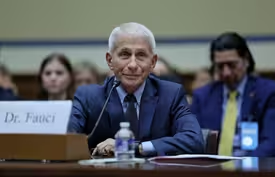
Fauci fires back at House Republicans in COVID hearing
Video has Closed Captions
Fauci fires back at House Republicans in hearing over COVID origins and response (6m 1s)
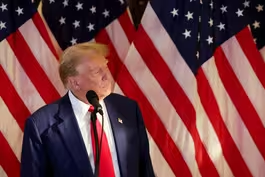
How Trump and his allies are reacting to his conviction
Video has Closed Captions
How Trump and his allies are reacting to his felony conviction (2m 20s)
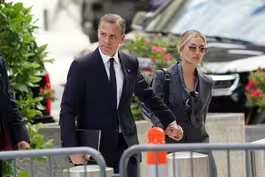
Jury selected for Hunter Biden's federal trial in Delaware
Video has Closed Captions
Jury selected for Hunter Biden's federal gun trial in Delaware (5m 30s)
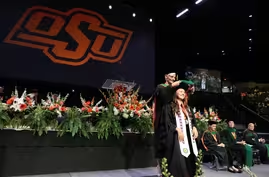
Medical school in Cherokee Nation graduates first class
Video has Closed Captions
Medical school in Cherokee Nation gives students experience serving Native communities (4m 4s)

'Talking Pictures' chronicles career of Michael Lindsay-Hogg
Video has Closed Captions
'Talking Pictures' exhibit chronicles prolific career of artist Michael Lindsay-Hogg (6m 58s)
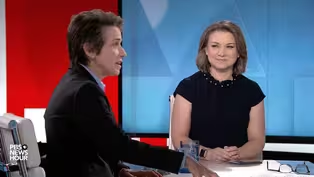
Tamara Keith and Amy Walter on fallout of the Trump verdict
Video has Closed Captions
Tamara Keith and Amy Walter on the political fallout of the Trump verdict (8m 55s)

What Sheinbaum's election means for U.S.-Mexico relations
Video has Closed Captions
What Claudia Sheinbaum's historic election win means for U.S.-Mexico relations (4m 24s)
Providing Support for PBS.org
Learn Moreabout PBS online sponsorship
- News and Public Affairs

FRONTLINE is investigative journalism that questions, explains and changes our world.

- News and Public Affairs

Amanpour and Company features conversations with leaders and decision makers.












Support for PBS provided by:
Major corporate funding for the PBS News Hour is provided by BDO, BNSF, Consumer Cellular, American Cruise Lines, and Raymond James. Funding for the PBS NewsHour Weekend is provided by...