OutSCIder Classroom
Congaree National Park
Episode 107 | 26m 48sVideo has Closed Captions
Dive into bottomland forests to learn about biotic and abiotic factors in Congaree National Park
Explore the bottomland forests of Congaree National park to learn about the different factors that make up an ecosystem. Join park rangers as they research to toxins move through food chains and learn about the Gullah/Geechee people and how they are adapting to climate change.
Problems playing video? | Closed Captioning Feedback
Problems playing video? | Closed Captioning Feedback
OutSCIder Classroom is presented by your local public television station.
Major funding is provided by the National Geographic Foundation
OutSCIder Classroom
Congaree National Park
Episode 107 | 26m 48sVideo has Closed Captions
Explore the bottomland forests of Congaree National park to learn about the different factors that make up an ecosystem. Join park rangers as they research to toxins move through food chains and learn about the Gullah/Geechee people and how they are adapting to climate change.
Problems playing video? | Closed Captioning Feedback
How to Watch OutSCIder Classroom
OutSCIder Classroom is available to stream on pbs.org and the free PBS App, available on iPhone, Apple TV, Android TV, Android smartphones, Amazon Fire TV, Amazon Fire Tablet, Roku, Samsung Smart TV, LG TV, and Vizio.
Providing Support for PBS.org
Learn Moreabout PBS online sponsorshipHey, everyone.
My name is Chris Anderson, and I'm in Congaree National Park.
This park protects the largest track of old growth bottomland forests in the United States.
There's giant trees, alligators, and a whole lot of water.
But what even is an ecosystem?
And how do they work?
Let's find out today on OutSCIder Classroom!
[Intro music] [Music] Ahh, theres nothing quite like a float down a river in Congaree.
You can relax, slow down.
Really take in the ecosystem that you're looking at.
But what am I looking at?
What is an ecosystem?
An ecosystem describes an area in which all the living and not living things interact.
There's no set size for an ecosystem.
It just depends on what you're studying.
It can be small, like underneath a rotting log, or big like 26,000 acres.
The ecosystem in Congaree is a bottomland forest.
There's lots of really tall, evergreen and deciduous trees that like to grow in the floodplain of the Congaree River.
All the living things, the population of every species in the area we call biotic factors.
That includes predators like the red tailed hawk or the gray fox, trees like the white pine or the tupelo, and the fungi and bacteria that break down all the dead material.
Swamp thing would be a biotic factor.
However, sadly, he does not exist.
All the non-living things we call abiotic factors.
Some important ones in Congaree include the amount of precipitation, the low lying elevation, and the amount of nutrients in the muddy, silty soil.
But how do all these factors interact?
Let's ask someone who knows a thing or two about ecosystems.
Hi, my name is Kat Ko.
I'm a biologist for the National Park Service.
I studied mercury, one of the abiotic factors it has to do with air and water, which are all abiotic factors in an ecosystem.
Mercury, it can be emitted into the air and transported thousands of miles and then deposited through things like rain, snow, fog, things like that, getting into the land and the water of an ecosystem.
Mercury, if it gets to certain high levels, can, be toxic to animals and, wildlife and humans.
So, for example, a fish eats a dragonfly larva, and a bird eats a fish and a person eats that fish, the mercury can, can build up, through those different levels of the food chain and, potentially have bad effects on wildlife and human health.
So we're trying to study mercury and those, different connections between abiotic and biotic factors to see what's going on in our ecosystem.
As a scientist, when you study things like that, it's important to consider there's a lot of different influences, you know, all working together and acting together and acting on each other.
So Congaree is an old growth bottomland forest, kind of low lying in the southeastern United States.
And it has big flooding events, you know, flooding seasonally every year, but also with big hurricane events, things like that.
So, the wildlife, plants, trees and different animals here have to adapt kind of as things like weather, rain, events change.
And so, you think about other plants and trees that have been living here for years, and different generations of animals and wildlife have probably adapted, you know, different ways to deal with the massive amount of rain that they can get at Congaree.
400 years ago, bottomland forest covered 30 million acres across the southeast United States, but only around 40% of that area still supports this unique habitat.
And most of those forests aren't connected.
That would be like taking an area the size of Pennsylvania and shrinking it down to an area the size of Maryland.
If Maryland was scattered into a thousand pieces, so what happened?
When European colonization happened, Most of those trees were cut down for the logging industry or for agriculture.
The timber was valuable, and the dark, rich soil was great for growing crops.
By 1917, most of the big trees were cut down.
Used to be the ten foot diameter sycamores and 200ft tall white pines were a common sight across the southeast.
Not so much anymore.
Which brings us to another factor that can impact ecosystems, humans.
There's lots of reasons why we've transformed or completely eliminated ecosystems around the world.
And to be honest, most of them aren't very good.
Which is why it's extremely important we protect ecosystems and wilderness areas that remain intact, not just as a habitat for other species, but for us too.
Take Congaree, for example.
The bottomland forest provides a habitat for thousands of species, but it also protects our homes and buildings from flood damage by providing a place for water to go during periods of excess rain.
This ecosystem also processes and filters organic material, making our drinking water cleaner and safer.
Wetlands like this are also really good at sequestering carbon.
Something we're going to need to do a lot more of in the future.
Pretty much all ecosystems do something for humans, which is why we need to not only be protecting them, but restoring them wherever we can.
[Music] Congaree is a great park to visit.
You can hike the boardwalk trail or go for a kayak tour.
Heck, most of the park is wilderness, so if you're into roughing it, backpacking can be a great way to explore.
Whatever you do, make sure you bring a map and a compass.
It's easy to get lost, and cell service isn't always an option.
Safety first guys.
But you don't have to come to Congaree to learn about ecosystems.
There's tons of citizen science programs you can participate in and help collect vital information about the health of ecosystems near you.
You can help the EPA track toxic cyanobacteria using the Bloom Watch app, and the NOAA measures and maps precipitation via their online platform.
You can also help track populations of plants, animals, and fungi by using the Seek app and taking photos of different species you observe.
The best part about citizen science programs is that you don't need any fancy equipment or a ton of college debt to participate.
For the most part, you just download an app on your phone and upload your photos and observation.
You help scientists understand how ecosystems work and change.
Which means you.
Yes, you can be a scientist too!
You get to be a scientist!
You get to be a scientist!
You get to be a scientist!
You get to be a scientist!
Everyone's a scientist!!
[Music] From Jacksonville, North Carolina to Jacksonville, Florida lies a nation within a nation.
The Gullah Geechee had been here for centuries, and they've developed their own food, music, language, and unique way of life.
To teach me a little more about the history and culture of the Gullah Geechee is community activist Akua Page.
So Akua how did the Gullah Geechee come to be?
So Gullah Geechee people were descendants of ancient agriculturalists who, came from west and central Africa, who were enslaved on Sea Islands off the coast of South Carolina, North Carolina, Georgia and Florida.
So how did this community, you know, you guys have developed your own unique way of life, what kind of factors led to that?
How was that possible?
We was able to develop our own way of life, language, culture and traditions because due to the nature of our enslavement, usually people will look up slavery, or they see like a movie, show, they usually see a white person as an overseer.
But our enslavement over here was different being that it was a marshland.
A lot of mosquitoes.
So a lot of white people, honestly, they couldn't stay on their plantations.
So it was usually a black person.
So you just had black people that came from different parts of west and central Africa that spoke different languages, different traditions, enslaved on Sea Islands.
And being we here isolated by ourselves, that created an environment for us to develop our own common language.
So to Gullah Geechee language developed on plantations such as this one, on rice plantations.
So Gullah Geechee people are a mixture of different west and central Africans I call this one the babies of the African Diaspora.
And being that we were here for so long, isolated on these plantations, it created an environment for us to develop our own unique, way of speaking, because we had to figure out a way to communicate with each other.
So one way I'm helping to preserve the legacy language is through my digital storytelling projects, where I'm just recording my elders and I'm also recording, millennials and younger generation kids, kids as young as four, just speaking in our native tongue, because unfortunately, Gullah is considered an endangered language now, since the youngest speakers of it are my elders and so trying to help keep that going by teaching people what I do know and trying to help elders be more comfortable, because there's a lot of linguistic, oppression that went on.
So a lot of people who do speak Gullah or Geechee kind of feel like, well, they don't want to speak it because people might discriminate against them.
And so that's one where I'm helping to preserve the land.
People know this is actual language, you know, being taught now at Harvard, you cant say its not.
It's an actual living, breathing language.
It's got to be really beautiful to hear those stories in their native language.
Definitely.
I will say it's been bittersweet, because I'm really working to help preserve that part of it because I don't speak fluent Gullah.
Most people I know, we don't speak it just because of all the oppression that went on and so when I'm finding somebody who do speak it, you know, they're scared to speak it because some of them, they share with me, they used to get beat for speaking Gullah and so, right.
So if you were beaten for speaking it, then you're not going to want to pass that language on to your kids or anybody that you know, because you will feel like that's something bad.
And so it's been bittersweet to just hear how they were treated.
But, it's also been beautiful.
To just capture the, the ones who are able to still speak it and feel like, okay, I think this is a safe space that I can speak the language that my ancestors passed down.
Well, tell me a little bit about food.
You guys have your own really cool, food tradition here.
Tell me a little bit about that.
So a lot of our food traditions are based on the sea and the land being naturally just enslaved on the land and by the sea.
So a lot of foods that we eat today, like rice, for example, which we eat for breakfast, lunch and dinner, that is a huge part of our culture.
We have a saying like a meal is not complete without a pot of rice.
It does not matter what you make.
You got to have that pot of rice or your meal is not complete.
So we're always pairing something with rice, be it seafood, which is one of my favorites, or some kind of vegetable.
Okra.
But anything that we can find well make sure that we pair it.
And also it's a way to just stretch it because a lot of people, we have big families and we also tend to just take on people, even if we're not blood related.
So being that rice is a grain that you can honestly make millions of different things with and feed a lot of people.
So rice is really important.
It's, economically it sounds pretty important.
You can feed a lot of folks.
How does that, how does rice connect to you, maybe with, with your ancestors or people who came before you?
So much being that rice is actually the reason why, this particular group of Africans from west and central Africa were targeted because they didn't take people from North Africa.
They wanted folks from west and central Africa, and they would even pay more for people who already had that skill of rice cultivation being that that's how Charleston made so much of their wealth from these rice, plantation farms.
And so naturally, now for us, just by cooking rice.
Or even some of us who are starting to try to attempt to grow rice, that's paying an homage and connecting with our ancestors to let them know that what they did and died for wasn't forgotten.
Because even some of the women during slavery, they would braid rice seeds into their daughter's hair just so they can have a piece of food on that journey, and also so they can plan to wherever they are so they can remember where they are.
[Music] My name is Colleen Flanagan Pritz.
And I'm an ecologist for the National Park Service.
[Woosh, pops] [Ding] So fortunate for me.
I get to spend a lot of time outside in the national parks.
My specific work falls in line with better understanding how contaminants or pollutants affect national parks and their resources.
So resources like wildlife, birds and fish and dragonflies.
So I do spend a fair amount of time when I am in the national parks, sampling lakes, streams, creeks and otherwise for dragonflies.
It's important to understand the levels of contaminants in parks because the parks were preserved to remain unimpaired for future generations.
So that basically means like, how can we keep them clean over time for like our kids too, to go out and explore and enjoy, like we want to see the same types of animals that are living there now, like and decades from now.
So with that in mind, we track the health of the ecosystems.
So it's essentially like the pulse of our environment.
So a better understanding, is it healthy?
Is it unhealthy?
So knowing if, you know, there's something that can be done about those pollutants, who we need to be talking with, like what stakeholders are involved, how we can keep our environment clean over time.
We spent a lot of time in the woods or, along the lakes.
So that was sort of just what we did growing up.
Every weekend we go up to Door County in Wisconsin, and we'd be with family and friends.
And I think it's the interconnectedness between the different spheres of our world.
So from the water to the rocks to the air and how each of those are entangled, it's like we put on one string and it connects to another.
So it's like the web of life and it's really fascinating.
I think the best part of my job is that I get to travel to national parks for my work, so I get to go to the gems of America and experience these really unique environments like, you know, old growth bottomland forests to, you know, the waterfalls of Yosemite, to, you know, the mountains of, the Intermountain West.
So it's a really fascinating way to experience different types of landforms across the U.S.
[Music] Water is the liquid of life.
But what happens when the place where you live is flooded?
Some, most or all of the time?
Too much of a good thing isnt always is a good thing.
What kind of species can live in an environment like this?
Don your gators cause biome train just pulled into its next station.
[Biome Tour song] I'm on a biome tour trekking pole in my hand up, peeping each and every climate that's out there, man.
Grasslands, tundra, taiga, wetlands.
I'm on a biome tour.
Trekking pole in my hand.
Checking abiotic factors on the sea and land.
Desert, rainforest, coral reefs, chaparral.
[music continues] Before we talk about what makes a wetland a wetland, we need to know a thing or two about groundwater, which, as you might have guessed, is water in the ground.
But groundwater is no small deal.
Around 30% of all freshwater on planet Earth is groundwater.
Groundwater is held in reservoirs called aquifers.
They're layers of rock or soil beneath the surface that are saturated with water.
Now, the top layer of an aquifer is called the water table.
And where that sits relative to the surface depends on a couple of different factors, how permeable the rock and soil is, how much and how frequently it rains, the proximity to an other body of water.
What's important here is at a wetland, the water table is at the surface, making it a place that's flooded either some or all of the year.
Congaree is a bottomland forest.
It sits in the floodplain of the Congaree River, which swells each winter and inundates the surrounding low lying landscape.
But that's not the only kind of wetland.
A marsh is a wetland that's by the coast is dominated by grasses and shrubs instead of trees.
What we have here is a slough.
A slough is a really wide, really slow moving river.
What makes wetlands special is that climate isn't the main driver behind who can live here.
Plants must live submerged, either all or part of the year in water, and all that water can make wetland soils really unstable and super low in oxygen, since air can't get introduced.
This is not an easy place for plants to grow.
Special adaptations will be required.
The bald cypress is one of the most famous trees in Congaree, and they've got a really cool adaptation.
Knees.
These knobby little columns here help the tree absorb air.
They also help the bald cypress stabilize itself in wet, saturated soil.
Scientists are actually still trying to figure out all the things these knees do for the trees.
You might say they're on a "knee-d" to know basis.
[drums] [crickets] The water tupelo is another tree that's adapted to the wetlands.
They've got this broad, twisty trunk that stabilizes them in wet soil.
They've also got a shallow, spongy root system to help them absorb oxygen.
These bad boys are right at home in the often but not always soggy soils of Congaree, and they provide a home and food for a bunch of different species.
That includes nearly 200 species of birds that call Congaree home, either full time or seasonally during their migrations.
Amphibians which spend part of their lives in the water find this biome particularly appealing.
There's nine different species of salamanders and around 20 different species of frogs.
There's also around 40 different species of snakes, two of which, the cottonmouth and the copperhead, are venomous.
If you see them out on the trail, just give them their space and they'll go along their merry way.
Just don't give them a hug.
[crowd "aww"ing] They don't like hugs.
There's also bobcats, possums, raccoons, foxes, deer, river otters and one of my favorites, the southern flying squirrel.
They don't really fly so much as glide from tree to tree, which is a pretty handy adaptation if you're trying not to get wet.
Wetlands aren't an easy place to adapt to, but they end up being places with a lot of biodiversity.
They're also super ecologically productive, generating tons of biomass each year.
Without wetlands, a lot of species just wouldn't have a home, which is why we need to protect and restore wetlands whenever we can.
[Music] I'm with Colleen Flanagan Pritz, an ecologist with the National Park Service, and she tries to understand how toxins get in and move around our ecosystems.
And as you can imagine, I've got a lot of questions.
So, Colleen, what kind of toxins are you looking at and why are they so darn bad?
We're particularly looking at, in this case, Mercury.
And Mercury is a natural element on the periodic table.
It is emitted in volcanic eruptions.
It is in geothermal features at Yellowstone and also it is emitted, from many different anthropogenic or human caused sources.
So how does the mercury go from being put into our environment, into the food web?
So mercury, when it's emitted, that's one source, is the airborne contributions of mercury to say, a national park.
It travels long distances, comes out in rain or snow or even in dust or sea spray.
And then when it falls onto the landscape, bacteria or little microbes convert it into a form that is available for organisms to uptake.
And so then it enters the food webs.
Biomagnification is the build up of that contaminant like mercury in the food chain as you move into higher orders.
How do you measure mercury in an ecosystem?
So there are several different ways you can look at soil.
You can look at the water.
You can look at the deposition.
So the rain or the snow.
We are particularly looking at a bio indicator.
So that's a living organism that indicates or represents the amount of a pollutant like mercury in the ecosystem.
We're doing that with dragonfly larvae.
So because they are ubiquitous or everywhere essentially they are more easily found.
They are smaller than fish, which are also a bio indicator of mercury.
But easier to collect and to, you know, track out from distances away from a certain trailhead.
Right.
So, and also cheaper to analyze, so.
So how, how do you go about collecting dragonfly larvae?
We, work with our groups to each don a net and waders and a life jacket and to get in the water and to use the net to kind of jab and sweep the bottom sediment of, the waterway.
So we work with a system that's been defined by our partners at the US Geological Survey to use spoons and Ziploc bags, you know, very sophisticated laboratory materials to preserve the specimen and provide for lab analysis.
What are some things that we should be doing to keep mercury from getting into our ecosystems?
Historically, over time, coal combustion for power generation has been a the main source of mercury in the United States emitted to the atmosphere.
So if we can use clean energy or conserve or reduce our energy consumption, that does serve to even reduce pollutants like mercury and other air pollutants that get into our atmosphere and are transported to clean places in our backyards.
So, you know, even whatever biking or walking instead of driving a car like these are ways in which we can support cleaner air quality.
Well, Colleen, sounds like you got a really cool job.
Yeah, I do feel very fortunate about my job.
And it does like, I am excited about it.
Say what!
[Music] Well, that's our show.
Thanks for watching.
Now, if you'll excuse me, I have some dissolved oxygen levels to measure.
We'll see you next time on OutSCIder Classroom!
[Music] Major funding is provided by the National Geographic Foundation.
Want to learn more about our national parks?
At OutSCIder.org you can find free activities and lesson plans for even more learning fun.
You can also catch cool bonus features and stay up to date on all things OutSCIder at our YouTube channel.

- Science and Nature

Explore scientific discoveries on television's most acclaimed science documentary series.
- Science and Nature

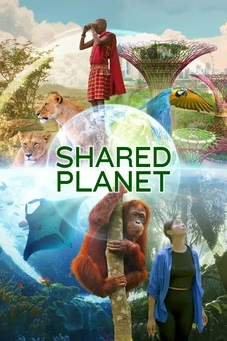
A stunning global series that shows how sharing space with wildlife benefits people.








Support for PBS provided by:
OutSCIder Classroom is presented by your local public television station.
Major funding is provided by the National Geographic Foundation