
Does Trump care if Republicans lose Congress?
Clip: 10/23/2026 | 8m 37sVideo has Closed Captions
Does Trump care if Republicans lose Congress?
President Trump has an unusual way of helping his candidates. His latest obsession seems to be bringing up the appearance of Republican men on the campaign trail. The panel discusses if Trump has a real plan to help the GOP retain control of Congress.
Problems playing video? | Closed Captioning Feedback
Problems playing video? | Closed Captioning Feedback
Major funding for “Washington Week with The Atlantic” is provided by Consumer Cellular, Otsuka, Kaiser Permanente, the Yuen Foundation, and the Corporation for Public Broadcasting.
Does Trump care if Republicans lose Congress?
Clip: 10/23/2026 | 8m 37sVideo has Closed Captions
President Trump has an unusual way of helping his candidates. His latest obsession seems to be bringing up the appearance of Republican men on the campaign trail. The panel discusses if Trump has a real plan to help the GOP retain control of Congress.
Problems playing video? | Closed Captioning Feedback
Where to Watch Washington Week with The Atlantic
Washington Week with The Atlantic is available to stream on pbs.org and the PBS app.
Buy Now

10 big stories Washington Week covered
Washington Week came on the air February 23, 1967. In the 50 years that followed, we covered a lot of history-making events. Read up on 10 of the biggest stories Washington Week covered in its first 50 years.Providing Support for PBS.org
Learn Moreabout PBS online sponsorshipJeffrey Goldberg: Good evening, and welcome to Washington Week.
So, if we were living in ancient Rome, and Senator Husted was in charge, we would undoubtedly be referring to him by now as Emperor Gluteus Maximus.
Okay, that's it.
That's the only joke I'm going to make on the subject.
I'm sure that's not true, actually.
The interesting thing here is that President Trump's discourse in the Ohio Senate race is not nearly as disconcerting as his discourse in the Ohio governor's race.
In that race, Trump is pushing the Republican, Vivek Ramaswamy, to double down on his attacks on his Democratic opponent, Amy Acton.
Ramaswamy's campaign has employed Acton's estranged mother as part of his campaign.
Even Republicans are denouncing Ramaswamy's ad for crossing previously sacrosanct lines.
Vice President J.D.
Vance, however, has told Republicans to, quote, stop whining about an advertisement and go win the race, end quote.
The question is, will this kind of brutality help the Republicans any more than Trump's shenanigans will?
To discuss all of this, I'm joined tonight by Leigh Ann Caldwell, the chief Washington correspondent for Puck.
Stephen Hayes is the editor and CEO of The Dispatch.
Zolan Kanno-Youngs is a White House correspondent for The New York Times, and Nancy Youssef is a staff writer at The Atlantic.
Okay.
No, I'm not going to do it.
I'm not making all the jokes that could be made.
But I do want to start with this behavior, which we've never before seen in a president, at least since Millard Fillmore, who couldn't stop making butt jokes.
We all know that from our history books.
I mean, what are we to make of the president's fixations with physical attributes of male senators and other males as well?
Before you answer, here he is riffing on the subject.
I want you to listen to this.
Donald Trump: I'm studying his body.
I've never studied the body of a man before.
It's not my thing.
But I looked at his ass.
And then I looked at his legs, and it -- I said, his ass is -- it's like a pile of muscle.
Then I looked at his legs and I said, man, his feet are big.
Jeffrey Goldberg: So, Zolan, you cover the White House.
Zolan Kanno-Youngs, White House Correspondent, The New York Times: Yes.
Jeffrey Goldberg: Is this just the president having the impulses of a stand-up comedian, which is to say he's testing lines in front of audiences.
He obviously doesn't have guardrails or the sort of thing that politicians have.
But he's testing lines, he's getting a reaction, he loves the reaction, and it sort of feeds this cycle.
Zolan Kanno-Youngs: Yes I think so.
I mean, man, didn't expect to be doing analysis on this topic, you know, at the start of this Trump term.
Jeffrey Goldberg: It's the new PBS, man.
Zolan Kanno-Youngs: But, hey, I'm with it.
This is now a trend for the president.
We've heard him talk about the appearances of males.
Jackson Dart, New York Times quarterback.
It's not always complimentary like it was in the case of Husted.
Just ask Ken Paxton as well, which he spent time during rallies as well, kind of poking and teasing him.
I think this is about playing to the crowd.
I think he sees that it gets attention.
He sees that it gets a reaction from these rallies.
But also I'm going to draw a through line here between the design of the administration.
I have reported at times on trying to find out, oh, there's an opening in this cabinet.
Oh, the president is trying to find a new Homeland Security secretary in term one.
Hey, who's the president going to bring in?
You often do hear the term, we all have heard it, central casting come up.
And yes, he tosses that out maybe for laughs, but also I know this does say something about how much the president watches T.V., how he assesses people based off of how they not only fight for him on T.V., but also how they look.
Jeffrey Goldberg: Right.
I mean, Nancy, you cover the Pentagon, and there might be a case in point.
Nancy Youssef, Staff Writer, The Atlantic: There might be a case in point.
I mean, this has actually played out on the international stage as well, because he commented on the appearance of Ahmed al-Sharaa, the president of Syria.
And has cited that as one of the reasons that he likes working with him, and there's actually been an extraordinary alliance between Syria and the United States.
Now, how much of that is based on appearance is one of the first things he brought up when this former member of Al-Qaeda took control of Syria, that all the sort of talk we heard about not wanting to be aligned with such parties, he moved very quickly and said that he sided with him.
And, of course, Pete Hegseth, the Defense Secretary, focuses on appearance, and it's become a central focus of his tenure how service members look, how fit they are, how often they work out.
His whole personality has been rooted in this idea that a strong service member, a masculine service member is the ideal -- Jeffrey Goldberg: Right.
Look, Hegseth is among the most controversial and among many swaths of American politics disliked cabinet secretary.
Do you think that career longevity has helped in this administration by just being fit?
Nancy Youssef: I think it's helped by looking a certain way as the president sees it.
Remember, this is a president who came up through beauty pageants, through The Apprentice, in which appearance was a key part of how he assessed people.
And you can imagine at some place like the Pentagon, where he's talked about how generals look in uniforms and the physical appearance of the force, that has been a topic that he has brought up over and over again.
So, you can imagine that extending to the top civilian in charge of it who's representing his administration in that building.
Jeffrey Goldberg: Right.
Leigh Ann, so the -- we understand that he's having a good old time breaking norms left and right.
Does he have a systematic plan to help the Republicans maintain control of Congress?
Leigh Ann Caldwell, Chief Washington Correspondent, Puck: I would say no.
He is -- Jeffrey Goldberg: He is traveling a lot.
Leigh Ann Caldwell: -- he is on the campaign trail, and he has a very rigorous campaign schedule.
He's traveling almost every single day to a new state, a new city to rally for Republicans.
It started 30 days, about 32 days before the election.
The money that he has agreed to spend, which is over $300 million now from his political groups that started just after Labor Day.
A lot of this came very late actually.
The cake has already been baked in many instances.
His poll ratings are at an all-time low.
They were low then, and there's some concern among Republicans, while they are grateful for these things, that it was -- it took too long to get there.
And there is a widespread belief on the Hill, and even some people close to the administration, who wonder if the president even cares if he's in -- if the Republicans are in the minority.
He likes a foil.
He doesn't really care, I'm told, about being investigated or being impeached.
He's already been impeached twice.
He's gone through investigations.
It has emboldened him and helped him reach the presidency again.
It's the people around him who are more concerned.
Jeffrey Goldberg: Steve, is there something to this idea as out of the norm as it seems, that the president doesn't care if his own party keeps control of Congress?
Do you think that's something -- Stephen Hayes, Editor, The Dispatch: Yes, and I don't think it's particularly new.
I mean, look at what he did in Georgia in 2020.
I mean, it's -- this was somebody who demonstrated that he didn't care.
He had advice that, you know, he should do certain things and not do other things, and he did everything he, just as he wanted to.
I do think there's also, and this is -- I think it's sometimes hard to communicate this when we're reporting these stories and we're talking about it in this context, the president just likes to do what the president likes to do.
So, some of the reasons he's going to these red states is because he loves to go to the red states.
And he loves the adulation, and he loves the feedback he gets from the crowd.
He said this, I believe it was in Tennessee last week.
There was this moment where he said, I can say anything, and you're going to applaud, and you love me.
Jeffrey Goldberg: Well, that's sort of the theme of this discussion is that he can say anything.
Stephen Hayes: It's right.
Yes.
I mean, he says this out loud because I think he believes it.
He thinks it.
And I think it is hard to communicate that to folks as we're, you know, doing our work reporting, that the president act -- when we say that the president is picking people because they looked good on Fox News, or they came from Central Casting, the reaction I get when I talk about that with friends or folks from back in Wisconsin is, no, like not really.
We say no.
Actually, that's how -- you talk to people around him, that's how he makes decisions.
Jeffrey Goldberg: Right.
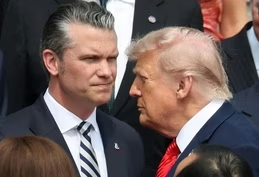 New
Will Congress impeach Hegseth – and how will Trump react?
Video has Closed Captions
Will Congress impeach Hegseth – and how will Trump react? (14m 28s)
Providing Support for PBS.org
Learn Moreabout PBS online sponsorship New Episode
- News and Public Affairs

Top journalists deliver compelling original analysis of the hour's headlines.
 New Episode
- News and Public Affairs

FRONTLINE is investigative journalism that questions, explains and changes our world.

 New Episode
 New Episode
 New Episode

 New Episode
 New Episode

 New Episode

 New Episode

Support for PBS provided by:
Major funding for “Washington Week with The Atlantic” is provided by Consumer Cellular, Otsuka, Kaiser Permanente, the Yuen Foundation, and the Corporation for Public Broadcasting.