
Boston's struggle to meet the ideals of America's founding
Clip: 2/11/2026 | 9m 20sVideo has Closed Captions
Boston's role in America's founding and its struggle to meet its ideals
The New England Patriots’ Super Bowl defeat was a disappointment for fans, but the team's return to the national stage also served as a reminder of the role the Greater Boston Area played in the country’s founding. Judy Woodruff explores that history, as well as some recent turmoil, to ask what it tells us about the country today. It's part of her series, America at a Crossroads.
Problems playing video? | Closed Captioning Feedback
Problems playing video? | Closed Captioning Feedback
Major corporate funding for the PBS News Hour is provided by BDO, BNSF, Consumer Cellular, American Cruise Lines, and Raymond James. Funding for the PBS NewsHour Weekend is provided by...
Support provided by:

Boston's struggle to meet the ideals of America's founding
Clip: 2/11/2026 | 9m 20sVideo has Closed Captions
The New England Patriots’ Super Bowl defeat was a disappointment for fans, but the team's return to the national stage also served as a reminder of the role the Greater Boston Area played in the country’s founding. Judy Woodruff explores that history, as well as some recent turmoil, to ask what it tells us about the country today. It's part of her series, America at a Crossroads.
Problems playing video? | Closed Captioning Feedback
How to Watch PBS News Hour
PBS News Hour is available to stream on pbs.org and the free PBS App, available on iPhone, Apple TV, Android TV, Android smartphones, Amazon Fire TV, Amazon Fire Tablet, Roku, Samsung Smart TV, and Vizio.
Providing Support for PBS.org
Learn Moreabout PBS online sponsorshipAMNA NAWAZ: This year, many are marking 250 years since our Declaration of Independence.
But even before that, the greater Boston area played a critical role in the country's founding.
Judy Woodruff explores some of that long ago history, as well as some more recent turmoil, to ask what it tells us about the country today.
It's for her series America at a Crossroads.
NATHANIEL PHILBRICK, Author, "Bunker Hill: A City, a Siege, a Revolution": The British ships in the harbor around Charlestown are firing their cannons.
JUDY WOODRUFF: Coming from over there.
NATHANIEL PHILBRICK: Coming from over there.
JUDY WOODRUFF: High above Boston's Charlestown neighborhood, a 221-foot obelisk marks the first major battle of the American Revolution and one of its bloodiest waged between the British troops then occupying the city and intent on taking this position from the colonial militiamen who had dug in to protect it.
NATHANIEL PHILBRICK: Towards the end, it was hand-to-hand fighting in the fort.
And just brutal stuff.
JUDY WOODRUFF: Bloody.
NATHANIEL PHILBRICK: Bloody.
The British were very angry that they had gone through all of this to get there.
And it was an ugly, bloody scene.
JUDY WOODRUFF: Though fought on Breed's Hill, it became known as the Battle of Bunker Hill, and marked an undeniable escalation in this conflict more than a year before the Declaration of Independence.
And even though the British won, the message was, the Americans can hold their own.
NATHANIEL PHILBRICK: Right.
And this was - - established the pattern of the war, that the British will win on the battlefield, but the Americans are still left to fight.
JUDY WOODRUFF: Nathaniel Philbrick is the author of many books about American history, including his 2013 "Bunker Hill: A City, a Siege, a Revolution," which transports readers to this area during the run-up to the war, the Boston Massacre in 1770 at the Old State House, the Boston Tea Party three years later, the in the Old North Church for Paul Revere's famous ride in 1775, and months later, the Battle of Bunker Hill, when there was no turning back.
NATHANIEL PHILBRICK: This is where it all began.
And what would next happen is an eight-year war to declare American independence.
JUDY WOODRUFF: And this building that we're in, the Athenaeum.
NATHANIEL PHILBRICK: It's full of history.
Oh, it is.
JUDY WOODRUFF: I joined Philbrick at the Boston Athenaeum, a library, museum, and cultural center, home to a collection from the Revolutionary period.
REED GOCHBERG, Boston Athenaeum: This is The Massachusetts Gazette.
JUDY WOODRUFF: Partisan newspapers, firsthand accounts, and detailed drawings and maps of Bunker Hill.
REED GOCHBERG: So this was created in the 1790s to show the action at Bunker Hill.
JUDY WOODRUFF: Philbrick explained that this area's Puritan origins and their search for religious freedom as well as a series of wars with Native Americans led to a fierce resistance against the British occupation.
NATHANIEL PHILBRICK: Boston and New England was militarized in a way with militia companies.
They were used to fighting wars.
And when it came to the British government deciding after these wars that Boston had to help pay for them, the people there weren't willing to just sort of take it.
They erupted in violence.
MOE GILLEN, Resident of Charlestown: Without Bunker Hill, July 4 doesn't happen.
JUDY WOODRUFF: Now 87, Moe Gillen is a long time resident of Charlestown, who has seen this neighborhood change, from the working class Irish-American enclave he grew up in to one more gentrified by young professionals today, with some turbulent times in between.
MOE GILLEN: This is where we stood up and we proved normal people could stand up against tyranny and win.
JUDY WOODRUFF: This city is full of reminders of the instrumental role it played in the founding of our country and in establishing the ideals that those early patriots fought and died for.
But it also contains reminders of the ways that at times this country has fallen short of those ideals over its 250-year history.
DENISE PRUITT, Former Bused Student: Growing up, it was a fight.
It was a fight to be able to go to the school that I wanted, to go into the career I wanted.
It was a fight.
KIM JANEY, Former Mayor of Boston, Massachusetts: What all families want is a quality education.
That is what Black families were fighting for.
I don't think they got it.
MOE GILLEN: The parent had the right to decide which school their child went to.
The government had no right to tell us where to send our kid to school.
MAN: Boston officials had expressed concern that there might be trouble when the city's 200 public schools opened today.
JUDY WOODRUFF: Two hundred years after the famous Revolutionary battle, Charlestown became a flash point again.
MAN: Police were keeping a special eye on the white close-knit community of Charlestown.
JUDY WOODRUFF: Opposing the effort to finally desegregate Boston's public schools; 14 plaintiffs had joined an NAACP lawsuit against the district, and, in 1974, a federal judge ordered nearly 17,000 children BUSSED across Boston to address chronic disparities.
The backlash was swift.
MAN: Some buses were stoned leaving the area this afternoon.
MAN: A car was set on fire in Charlestown, and another turned over.
WOMAN: I live in Charlestown.
My child should be able to go to the neighborhood school, not to be put on to a bus and have to be driven out so many miles.
MOE GILLEN: You have to understand the context of what's working hard to get new schools.
We worked to get a community college.
We worked to get a new high school, and that was ripped right away from us.
DENISE PRUITT: Inside the school, we all got along great.
JUDY WOODRUFF: Denise Pruitt was bused from her home in Dorchester to Hyde Park, where she faced angry white parents as a 13-year-old freshman.
DENISE PRUITT: I was walking in from the bus, and one of the women got through the barricade and came right up and spit in my face.
And my friend, who was white, was standing at the top of the stairs, came running down, and she got me, and she walked me up the stairs, and she's wiping my face.
"I'm so sorry.
My grandmother is really rude."
JUDY WOODRUFF: It was her grandmother?
EARLINE PRUITT, Mother of Denise Pruitt: Yes.
DENISE PRUITT: Yes.
And she was embarrassed by it.
JUDY WOODRUFF: Denise's mother, Earline Pruitt, is now 91.
She was one of the original plaintiffs to join the lawsuit, hoping it would force the city to better fund their local school.
EARLINE PRUITT: I could remember when I was in school and what I had, and I felt that they weren't getting as much as I got.
And so I wanted more for them than what I had.
JUDY WOODRUFF: But busing wasn't what she wanted.
DENISE PRUITT: Every day that we drove in those bus droves in, there were adults there, angry adults.
JUDY WOODRUFF: So, Earline, your daughter is experiencing this, and she's telling you about it.
And what are you thinking?
EARLINE PRUITT: Anger that my children had to go through this.
And I wanted to do something to help them.
So I got a job at the high school and I was there to protect my children.
KIM JANEY: It was a difficult time in our city.
It was a difficult time for me personally.
JUDY WOODRUFF: In 1976, Kim Janey was bused to Charlestown for middle school.
She would grow up to become a community organizer, city counselor, and, in 2021, the first Black and female mayor of Boston after Marty Walsh left to join the Biden administration.
She says the city has come a long way, but there's still a lot of work to be done.
KIM JANEY: I have to ask myself, did those parents get what they were fighting for?
Fifty years later, are schools still lack quality and they are not integrated.
Our schools are still very much racially segregated here in Boston.
JUDY WOODRUFF: In fact, a Boston Globe piece just last week found that more than a third of public school seniors are failing to meet core curriculums.
A disproportionate number are students of color.
NATHANIEL PHILBRICK: So, you see factors from the past, from the really distant past, hundreds and hundreds of years before, that were never settled.
JUDY WOODRUFF: For Nathaniel Philbrick, it's a complicated picture that reflects the country's past, present and future.
NATHANIEL PHILBRICK: Each generation of Americans is always wrestling with these issues.
The great challenge put to us in the Declaration of Independence that all of us are created equal is something that gets reinvented with every generation.
I think there is a continuity there and a tragedy there.
But I also think it's part of a process that America will always be going through, of trying to live up to the ideals that we set forth in the beginning.
We're an aspirational society.
And we will inevitably fail, but I think the important thing is that we keep on trying.
JUDY WOODRUFF: For the "PBS News Hour," I'm Judy Woodruff in Boston.
Bondi sidesteps Epstein questions in tense hearing
Video has Closed Captions
Clip: 2/11/2026 | 4m 34s | Bondi sidesteps Epstein questions in tense Judiciary Committee hearing (4m 34s)

Mideast experts on what Israel wants from U.S.-Iran talks
Video has Closed Captions
Clip: 2/11/2026 | 6m 58s | Mideast experts on what Israel wants from U.S.-Iran nuclear discussions (6m 58s)

Netanyahu visits Trump as U.S. restarts Iran nuclear talks
Video has Closed Captions
Clip: 2/11/2026 | 4m 3s | Netanyahu meets with Trump as U.S. restarts talks on Iran’s nuclear program (4m 3s)
News Wrap: Canadian police identify mass shooting suspect
Video has Closed Captions
Clip: 2/11/2026 | 7m 7s | News Wrap: Canadian police identify mass shooting suspect (7m 7s)
Rep. Crow signals legal action after effort to indict 6 Dems
Video has Closed Captions
Clip: 2/11/2026 | 7m 6s | Rep. Crow signals legal action after administration’s effort to indict 6 Democrats (7m 6s)
Revised economic numbers inject uncertainty into jobs market
Video has Closed Captions
Clip: 2/11/2026 | 5m 33s | Revised economic numbers inject uncertainty into jobs market (5m 33s)
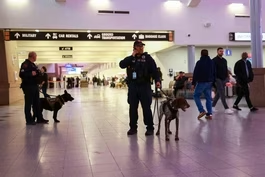
What caused the sudden closure of El Paso's airspace
Video has Closed Captions
Clip: 2/11/2026 | 7m 34s | What caused the sudden and confusing closure of El Paso's airspace (7m 34s)
Providing Support for PBS.org
Learn Moreabout PBS online sponsorship
- News and Public Affairs

FRONTLINE is investigative journalism that questions, explains and changes our world.

- News and Public Affairs

Amanpour and Company features conversations with leaders and decision makers.












Support for PBS provided by:
Major corporate funding for the PBS News Hour is provided by BDO, BNSF, Consumer Cellular, American Cruise Lines, and Raymond James. Funding for the PBS NewsHour Weekend is provided by...